
Quick Answer
AI Search SEO means improving pages so they can rank in classic search results, get retrieved and cited in AI-led answers, and convert users after they click. It combines technical SEO, helpful content, answer clarity, entity signals, semantic coverage, internal links, proof, and conversion-focused page design.
AI Search SEO matters because search visibility is no longer only about ranking in traditional results. A page may rank in classic SERPs, appear in an AI Overview, support an AI Mode answer, be cited as a source, or lose the click because the page offers nothing beyond a basic summary.
That is why SEO teams need a wider workflow. A strong page should be technically eligible, easy to understand, useful enough to cite, and persuasive enough to convert. For the bigger planning layer, connect this with your SEO for AI Overviews strategy.
This became more important after Google’s March 2026 update cycle reinforced broad quality evaluation and Google’s AI-search guidance reaffirmed that SEO still underpins generative search visibility.
This guide explains what AI Search SEO means, what Google actually says, where teams go wrong with commodity content, and how to build pages that rank, get cited, and convert.
In This Guide
What Is AI Search SEO?
AI Search SEO is the practice of optimizing pages for both traditional search and AI-led search experiences. It includes classic SEO work such as crawlability, indexability, internal links, and helpful content, but it also adds a stronger focus on answer clarity, citation value, retrieval-friendly sections, entity signals, semantic coverage, and conversion paths.
The goal is not only to appear. The goal is to become a useful source that AI systems can understand and users still want to visit. That is where AI Search SEO connects with semantic SEO, entity SEO, and conversion-focused page planning.
Simple definition
AI Search SEO helps pages rank in search, get cited in AI answers, and convert qualified visitors after the click.
Why AI Search SEO Matters Now
AI search changes the path from query to click. Users may see summaries, source cards, follow-up answers, and comparisons before they open a website. That means pages need to work harder: they must be discoverable, cite-worthy, and useful enough to continue the journey.
This is where many teams make a mistake. They optimize only for impressions, not for source value or conversion. A page that gets cited but does not explain next steps may create awareness but no pipeline. A page that converts well but cannot be retrieved may never enter the AI-led journey.
1
Rank
The page must be technically eligible and relevant.
2
Get cited
The page needs clear answers, proof, and source value.
3
Convert
The page needs next steps, trust, and decision support.
Practical AI Search SEO Framework
Use this framework when building or refreshing important pages for AI search visibility.
| Layer | What to Improve | Why It Helps |
|---|---|---|
| Technical eligibility | Crawlability, indexability, snippets, rendering, speed, and internal links. | Gives the page a chance to rank and be discovered. |
| Retrieval clarity | Direct answers, clear sections, FAQs, summaries, and comparison tables. | Makes the page easier to quote, summarize, and cite. |
| Source value | Proof, examples, original insights, expert review, and useful visuals. | Helps the page stand out from commodity content. |
| Conversion path | CTAs, demos, tools, templates, next guides, proof points, and trust signals. | Turns visibility into business outcomes. |
Step-by-Step Workflow to Build AI Search SEO Pages
Use this workflow when creating or refreshing pages for classic rankings, AI citations, and conversions.
Start with search eligibility
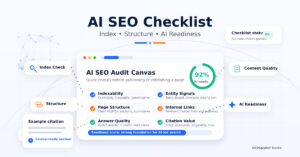
Check whether the page is crawlable, indexable, internally linked, mobile-friendly, and eligible for snippets. Use your AI SEO checklist as the baseline.
Answer the main query directly
Put the answer near the top. Then support it with definitions, use cases, examples, comparisons, and practical steps. This supports stronger LLM SEO because each section becomes easier to parse and retrieve.
Build topic and entity signals
Use related terms, entities, definitions, internal links, and supporting pages to clarify the topic. This is where entity SEO and semantic coverage strengthen your page.
Add unique source value
Include examples, expert notes, data, screenshots, use cases, frameworks, or original workflows. Your AI content optimization process should improve originality, not just rewrite existing points.
Design for the next action
After the answer, guide users toward the next step: a tool, demo, checklist, comparison, product page, or deeper guide. This is how AI Search SEO moves beyond visibility.
Common AI Search SEO Mistakes
Mistake 1: Optimizing for citations but not conversions
A citation is useful, but the page still needs a clear reason for users to click and act.
Mistake 2: Publishing commodity content
If your content repeats the same generic points as every competitor, AI systems can summarize it without sending users to your site.
Mistake 3: Ignoring classic SEO
AI search does not remove the need for crawlability, indexability, internal linking, page speed, and helpful content.
Mistake 4: Treating AI SEO as only TOFU content
AI search also affects comparison, alternative, pricing, use-case, and decision-stage journeys. Use AI keyword research to map questions across the full funnel.
SEOSpyder AI Search Readiness Snapshot Use Case
The practical use case for SEOSpyder is to help teams review whether important pages are ready to rank, get cited, and convert before publishing or refreshing them.
A SEOSpyder AI Search Readiness Snapshot can review indexability, answer clarity, internal links, topic depth, entity signals, unique value, and conversion readiness so teams can prioritize improvements with less guesswork.
| Snapshot Area | What It Checks | Why It Matters |
|---|---|---|
| Rank readiness | Indexability, structure, internal links, and search intent. | Helps pages compete in classic SERPs. |
| Citation readiness | Direct answers, proof, examples, and topic depth. | Makes the page more useful as a source. |
| Conversion readiness | CTAs, next steps, trust signals, and decision support. | Turns AI-search visibility into business outcomes. |
| Cluster readiness | Internal links to related guides, entities, and funnel pages. | Strengthens authority beyond one page. |
Build pages that rank, get cited, and convert
Use SEOSpyder to review technical SEO, answer clarity, internal links, entity signals, topic depth, citation value, and conversion readiness before your next publishing cycle.
For SEO managers, content leads, founders, and agencies building AI-ready organic growth.
Frequently Asked Questions
“`





No comment yet, add your voice below!