
Quick Answer
AI keyword research means using AI to discover, cluster, qualify, and prioritize keyword opportunities faster. But the goal is not to publish more pages. The goal is to identify topics worth publishing: queries with real search demand, clear intent, business relevance, useful depth, and enough original value to compete in classic Google Search and AI-led results like AI Overviews and AI Mode.
AI keyword research has become important because SEO teams are no longer just choosing keywords for blue-link rankings. They now need topics that can satisfy users, survive quality updates, support AI-search visibility, and create a reason for people to click.
For a stronger AI-led SEO foundation, start with this guide on AI SEO optimization. Keyword research should connect to your full workflow: intent mapping, content quality, technical readiness, internal links, and AI search preparation.
This matters more after Google’s March 2026 core update, which ran from March 27 to April 8, 2026. Google’s official core update guidance recommends waiting at least a full week after a core update completes before analyzing Search Console impact, then reviewing top pages and queries carefully.
This guide explains what AI keyword research means, what it changes, how to avoid commodity topic selection, and how SEOSpyder’s AI Search Readiness Snapshot can help you decide which topics are actually worth publishing.
In This Guide
What Is AI Keyword Research?
AI keyword research is the process of using artificial intelligence to find, group, analyze, and prioritize search queries. It helps SEO teams move faster by clustering keywords, detecting intent patterns, surfacing subtopics, identifying related questions, and turning raw keyword lists into publishable topic plans.
Traditional keyword research focuses on search volume, difficulty, competition, and intent. AI keyword research adds another layer: it helps you understand how queries connect, what users may ask next, what content gaps exist, and whether a topic has enough depth to deserve a standalone page.
Simple definition
AI keyword research helps you move from keyword lists to topic decisions by using AI to organize intent, gaps, questions, and publishing priorities.
Why AI Keyword Research Matters After the March 2026 Update
After a core update, the wrong reaction is to publish more content blindly. Google’s core update guidance pushes teams to assess top pages and queries, compare the right date ranges, and avoid drastic changes to pages that are already performing well.
That changes how keyword research should work. Instead of asking “What keywords have volume?” SEO teams should ask “Which topics deserve a page because we can answer them better than existing results?” Ahrefs defines keyword research as discovering valuable search queries your target customers use, while Semrush emphasizes using keyword metrics and analysis to prioritize opportunities.
1
Intent fit
Does the topic match a real user need?
2
Original value
Can you add something competitors do not?
3
AI-search fit
Can the page support clear answers and citations?
Important note
AI keyword research should reduce waste. A topic is not worth publishing just because AI can produce an outline for it. It is worth publishing when it has demand, intent clarity, business relevance, and a real content advantage.
A Practical AI Keyword Research Framework
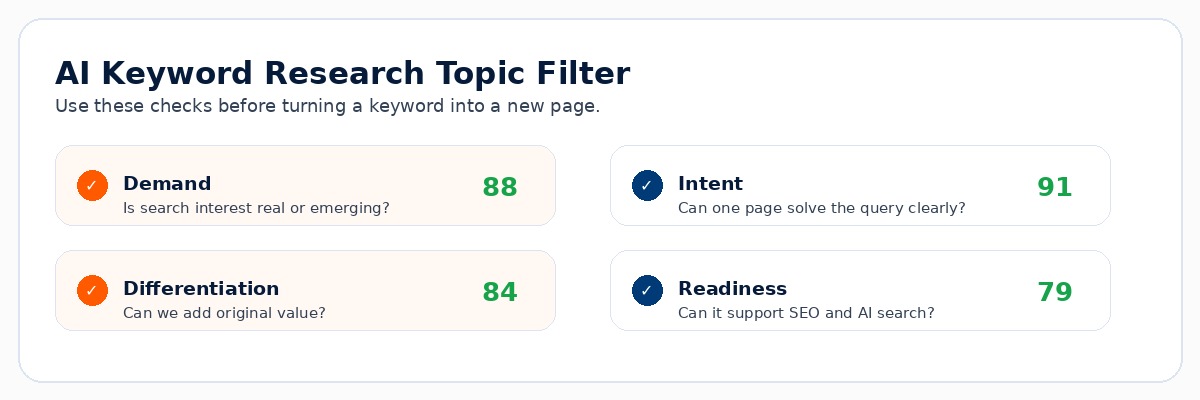
The strongest AI keyword research workflow filters topics before writing starts. Use AI to speed up analysis, but use human judgment to decide what deserves publishing.
| Filter | Question to Ask | Publish Decision |
|---|---|---|
| Demand | Is there search interest or emerging AI-search demand? | Publish only if demand is real or strategically emerging. |
| Intent | Does one page solve the user need clearly? | Cluster similar keywords into one strong page. |
| Differentiation | Can we add original data, examples, or workflow? | Publish when you can add non-commodity value. |
| Readiness | Can the page be structured for SEO and AI search? | Publish when the page can support rankings and citations. |
Step-by-Step AI Keyword Research Workflow
Use this workflow before creating a new blog, landing page, or topic cluster.
Start with seed keywords and audience pain points
Begin with seed terms such as AI keyword research, AI SEO tools, AI search optimization, and answer engine optimization. Then map them to the actual pain points of SEO managers, content leads, founders, and agencies.
Use AI to cluster intent, not just keywords
Ask AI to group keywords by user problem, funnel stage, search intent, and page type. A single strong page should often target a cluster, not just one exact keyword.
Score topics by publish-worthiness
Score each topic by demand, intent clarity, business relevance, difficulty, content gap, and original value. This is where AI can help, but final prioritization should stay human-led.
Plan the page for classic SEO and AI search
For each approved topic, plan a direct answer, H2 structure, FAQs, internal links, original examples, and a reason to click. This connects keyword research with AI search optimization and answer engine optimization.
Validate with human judgment before publishing
Before writing, ask whether the page will add something useful beyond generic AI summaries. If not, combine it into another page, delay it, or improve the angle before publishing.
Common AI Keyword Research Mistakes
Mistake 1: Publishing every AI-suggested topic
AI can suggest hundreds of topics quickly, but many will be repetitive, low-value, or too similar to pages you already have. Filter before publishing.
Mistake 2: Choosing keywords only by search volume
High volume does not always mean high value. A lower-volume topic with strong intent, better differentiation, and business relevance can be more useful.
Mistake 3: Creating commodity content clusters
If every topic becomes a generic definition blog, the site becomes weaker. Use this guide on non-commodity content for AI search to keep topic quality high.
Mistake 4: Ignoring internal links and topic architecture
Keyword research should support a topic cluster, not isolated posts. Connect related pages like generative engine optimization and AI SEO workflows where relevant.
SEOSpyder AI Search Readiness Snapshot Use Case
The practical use case for SEOSpyder is to help teams move from keyword ideas to publishing decisions. Instead of choosing topics only because they have volume, teams can review whether a page has the structure, quality, and AI-search readiness needed to compete.
A SEOSpyder AI Search Readiness Snapshot can help evaluate whether a topic has answer clarity, internal link fit, technical readiness, original value, and enough depth to support classic rankings and AI-search citations.
| Snapshot Area | What It Checks | Why It Matters |
|---|---|---|
| Answer clarity | Can the page answer the main query early? | Supports user satisfaction and AI-search understanding. |
| Original value | Can the page add useful insight competitors miss? | Reduces commodity content risk. |
| Internal link fit | Does the topic strengthen the site’s cluster? | Improves topical context and navigation. |
| Technical readiness | Can the page be crawled, indexed, and understood? | Keeps the page eligible for Search and AI features. |
Find topics worth publishing before you write
Use SEOSpyder to review content quality, technical SEO, internal links, answer clarity, and AI-search readiness before your next publishing cycle.
For SEO managers, content leads, founders, and agencies building AI-ready organic growth.
Frequently Asked Questions
“`







No comment yet, add your voice below!