AI Search Optimization | How to Win Visibility in AI Overviews and AI Mode

AI Search Optimization

“`html

SEOSpyder Guide · AI SEO & AI Search

Quick Answer

AI search optimization means improving your pages so they can perform in classic Google Search and become easier to understand, summarize, and cite in AI-led experiences like AI Overviews and AI Mode. It is not a separate trick from SEO. It is a practical mix of useful content, clear page structure, crawlability, internal linking, evidence-backed answers, and non-commodity insights.

AI search optimization matters because search behavior is moving from simple keyword results to answer-led journeys. Users still use Google, but they now expect summaries, follow-up questions, deeper context, and direct explanations from AI-powered search experiences.

Before building an AI-search workflow, start with this practical guide on AI SEO optimization so your content, audit, and optimization process stays connected to real SEO fundamentals.

This became more important after Google’s March 2026 core update cycle, which reinforced broad quality evaluation. Google’s May 2026 AI-search guidance also reaffirmed that SEO best practices still matter because AI Overviews and AI Mode are rooted in Google’s core Search ranking and quality systems.

This guide explains what AI search optimization means, what Google actually says, where teams go wrong with commodity content, and how to create pages that can rank in classic SERPs while becoming more useful for AI search visibility.


What Is AI Search Optimization?

AI search optimization is the process of improving a website so AI-powered search features can better understand, retrieve, summarize, and cite its content. It includes classic SEO work such as crawlability, technical structure, internal links, useful headings, helpful content, and trustworthy information.

It also includes content-level improvements that make answers easier to extract: direct definitions, clear claim-to-evidence structure, concise explanations, original examples, FAQs, and expert-led insights. This is why AI search optimization, answer engine optimization, and SEO with AI all overlap.

Simple definition

AI search optimization means making your content useful, crawlable, structured, and trustworthy enough to support both traditional rankings and AI-generated search answers.

1

Crawlable

Make pages discoverable and technically clean.

2

Useful

Answer real user needs with original value.

3

Citable

Use clear answers, proof, and structured sections.


Why AI Search Optimization Matters After the 2026 Search Updates

Google’s March 2026 core update started on March 27, 2026, and finished on April 8, 2026, according to the Google Search Status Dashboard. Core updates do not reward one tactic. They reassess broad quality signals such as usefulness, relevance, trust, and content value.

Google’s official AI-search guidance says SEO best practices continue to matter for generative AI features because AI Overviews and AI Mode are rooted in Google’s core Search ranking and quality systems. That means strong SEO still supports AI visibility.

13

Days of rollout

Google’s March 2026 core update ran from March 27 to April 8.

May

AI-search guidance

Google reaffirmed that SEO remains relevant for AI Overviews and AI Mode.

0

AI-only tricks

The safest approach is better SEO, not shortcuts.

Important note

AI search optimization does not mean writing only for AI systems. The page still needs to satisfy real users first. If users find the page useful, clear, and trustworthy, it has a stronger foundation for both SEO and AI-led search.

Check if your page is ready for AI search

Use SEOSpyder to review content quality, technical SEO, internal links, and AI-search readiness before your next publishing cycle.

Try SEOSpyder AI Search Readiness Snapshot →


AI Search Optimization Myths vs What Google Actually Says

Many teams are confused because AI search has created new terms like AEO, GEO, and AI SEO. These terms can be useful internally, but Google’s message is simple: optimizing for generative AI search is still part of SEO.

Myth Reality
You need a separate AI-only SEO strategy. AI search optimization should strengthen your existing SEO foundation.
You must create many pages for every query variation. High-quality, comprehensive pages are safer than scaled thin content.
Structured data guarantees AI Overview visibility. Schema helps SEO, but there is no special schema that guarantees generative AI visibility.
AI-generated content is automatically risky. AI-assisted content can work if it is helpful, accurate, reviewed, original, and people-first.

A Practical Workflow to Win Visibility in AI Overviews and AI Mode

The best workflow starts with strong SEO pages, then improves them for clarity, completeness, and AI-search readiness. Use AI SEO tools to speed up analysis, but keep expert review in the final process.

1

Start with search intent, not AI terms

Decide what the user wants: a definition, comparison, workflow, checklist, decision guide, or troubleshooting answer. AI search visibility begins with solving the real query better than competing pages.

2

Audit the page before rewriting

Check crawlability, headings, metadata, internal links, technical issues, topical coverage, and current rankings. If you need a workflow, use this guide on AI SEO agents to structure audit tasks more clearly.

3

Add non-commodity value

Do not just restate competitor summaries. Add first-hand examples, expert notes, data, screenshots, workflows, product insights, or decision frameworks. For a deeper method, use this guide on non-commodity content for AI search.

4

Use answer-first formatting

Start important sections with direct answers. Then support the answer with context, proof, examples, and next steps. This helps both readers and AI systems understand the claim quickly.

5

Strengthen technical and internal signals

Keep the page crawlable, mobile-friendly, fast, internally linked, and eligible for snippets. AI search cannot reliably surface a page that search systems cannot properly discover or process.

6

Review before publishing

AI can help identify gaps, but humans should approve accuracy, business relevance, examples, tone, and whether the page is genuinely useful before publishing.


Common AI Search Optimization Mistakes

Mistake 1: Creating pages only for AI Overviews

Do not create thin pages for every possible AI query. Build helpful pages for real users, then structure them clearly for search systems.

Mistake 2: Rewriting competitor content

Pages that only summarize what competitors already say are easy to ignore. Add original insight, examples, data, or a stronger workflow.

Mistake 3: Ignoring technical SEO

If pages are not crawlable, indexed, fast, mobile-friendly, or internally linked, AI search optimization becomes much weaker.

Mistake 4: Treating schema as a shortcut

Schema is useful for SEO, but it does not replace helpful content, clear answers, and strong page structure.


SEOSpyder AI Search Readiness Snapshot Use Case

The practical use case for SEOSpyder is to help teams audit whether a page is ready for both classic SEO and AI search visibility. Instead of guessing, teams can review page structure, internal links, technical SEO, and content quality before publishing or refreshing a page.

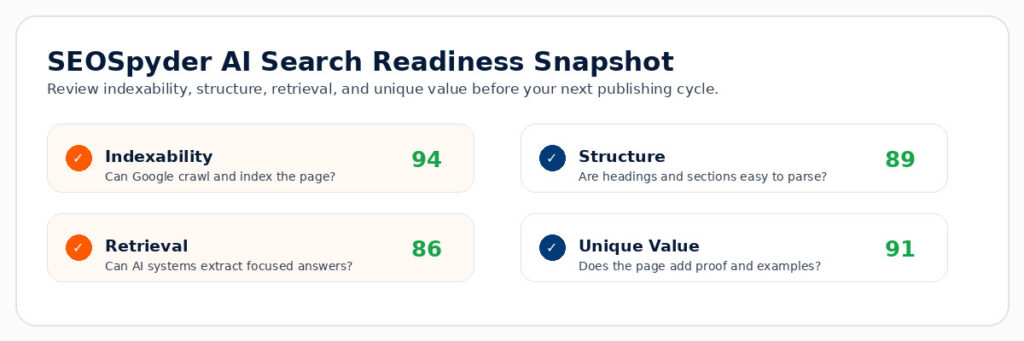
A SEOSpyder AI Search Readiness Snapshot can help identify whether a page has a direct answer, strong topical coverage, useful internal links, schema opportunities, clear headings, and enough original value to avoid commodity content.

Snapshot Area What to Check Why It Matters
Direct answer Does the page answer the main query early? Supports snippets, AI summaries, and reader clarity.
Original value Does the page add insight beyond generic AI output? Reduces commodity content risk.
Internal links Is the page connected to related SEO resources? Improves topical context and user navigation.
Technical readiness Are crawlability, metadata, mobile layout, and schema clean? Keeps the page eligible and easier to process.

Best practical approach

Use SEOSpyder before publishing new AI-assisted content, after major Google updates, and when refreshing pages that need stronger AI-search readiness.

Improve visibility in Google Search and AI search

Use SEOSpyder to audit content quality, technical SEO, internal links, and AI-search readiness before your next publishing cycle.

For SEO managers, content leads, founders, and agencies building AI-ready organic growth.

Frequently Asked Questions

What is AI search optimization? +

AI search optimization is the process of improving content, technical SEO, structure, internal links, and answer clarity so pages can perform in classic search and AI-led search experiences like AI Overviews and AI Mode.

Is AI search optimization different from SEO? +

It is not separate from SEO. Google says generative AI search still relies on core Search ranking and quality systems, so foundational SEO remains important.

How do I optimize for AI Overviews and AI Mode? +

Create helpful, crawlable, well-structured pages with direct answers, original value, internal links, schema where useful, and clear evidence for important claims.

Do I need special schema for AI search optimization? +

No special schema guarantees AI search visibility. Structured data can still support overall SEO and rich result eligibility, but it does not replace useful content and technical readiness.

Can AI SEO tools help with AI search optimization? +

Yes. AI SEO tools can help identify content gaps, internal link opportunities, technical issues, missing FAQs, weak headings, and unclear answers. Human review is still needed before publishing.

How can SEOSpyder help with AI search optimization? +

SEOSpyder can help teams review content quality, technical SEO, internal links, topical coverage, and AI-search readiness before publishing or refreshing SEO pages.


Continue reading

AI SEO Optimization 2026 | A Practical Framework for Faster Wins

ai seo optimization
SEOSpyder Guide · SEO Automation & Audits

Quick Answer

AI SEO optimization means using AI to improve SEO audits, search intent mapping, content structure, internal linking, technical checks, and AI search readiness without replacing expert judgment. The goal is not to publish more generic AI-written pages. The goal is to use AI SEO tools and structured workflows to create useful pages that can perform in classic Google Search while also becoming easier to understand, summarize, and cite in AI Overviews and AI Mode.

AI SEO optimization has become important because SEO teams are under pressure to move faster while maintaining quality. AI can help with audits, briefs, keyword grouping, content reviews, and technical checks, but faster output does not automatically mean better rankings.

For a strong foundation, start with this guide on AI SEO in 2026 before building your optimization workflow.

This matters more after Google’s March 2026 core update cycle, which reinforced broad quality evaluation across search results. Google’s May 2026 AI-search guidance also reaffirmed that SEO fundamentals still support visibility in generative search features like AI Overviews and AI Mode.

This guide explains what AI SEO optimization means, what it is not, how teams can use it without creating commodity content, and how SEOSpyder’s AI Search Readiness Snapshot can help you prioritize faster wins.


What Is AI SEO Optimization?

AI SEO optimization is the process of using artificial intelligence to improve SEO decisions and execution. It can help SEO teams analyze keywords, review search intent, detect content gaps, improve headings, check internal links, identify technical issues, and prepare pages for AI search optimization.

But AI SEO optimization is not the same as asking a chatbot to write a full blog and publishing it as-is. That approach often creates commodity content: pages that repeat the same definitions, lists, and generic advice already available across search results.

Simple definition

AI SEO optimization means using AI to make SEO audits, content improvements, and search readiness checks faster, more structured, and more consistent.

1

Audit

Find SEO gaps across content, structure, and technical setup.

2

Prioritize

Separate fast wins from low-impact changes.

3

Improve

Update answers, links, schema, headings, and quality signals.


Why AI SEO Optimization Matters After the 2026 Search Updates

Google’s March 2026 core update started on March 27, 2026, and finished on April 8, 2026, according to the Google Search Status Dashboard. Core updates do not reward one small trick. They reassess broad quality signals across content, relevance, usefulness, and trust.

Google’s guidance for generative AI features also makes the direction clear: SEO best practices still matter because AI Overviews and AI Mode rely on Google’s Search systems. That means AI SEO optimization should improve page quality, not bypass SEO fundamentals.

13

Days of rollout

Google’s March 2026 core update ran from March 27 to April 8.

May

AI search guidance

Google reaffirmed that SEO remains relevant for AI search experiences.

0

AI-only shortcuts

The safer path is better content, crawlability, structure, and usefulness.

Important note

AI SEO optimization should not be used to mass-produce thin pages. It should help teams improve page quality, reduce manual audit time, and make content easier to understand for readers and search systems.

Find faster SEO wins before publishing

Use SEOSpyder to review content quality, technical SEO, internal links, and AI-search readiness before your next update cycle.

Try SEOSpyder AI Search Readiness Snapshot →


AI SEO Optimization vs Generic AI Content Generation

The biggest mistake teams make is thinking AI SEO optimization means “generate more content.” The better approach is to use AI to improve the quality and performance potential of pages that already have a clear purpose.

Factor Generic AI Content AI SEO Optimization
Goal Produce more text quickly. Improve pages for search intent, quality, and discoverability.
Output Generic summaries and repeated advice. Clear answers, stronger structure, and better SEO readiness.
Risk Thin or commodity content. Lower risk when reviewed by experts.
Best use Drafting ideas and outlines. Audits, content refreshes, internal links, and AI-search readiness.

A Practical AI SEO Optimization Framework for Faster Wins

The best AI SEO optimization workflow starts with pages that already matter: pages with impressions, rankings, internal link potential, outdated content, or conversion value. Then use AI to audit, prioritize, and improve them with human review.

1

Start with page selection

Choose pages that already have SEO potential: ranking pages stuck on page two, blogs losing traffic, pages with weak CTR, or commercial pages missing supporting content. This keeps optimization focused on faster wins.

2

Run a content and technical audit

Review metadata, headings, crawlability, content depth, schema, page speed, internal links, and topical coverage. For site authority checks, pair this with a domain authority and page authority checker.

3

Improve search intent coverage

Use AI SEO tools to identify missing questions, weak definitions, thin examples, and unsupported claims. Then add useful sections that actually help the reader instead of filling the page with generic paragraphs.

4

Strengthen AI-search readiness

Add direct answers, clear H2s, comparison tables, FAQs, schema, and concise explanations. This supports answer engine optimization and makes the page easier for AI systems to understand and summarize.

5

Add internal links with context

Connect the page to related resources such as your guide on non-commodity content for AI search and your guide on how to use SEO analysis tools.

6

Review before publishing

AI can suggest improvements, but SEO managers should still review accuracy, brand voice, examples, prioritization, and whether the updated page gives readers something genuinely useful.


Common AI SEO Optimization Mistakes

Mistake 1: Optimizing every page equally

Not every page deserves the same effort. Start with pages that already have rankings, impressions, commercial value, or clear refresh potential.

Mistake 2: Using AI only to rewrite content

Rewriting weak content does not fix weak strategy. Use AI to diagnose intent gaps, structure problems, missing links, and unsupported claims.

Mistake 3: Treating AI search optimization as a hack

AI search visibility still depends on useful, crawlable, well-structured pages. Do not ignore classic SEO while chasing AI Overviews or AI Mode.

Mistake 4: Publishing without expert review

AI can speed up optimization, but humans should still verify facts, tone, examples, business relevance, and whether the page feels trustworthy.


SEOSpyder AI Search Readiness Snapshot Use Case

The practical use case for SEOSpyder is to turn AI SEO optimization into a structured review process. Instead of guessing what to update, teams can review pages across content quality, technical SEO, internal linking, and AI-search readiness.

A SEOSpyder AI Search Readiness Snapshot can help identify whether a page has a direct answer, clear search intent match, useful internal links, schema opportunities, original value, and enough structure to support answer engine optimization.

Snapshot Area What to Check Why It Matters
Intent match Does the page solve the real search need? Improves relevance and user satisfaction.
Content quality Does the content add value beyond generic AI output? Reduces commodity content risk.
AI-search readiness Are answers, headings, FAQs, and schema clear? Helps AI systems understand and summarize the page.
Technical readiness Are metadata, crawlability, speed, and mobile layout clean? Keeps the page eligible and easier to process.

Best practical approach

Use SEOSpyder before publishing new AI-assisted content, after major Google updates, and when refreshing pages that are close to ranking but not improving.


Pre-Publish Checklist for AI SEO Optimization

Before publishing, check:

✓ Did you choose a page with real SEO upside?

✓ Does the page answer the main query early?

✓ Are technical SEO issues fixed or clearly prioritized?

✓ Does the content add insight beyond generic AI summaries?

✓ Are internal links useful and contextually placed?

✓ Are FAQs and schema aligned with visible page content?

✓ Has a human reviewed accuracy, examples, and brand voice?

Use AI SEO optimization to find faster wins

Use SEOSpyder to audit content quality, technical SEO, internal links, and AI-search readiness before your next content refresh or publishing cycle.

For SEO managers, content leads, founders, and agencies building AI-ready organic growth.

Frequently Asked Questions

What is AI SEO optimization? +

AI SEO optimization is the use of artificial intelligence to improve SEO audits, content structure, search intent coverage, internal links, technical checks, and AI-search readiness.

Is AI SEO optimization the same as AI content generation? +

No. AI content generation focuses on producing text. AI SEO optimization focuses on improving pages for search intent, technical SEO, internal linking, content quality, and AI search visibility.

Can AI SEO tools improve rankings? +

AI SEO tools can help identify issues and opportunities, but rankings still depend on content quality, technical SEO, relevance, authority, user value, and competition.

How does AI SEO optimization support AI Overviews and AI Mode? +

It helps by improving answer clarity, page structure, crawlability, internal links, schema opportunities, and content usefulness. Google says SEO fundamentals still apply to generative AI features in Search.

What pages should I optimize first with AI SEO? +

Start with pages that already have impressions, rankings, traffic drops, weak CTR, outdated content, or strong business value. These pages usually offer faster wins than starting from zero.

How can SEOSpyder help with AI SEO optimization? +

SEOSpyder can help teams review content quality, technical SEO, internal links, topical coverage, and AI-search readiness before publishing or refreshing important SEO pages.


What an AI SEO Agent 2026 | Does Better Than a Generic AI Chatbot

Ai Seo Agent
SEOSpyder Guide · SEO Automation & Audits

Quick Answer

An AI SEO agent is a task-focused SEO system that can audit pages, check technical issues, analyze search intent, review content quality, suggest internal links, and guide optimization workflows. A generic AI chatbot can answer questions, but an AI SEO agent is built to act inside SEO processes. It is more useful for teams that need repeatable audits, content improvement, AI search optimization, and answer engine optimization at scale.

SEO teams are using AI more than ever, but there is a big difference between asking a chatbot for SEO advice and using an AI SEO agent to complete a specific audit or optimization workflow. A chatbot can give ideas. An AI SEO agent should help diagnose, prioritize, and improve pages based on SEO signals.

This matters more in 2026 because Google’s March 2026 core update reinforced broad quality evaluation, while Google’s May 2026 AI-search guidance confirmed that SEO still underpins visibility in generative search experiences like AI Overviews and AI Mode.

For a wider foundation on AI-led SEO workflows, read this practical guide on AI SEO in 2026 before building your agent-based optimization process.

In this guide, we’ll explain what an AI SEO agent does, how it differs from a generic AI chatbot, where teams go wrong, and how to use SEOSpyder’s AI Search Readiness Snapshot to create pages that perform in classic search and AI-led results.


What Is an AI SEO Agent?

An AI SEO agent is an AI-powered system designed to perform or assist with specific SEO tasks. Instead of only responding to prompts, it works around a defined workflow such as auditing a page, checking metadata, reviewing keyword intent, suggesting internal links, identifying technical issues, or improving content for AI search optimization.

A generic chatbot can explain SEO concepts, but it usually does not know your page structure, crawl issues, internal link gaps, topical depth, or publishing priorities unless you manually provide that context. An AI SEO agent is more useful because it is built around SEO actions, not just conversation.

Simple definition

An AI SEO agent is a specialized AI system that helps complete SEO tasks such as audits, optimization checks, content reviews, and AI-search readiness analysis.

1

Audit

Find technical, content, and on-page SEO gaps.

2

Prioritize

Separate urgent fixes from low-impact suggestions.

3

Optimize

Improve structure, internal links, schema, and clarity.


Why AI SEO Agents Matter After the 2026 Search Updates

The March 2026 core update ran from March 27 to April 8, 2026, according to the Google Search Status Dashboard. Broad updates like this are not about one ranking trick. They reassess overall quality, relevance, usefulness, and trust across search results.

Google’s May 2026 guidance for generative AI features also says SEO best practices continue to matter because AI Overviews and AI Mode are rooted in Google’s core Search ranking and quality systems. This makes structured audits, content quality checks, and AI-search readiness more important.

13

Days of rollout

Google’s March 2026 core update ran from March 27 to April 8.

May

AI search guidance

Google reaffirmed that SEO remains relevant for AI search experiences.

1

Core goal

Create pages useful enough to rank, summarize, and cite.

Important note

An AI SEO agent does not replace SEO judgment. It improves consistency, speed, and coverage, but humans still need to approve strategy, accuracy, brand voice, and final publishing decisions.

Turn AI SEO checks into a repeatable workflow

Use SEOSpyder to review content quality, technical SEO, internal links, and AI-search readiness before your next publishing cycle.

Try SEOSpyder AI Search Readiness Snapshot →


AI SEO Agent vs Generic AI Chatbot

The main difference is workflow depth. A chatbot is useful for brainstorming and explanations. An AI SEO agent is better when you need structured audits, repeatable checks, and page-level optimization support.

Factor Generic AI Chatbot AI SEO Agent
Main role Answers prompts and explains ideas. Runs SEO-specific checks and workflows.
SEO context Depends on what the user provides manually. Works around audits, page checks, and optimization criteria.
Best use Brainstorming, outlines, explanations, drafts. Audits, prioritization, AI search readiness, internal links.
Risk Can produce generic advice without verification. Still needs human review, but gives more workflow control.

How to Use an AI SEO Agent in a Practical SEO Workflow

The best way to use an AI SEO agent is not to ask it for random suggestions. Use it inside a structured workflow where each step has a clear purpose and review point.

1

Start with a page-level audit

Use the agent to review metadata, headings, crawlability, indexability, keyword focus, content depth, and technical issues. Pair this with a broader check using tools such as a domain authority and page authority checker when evaluating site-level strength.

2

Check content for commodity risk

The agent should flag pages that repeat common definitions, lack original insight, miss examples, or do not clearly answer the user’s search need. Use this alongside your guide to non-commodity content for AI search.

3

Improve structure for AI search optimization

Ask the agent to check whether the page has a direct answer, clear section hierarchy, comparison tables, FAQs, schema opportunities, and concise explanations that AI systems can understand and summarize.

4

Find internal linking opportunities

Use the agent to suggest links to related pages, supporting guides, and conversion pages. If you are new to audit workflows, start with this guide on how to use SEO analysis tools.

5

Review and approve before publishing

AI SEO agents can speed up decisions, but SEO managers should still approve accuracy, prioritization, tone, claims, and final changes before publishing.


Common Mistakes When Using AI SEO Agents

Mistake 1: Treating the agent like a magic ranking tool

An AI SEO agent can identify opportunities, but it cannot guarantee rankings. It still needs strong content, technical SEO, authority, and user value.

Mistake 2: Publishing suggestions without review

Agent outputs should be reviewed by someone who understands the business, the audience, and the search intent. Do not publish recommendations blindly.

Mistake 3: Using agents only for content generation

The best use is not only writing. AI SEO agents are stronger when used for audits, gap analysis, content quality checks, internal linking, and AI-search readiness reviews.

Mistake 4: Ignoring the full SEO system

AI search optimization still depends on technical SEO, content quality, internal links, authority, and clear user value. A single agent cannot fix a weak SEO foundation alone.


SEOSpyder AI Search Readiness Snapshot Use Case

The practical use case for SEOSpyder is to help teams turn AI SEO into a structured audit process. Instead of asking a generic chatbot what to improve, teams can review page readiness across content quality, technical SEO, internal links, and AI-search visibility signals.

A SEOSpyder AI Search Readiness Snapshot can help identify whether a page has a direct answer, original value, strong structure, crawlable setup, useful internal links, and enough clarity to support answer engine optimization.

Snapshot Area What to Check Why It Matters
Content quality Does the page add value beyond generic AI output? Reduces commodity content risk.
AI search readiness Does the page have clear answers, structure, and context? Helps AI systems understand and summarize the page.
Internal links Is the page connected to related SEO resources? Improves navigation, relevance, and topical context.
Technical SEO Are metadata, schema, crawlability, and mobile layout clean? Keeps the page eligible and easier to process.

Best practical approach

Use SEOSpyder before publishing new AI-assisted content, after major Google updates, and when refreshing pages that stopped gaining visibility.


Pre-Publish Checklist for AI SEO Agent Workflows

Before publishing, check:

✓ Did the agent identify technical and content issues clearly?

✓ Are the recommendations prioritized by business and SEO impact?

✓ Does the page answer the main query early?

✓ Does the content avoid generic AI summaries?

✓ Are internal links useful and contextually placed?

✓ Is schema aligned with visible content?

✓ Has a human reviewed the final changes?

Use AI for SEO audits, not just SEO prompts

Use SEOSpyder to audit content quality, technical SEO, internal links, and AI-search readiness before your next publishing cycle.

For SEO managers, content leads, founders, and agencies building AI-ready organic growth.

Frequently Asked Questions

What is an AI SEO agent? +

An AI SEO agent is a specialized AI system that helps complete SEO tasks such as audits, content reviews, technical checks, internal link suggestions, and AI-search readiness analysis.

How is an AI SEO agent different from a chatbot? +

A chatbot mainly responds to prompts. An AI SEO agent is designed around SEO workflows, such as auditing pages, checking content quality, identifying internal link opportunities, and prioritizing optimization tasks.

Can AI SEO agents replace SEO managers? +

No. AI SEO agents can speed up audits and recommendations, but SEO managers still need to approve strategy, accuracy, prioritization, business relevance, and final publishing decisions.

Do AI SEO agents help with AI search optimization? +

Yes. They can help review whether a page has clear answers, useful structure, internal links, schema opportunities, and content quality signals that support visibility in AI Overviews and AI Mode.

What should an AI SEO agent check first? +

It should start with page-level fundamentals: indexability, metadata, headings, content quality, search intent match, internal links, schema opportunities, and technical issues.

How can SEOSpyder help with AI SEO agents? +

SEOSpyder can help teams turn AI SEO into a structured audit workflow by reviewing content quality, technical SEO, internal links, topical coverage, and AI-search readiness before publishing or refreshing SEO pages.


How to Create Non-Commodity Content That Performs in Search and AI Results 2026

Non Commodity Content: Create Pages That Rank in AI Search
SEOSpyder Guide · AI SEO & AI Search

Quick Answer

Non commodity content is content that gives readers something they cannot get from a generic AI summary or copied competitor structure. It includes original insight, clear answers, expert review, useful examples, strong structure, and proof. In 2026, this matters because AI SEO, AI SEO agents, AI search optimization, and answer engine optimization all depend on the same core idea: pages must be genuinely useful, easy to understand, and strong enough to perform in both classic Google results and AI-led search experiences.

Most SEO teams are not struggling because they cannot publish enough content. They are struggling because too many pages now look the same. AI tools can generate definitions, lists, outlines, FAQs, and summaries quickly, but speed alone does not create search value.

Google’s March 2026 core update ran from March 27 to April 8, 2026, according to the Google Search Status Dashboard. Core updates are broad quality reassessments, not single-factor changes. Then Google’s May 2026 AI-search guidance reaffirmed that SEO still matters for AI Overviews and AI Mode because these features are rooted in Google’s core Search ranking and quality systems.

That is why non commodity content is becoming a practical SEO requirement. If a page only repeats what other websites already say, it becomes easy to ignore. If it adds useful insight, clear structure, evidence, and expert judgment, it becomes easier for users, search engines, and AI systems to trust.


What Is Non Commodity Content?

Non commodity content is content that has a clear reason to exist beyond covering a keyword. It does not simply summarize competitor pages, rewrite common definitions, or fill a template with generic AI output. It gives the reader useful information, original thinking, and a better way to understand or solve the problem.
Related- How to rank your blog in Italy

For SEO practitioners, this means the page should answer the query quickly, explain the topic with clarity, add a practical workflow, include evidence where needed, and show a point of view that reflects real experience. This is where AI SEO tools are useful: they can support research and structure, but the final value must come from expert judgment.

Simple definition

Non commodity content gives readers original value, not just information they could already get from ten similar pages or a basic AI summary.

1

Intent

Start with the reader’s real search need.

2

Insight

Add examples, data, opinions, or workflows.

3

Structure

Make the page easy to scan and cite.


Why Non Commodity Content Matters After the 2026 Search Updates

The March 2026 core update reinforced a familiar truth: Google does not reward content only because it targets a keyword. Broad core updates reassess whether pages are useful, trustworthy, and relevant compared with what else is available on the web.

Google’s May 2026 guidance for generative AI features also makes one point clear: AI Overviews and AI Mode still depend on Google’s Search index, ranking systems, and quality systems. That means AI search optimization is not a separate hack. It is SEO with better structure, stronger answers, and clearer evidence.

13

Days of rollout

Google’s March 2026 core update ran from March 27 to April 8.

May

AI search guidance

Google reaffirmed that SEO remains relevant for AI search experiences.

1

Core goal

Create pages that are useful enough to deserve visibility.

Important note

Using an AI SEO agent or AI writing tool does not automatically make content weak. The risk comes when teams publish AI output without insight, evidence, expert review, or differentiation.

Check if your page looks too generic

Use SEOSpyder to review content quality, search intent coverage, internal links, technical SEO, and AI-search readiness before publishing.

Try SEOSpyder AI Search Readiness Snapshot →


Commodity Content vs Non Commodity Content

The difference is not whether AI was used. The difference is whether the final page gives the reader a stronger answer than what already exists.

Factor Commodity Content Non Commodity Content
Main value Repeats common information. Adds insight, experience, examples, or data.
Structure Generic headings copied from SERP patterns. Clear answer-first structure built around user needs.
AI search fit Hard to distinguish from other pages. Easier to summarize, cite, and trust.
SEO outcome May rank briefly but is easy to replace. Builds stronger long-term search visibility.

How to Create Non Commodity Content That Performs in Search and AI Results

The best workflow combines AI-supported research with human judgment. Use AI to speed up analysis, but use expertise to decide what is worth publishing.

1

Start with the search need, not the keyword alone

A keyword tells you what people type. Search intent tells you what they need. Before writing, define whether the user wants a definition, checklist, tool comparison, workflow, diagnosis, or decision support.

2

Find what competitors are missing

Review top-ranking pages, AI SEO tools roundups, and AI search optimization guides. Do not copy their structure blindly. Look for weak definitions, missing examples, thin comparisons, outdated advice, or unclear workflows.

3

Add a source of originality

Originality can come from product data, expert commentary, a workflow, a template, a benchmark, a real example, or a clear decision framework. For authority signals, also review technical and trust factors like domain health using tools such as a domain authority and page authority checker.

4

Structure the page for classic SEO and AI search

Use a direct answer, descriptive H2s, short explanation blocks, comparison tables, FAQs, and schema. This supports AI search optimization and answer engine optimization without relying on AI-only tricks.

5

Review for commodity risk before publishing

Ask one simple question: if this page disappeared, would the search result lose anything useful? If the answer is no, the content needs more originality, clarity, or proof.


Common Mistakes That Turn AI SEO Content Into Commodity Content

Mistake 1: Publishing AI drafts without a point of view

AI can create a clean draft, but clean does not mean valuable. Add experience, examples, and a clear editorial decision.

Mistake 2: Confusing length with depth

A long page can still be thin if it repeats obvious points. Depth comes from better explanations, sharper examples, and useful decisions.

Mistake 3: Treating AEO as only FAQ writing

FAQs help, but answer engine optimization starts with the whole page. The main sections should already answer important user questions clearly.

Mistake 4: Skipping technical and internal link review

Even strong content can underperform if it is not crawlable, internally linked, mobile-friendly, or clearly connected to related pages such as your AI SEO guide.


SEOSpyder AI Search Readiness Snapshot Use Case

The practical use case for SEOSpyder is to review whether a page is ready for both classic SEO and AI-led discovery before it goes live. This is especially useful for content teams using AI SEO tools or AI agents to speed up production.

A SEOSpyder AI Search Readiness Snapshot can check whether the page has a direct answer, unique value, complete topical coverage, clear headings, internal links, technical SEO basics, and FAQ/schema opportunities.

Snapshot Area What to Check Why It Matters
Direct answer Does the page answer the main query early? Supports snippets, AI summaries, and user clarity.
Original value Does the page add examples, data, workflow, or expert insight? Reduces commodity content risk.
Internal linking Is the page connected to related SEO resources? Helps users and search engines understand page relationships.
Technical readiness Are metadata, schema, crawlability, and mobile layout clean? Keeps the page eligible and easy to process.

Best practical approach

Use SEOSpyder before publishing new AI-assisted content and when refreshing pages that lost rankings after a major search update.


Pre-Publish Checklist for Non Commodity Content

Before publishing, check:

✓ Does the page answer the main query in the first section?

✓ Does it add something competitors do not clearly provide?

✓ Is there an example, framework, data point, workflow, or expert view?

✓ Are claims easy to verify and not overstated?

✓ Are headings written for readers, not just keywords?

✓ Are internal links useful and contextually placed?

✓ Has a human reviewed accuracy, usefulness, and brand voice?

Create content that stands out in Google and AI search

Use SEOSpyder to audit content quality, technical SEO, internal links, and AI-search readiness before your next publishing cycle.

For SEO managers, content leads, founders, and agencies building AI-ready organic growth.

Frequently Asked Questions

What is non commodity content? +

Non commodity content is content that adds original value beyond generic summaries. It usually includes expert insight, examples, data, practical workflows, clear answers, and a reason for readers to trust the page.

Why does non commodity content matter for AI SEO? +

It matters because AI SEO is not just about producing more pages. AI search systems need clear, trustworthy, useful content to surface and summarize. Generic content is harder to distinguish and easier to replace.

Can AI tools create non commodity content? +

AI tools can help with research, outlines, keyword grouping, and optimization. But the final content becomes non commodity only when humans add judgment, original insight, examples, verification, and brand-specific value.

How do I make content perform in AI Overviews and AI Mode? +

Create crawlable, helpful, well-structured content with direct answers, strong headings, internal links, reliable evidence, and original value. Google says SEO fundamentals still apply to generative AI features in Search.

What is the biggest mistake in AI-assisted content? +

The biggest mistake is publishing AI-generated drafts without adding a real point of view, examples, accuracy checks, or expert review. This often creates pages that look polished but feel replaceable.

How can SEOSpyder help create better content? +

SEOSpyder can help teams review content structure, technical SEO, internal links, topical coverage, and AI-search readiness before publishing or refreshing SEO pages.


What AI SEO Means in 2026 | How to Use It Without Creating Commodity Content

SEOSpyder Guide · AI SEO & AI Search

Quick Answer

AI SEO means using artificial intelligence to improve keyword research, search intent mapping, content structure, technical SEO checks, internal linking, and AI search optimization without removing expert judgment. In 2026, the goal is not to publish more AI-written pages. The goal is to create original, useful, well-structured content that can rank in classic Google results and become easier to understand, summarize, and cite in AI Overviews and AI Mode.

AI SEO has become one of the most searched topics among SEO managers, content leads, founders, and agencies because search is changing from simple blue-link rankings to answer-led experiences. Users still search on Google, but they also expect summarized answers, deeper follow-up paths, and direct explanations from AI-powered search systems.
Related- How to use seo analysis tools

That does not mean traditional SEO is dead. Google’s official guidance for AI features says SEO best practices remain relevant because AI Overviews and AI Mode are rooted in Google’s core Search ranking and quality systems. The March 2026 core update cycle also reminded SEO teams that quality evaluation is broad, sitewide, and not limited to one page element.

This guide explains what AI SEO means in 2026, where teams go wrong with commodity content, and how to build a practical workflow that supports Google rankings, answer engine optimization, and AI search visibility.


What Is AI SEO?

AI SEO is the use of AI systems to make SEO research, planning, optimization, and review faster and more accurate. It can help with clustering keywords, finding search intent gaps, improving page structure, checking headings, creating schema drafts, summarizing SERP patterns, and identifying internal linking opportunities.

But AI SEO is not the same as publishing hundreds of AI-generated articles. That approach often creates commodity content: pages that repeat what already exists, add no original insight, and fail to show why the brand deserves to be trusted.

Simple definition

AI SEO means using AI to support better SEO decisions while keeping the final content original, useful, expert-reviewed, and aligned with real search intent.

1

Research

Use AI to group keywords, questions, entities, and user needs.

2

Structure

Build pages with direct answers, clear headings, and helpful sections.

3

Review

Check originality, accuracy, internal links, schema, and quality signals.


Why AI SEO Matters After the 2026 Google Updates

Google’s March 2026 core update started on March 27, 2026, and finished on April 8, 2026, according to the Google Search Status Dashboard. Core updates do not reward one trick. They reassess broad quality signals across content, relevance, usefulness, and trust.

Then, in May 2026, Google published official guidance for generative AI features in Search. The key point for SEO teams is clear: SEO still matters because AI Overviews and AI Mode use Google’s Search index and ranking systems to surface helpful content.

13

Days of rollout

March 2026 core update ran from March 27 to April 8, 2026.

May

AI search guidance

Google reaffirmed that SEO fundamentals apply to AI search features.

0

AI-only hacks

Google says there are no special AI-only technical requirements beyond Search eligibility.

Important note

AI search optimization is not about tricking AI systems. It is about making your page easier to understand, verify, summarize, and trust.

Check if your page is ready for AI search

Use SEOSpyder to review content structure, search intent coverage, technical SEO, internal links, and AI-search readiness before publishing.

Try SEOSpyder AI Search Readiness Snapshot →


AI SEO vs AI Search Optimization vs Answer Engine Optimization

These terms are connected, but they are not exactly the same. A strong 2026 strategy should cover all three because users discover answers through classic rankings, AI summaries, and answer-led search journeys.
Related- DA PA Checker

Term What It Means Main Goal
AI SEO Using AI to improve SEO research, content planning, technical checks, and optimization. Rank better while improving quality and efficiency.
AI search optimization Structuring pages so AI search systems can understand entities, claims, answers, and context. Improve visibility in AI Overviews, AI Mode, and AI-led discovery.
Answer engine optimization Creating concise, accurate answers for question-based and conversational queries. Win snippets, FAQ visibility, and answer-led search moments.

How to Use AI SEO Without Creating Commodity Content

The best SEO with AI workflow starts with strategy, not generation. AI should help your team find gaps, speed up research, and improve structure. It should not replace original insight, subject-matter review, or real examples.

1

Start with one search intent

Decide whether the page should define a topic, compare tools, solve a problem, explain a workflow, or help the reader make a decision. For this blog, the primary intent is clear: explain what AI SEO means and how to use it correctly in 2026.

2

Map questions before writing

Use AI SEO tools to collect related questions, People Also Ask patterns, entity gaps, and follow-up topics. Then group them into sections so the page answers the topic fully without becoming bloated.

3

Add original insight

Add your own audits, product data, examples, screenshots, expert notes, templates, or frameworks. For international pages, show how search intent changes by market, like ranking a blog in Spain, Brazil, or Italy.

4

Structure for readers and AI systems

Use answer-first sections, descriptive H2s, clean comparison tables, short definitions, FAQs, and schema. This helps users scan the page and helps search systems understand the relationship between claims, evidence, and answers.

5

Run a quality review before publishing

Check whether the page has a clear answer, real value, factual accuracy, useful internal links, author or brand expertise, and a reason to exist beyond summarizing competitor pages.

6

Refresh after ranking signals change

AI search behavior, SERP layouts, and competitor coverage change quickly. Review important pages after core updates, traffic drops, or major product changes so content stays useful and current.


Common AI SEO Mistakes That Create Commodity Content

Mistake 1: Starting with AI output instead of user intent

If the page starts from a generic prompt, it usually becomes a generic article. Start with the query, audience, problem, and search result gap.

Mistake 2: Repeating competitor definitions

A page that only restates what Ahrefs, Semrush, Moz, or tool roundups already say has no strong reason to rank. Add your own framework, data, examples, or workflow.

Mistake 3: Treating AEO as a separate trick

Answer engine optimization works best when the full page is helpful. Do not add FAQs to a weak article and expect the page to become authoritative.

Mistake 4: Publishing without expert review

AI can speed up drafts, but humans should check claims, examples, nuance, brand voice, and whether the page actually helps the target reader.


SEOSpyder AI Search Readiness Snapshot Use Case

The practical use case for SEOSpyder is simple: before publishing or refreshing a page, run an AI Search Readiness Snapshot to check whether the content is structured for both classic SEO and AI-led discovery.

For example, a content lead can review whether a page has a direct answer, complete topical coverage, clean headings, useful internal links, schema opportunities, technical SEO issues, and enough first-hand value to avoid sounding like a recycled AI summary.

Snapshot Area What SEOSpyder Should Check Why It Matters
Direct answer Does the page answer the main query in the first section? Supports snippets, AEO, and AI summary extraction.
Topical coverage Does the page cover related questions and searcher needs? Helps match query fan-out and follow-up search behavior.
Original value Does the page include examples, data, workflow, or expert insight? Reduces the risk of commodity content.
Technical readiness Are metadata, schema, crawlability, speed, and mobile layout clean? Keeps the page eligible and easy to understand.

Best practical approach

Use SEOSpyder before publishing, after a Google update, and when refreshing pages that lost traffic or stopped appearing for important queries.


Pre-Publish Checklist for AI SEO Pages

Before publishing, check:

✓ Does the first section directly answer the primary query?

✓ Is the page useful without relying on generic AI summaries?

✓ Are claims supported by evidence, examples, or official sources?

✓ Are headings clear enough for readers and search systems?

✓ Are internal links relevant and placed naturally in the body?

✓ Is FAQ schema aligned with visible FAQ content?

✓ Has a human reviewed accuracy, examples, and brand voice?

Build pages that are ready for SEO and AI search

Use SEOSpyder to audit content structure, technical SEO, internal links, and AI-search readiness before your next update or publishing cycle.

For SEO managers, content leads, founders, and agencies building AI-ready organic growth.

Frequently Asked Questions

What is AI SEO? +

AI SEO is the use of artificial intelligence to improve SEO research, content planning, optimization, technical checks, internal linking, and quality review while keeping human expertise in the final decision-making process.

Is AI SEO different from SEO with AI? +

They are closely related. SEO with AI usually means using AI inside existing SEO workflows. AI SEO is the broader practice of preparing content, technical signals, and page structure for both classic search and AI-led search experiences.

Do AI SEO tools replace SEO experts? +

No. AI SEO tools can speed up audits, keyword grouping, content briefs, and technical checks, but SEO experts still need to review strategy, search intent, accuracy, originality, and business relevance.

How do I optimize content for AI Overviews and AI Mode? +

Create helpful, crawlable, well-structured content with clear answers, strong headings, reliable evidence, schema where useful, and original value. Google says SEO fundamentals still matter for generative AI features in Search.

What is commodity content in AI SEO? +

Commodity content is generic content that repeats existing search results without adding original insight, real examples, expert review, data, or a useful workflow. It is a common risk when teams use AI only to scale output.

How can SEOSpyder help with AI SEO? +

SEOSpyder can help teams review content structure, technical SEO, internal links, topical coverage, and AI-search readiness before publishing or refreshing important SEO pages.


How to Rank Your Blog in Brazil

How to Rank Your Blog in Brazil

Have you ever wondered why your well-crafted blog-with its clean design, catchy headlines, and engaging content-doesn’t show up prominently on Google’s Brazilian search results? The key lies in mastering country-specific SEO tailored to Brazil’s unique digital landscape. Achieving high rankings in Brazil goes beyond generic SEO; it requires a deep understanding of Brazilian search intent, adapting to local ranking criteria, and leveraging powerful tools like Google Search Console to fine-tune every aspect of your site. This comprehensive guide takes you on a step-by-step journey on How to Rank Your Blog in Brazil.

You’ll learn how to conduct precise keyword research specific to the Brazilian market, track your competitors effectively, and implement essential technical SEO tweaks. Additionally, discover how to optimize your content to resonate with Brazilian users and measure your performance through analytics. Along the way, you’ll gain practical insights and proven strategies to climb the Google rankings in Brazil without getting overwhelmed by complex jargon or unnecessary technicalities. Whether you’re new to SEO or looking to sharpen your skills, this guide offers clear, actionable advice tailored for Brazil’s online environment.

Step 1: Understand How Google Ranks Content in Brazil

The Brazilian search landscape is competitive, mobile-first, and often price- or utility-driven. Google Brazil prioritizes Experience, Expertise, Authoritativeness, and Trustworthiness (E-E-A-T) while placing significant weight on user satisfaction signals. Demand for high-quality, original content that genuinely meets user needs has never been higher, making E-E-A-T essential in this market.

To rank high in Brazil:

  • Publish original, authoritative content – avoid recycled or duplicated information that doesn’t add real value.
  • Earn backlinks from well-regarded Brazilian websites (.com.br, .org.br, .edu.br), national media outlets, and respected industry organizations to boost your site’s credibility.
  • Strengthen your site with technical SEO fundamentals – implement mobile-first indexing, structured schema markup, and ensure fast page speeds to enhance both user experience and crawlability.
  • Align your content precisely with search intent, whether it’s informational, product research, or comparison-based queries, so your audience finds exactly what they’re looking for.
  • Monitor engagement metrics such as clicks, dwell time, and bounce rates as these reflect how users perceive your content’s value, influencing rankings over time.

In short, Google rewards blogs that feel authentic, relevant, and truly helpful to Brazilian audiences. Focusing on content quality, robust technical SEO, and strong local backlinks creates a solid foundation for ranking success in Brazil’s distinct search ecosystem.

Related – How to Rank Your Blog in Spain

Step 2: Brazil-Specific Keyword Research

When it comes to keyword research, understanding that intent can vary significantly by country and language is crucial. For effective Brazilian SEO optimisation, you need to start with localised data to rank well on Google Brazil with terms that actual users search for. This approach helps your content connect directly with the Brazilian audience’s search behavior and preferences, making your SEO strategy more impactful.

Here’s how to nail Brazil-specific keyword research:

  • Google Keyword Planner: Set Location to Brazil and Language to Portuguese (Brazil). If you’re also targeting expats, include English as well. This tool will provide keywords commonly searched by locals and expats alike.
  • SEMrush / Ahrefs: Switch the database to Brazil to accurately track and analyze target terms used within the country.
  • Google Search Console: Use the Country filter to Brazil in performance reports. This shows real query data from actual Brazilian users visiting your site.
  • People Also Ask & Google Trends (BR): These features help identify seasonal search spikes and common Brazilian phrasing, so you can tailor content timing and wording effectively.
  • Geo-modifiers: Incorporate location-specific terms like “best SEO tips for Brazil” or city-specific keywords such as “local SEO guide for São Paulo,” “SEO strategies for Rio de Janeiro,” or “SEO services in Belo Horizonte, Porto Alegre, Recife, Salvador.”

Pro tip: When researching Portuguese queries, pay attention to diacritics like ã, ç, and é, as they affect search intent and accuracy. However, in URLs, keep slugs short and easy to read by using unaccented characters-e.g., use “seo-brasil” instead of “seo-brásil” to maintain clarity and user-friendliness.

By following these steps, you align your keyword strategy with authentic Brazilian search behavior, boosting your chances to rank higher and drive more relevant traffic from Brazil. This targeted approach also helps you generate content that resonates culturally and linguistically with the local audience.

Step 3: Competitor Analysis – Use VPNs and Tools

If you’re optimising from outside Brazil, search results can differ significantly compared to what local users see. To truly understand the Brazilian search landscape and get authentic results:

  • Use a VPN set to key cities like São Paulo, Rio de Janeiro, Belo Horizonte, or Porto Alegre. This allows you to simulate local searches and view the exact top-ranking pages for your target queries.
  • Search target queries through the VPN and carefully note who ranks in the top 10 results. 
  • Pay close attention to factors such as word count, tone, backlink strength, internal linking, and content depth to understand why those competitors rank well.

Then, dive deeper using SEO tools designed for competitor analysis in Brazil:

  • Ahrefs, SimilarWeb, and SISTRIX (BR) provide insights on referring domains, authority scores, traffic sources, and backlink profiles. These tools help you assess the overall authority and marketing strategies of competitors.
  • Perform gap analysis to identify subtopics and related keywords your competitors are missing or under-targeting. This uncovers opportunities to fill content voids that appeal specifically to Brazilian readers.

Using VPNs combined with these advanced tools ensures you don’t just create content that’s better but that also stands out by being uniquely tailored and relevant to the Brazilian market. This approach gives you a competitive edge by delivering content that resonates culturally and linguistically with local audiences, boosting your chances of ranking higher in Brazilian SERPs.

Step 4: Technical SEO Foundation for the Brazilian Market

Great content alone won’t rank well without a solid technical SEO foundation tailored to the Brazilian market. In 2025, ensuring your site’s technical health is crucial for gaining visibility and improving user experience, especially given Brazil’s unique internet infrastructure and user behavior. Here is a comprehensive checklist to help you build an effective technical SEO base:

  • Speed optimisation: Use tools like Google PageSpeed Insights and aim for a Largest Contentful Paint (LCP) under 2.5 seconds. To minimize latency and improve load times for Brazilian users, consider leveraging Content Delivery Networks (CDNs) with Points of Presence in Latin America and Brazil specifically.
  • Mobile optimisation: Since the majority of Brazilian searches happen on mobile devices, prioritize a mobile-first user experience. Ensure the design includes clear, easy-to-tap targets and provides fast, smooth navigation on various smartphones commonly used in Brazil.
  • Core Web Vitals: Monitor vital metrics such as LCP, Cumulative Layout Shift (CLS), and Interaction to Next Paint (INP) with targets of LCP < 2.5s, CLS < 0.1, and INP < 200ms, optimizing for smooth, responsive experiences.
  • Schema markup: Implement structured data markup like Article, Breadcrumb, and Organization/Person schema. Use FAQ and HowTo schemas only when they add real value, and avoid overdependence on FAQ rich results since they don’t always appear in Google.
  • Secure site: Having HTTPS enabled with a valid SSL certificate is mandatory for trust and ranking benefits.
  • Hreflang tags: If your site targets multiple languages or regions, implement the pt-BR hreflang tag along with the x-default tag on selector pages to guide Google correctly. For Portuguese-only sites focused solely on Brazil, hreflang can be optional.
  • Canonicals & sitemaps: Use self-referencing canonical tags on all indexable pages to avoid duplicate content issues and submit updated XML sitemaps to Google after any significant site changes.
  • Legal compliance (Brazil): Add a Política de Privacidade that complies with Brazil’s LGPD data protection law. Implement user consent mechanisms for analytics and advertising tracking as required by legal standards.

By prioritizing this technical SEO checklist, your website will be well-optimised to meet the expectations of Brazilian users and search engines alike, helping you achieve faster rankings and a better overall user experience.

Step 5: Build a Brazil-Centric Content Strategy

Your content should truly mirror Brazilian search behaviour – focusing on being practical, value-driven, and solution-oriented to meet the specific needs of local users.

Content creation essentials:

  • Prioritise clarity, actionable insights, and originality instead of repeating generic information. This approach keeps your content fresh and trustworthy, encouraging users to engage and return for more.
  • Add Brazilian context: incorporate metric units, real examples in R$ (Brazilian real), relevant local references, and Portuguese language screenshots whenever possible. This local flavour helps your content feel more authentic and relatable for Brazilian readers.
  • Format for readability – use short paragraphs, clear bullet points, and sub-headers to make content easy to scan and digest, particularly on mobile devices common in Brazil.
  • Include FAQ sections that add real value for users and boost voice search potential, even if rich snippets don’t always appear. FAQs address common queries directly, improving user satisfaction.

On-page optimisation:

  • Make sure to include the main keyword (“How to rank your blog in Brazil”) prominently in your title, meta description, and within the first 150 words of your content to signal relevance to search engines effectively.
  • Sprinkle related phrases naturally throughout the text, such as “SEO strategies for ranking in Brazil,” “how to get more traffic in Brazil,” and “top SEO tools for ranking in Brazil,” to build comprehensive keyword coverage without keyword stuffing.
  • Add 3–5 descriptive internal links to related posts on your site. Regularly audit your site to find and fix orphan pages, strengthening your site’s internal linking structure and improving crawlability.
  • Close with a clear, compelling call-to-action (CTA) like encouraging readers to subscribe, read the next article, or download a useful checklist. This guides users toward deeper engagement and increases conversions.

By following this Brazil-centric strategy, your content becomes locally relevant and optimized not just for better rankings but also for delivering practical value to Brazilian audiences in their preferred language and context.

Step 6: Local SEO – The Hidden Multiplier

Even if your target audience spans the entire country, leveraging local SEO signals can significantly boost your trustworthiness and visibility in location-sensitive searches. Local SEO acts as a powerful multiplier that amplifies your overall PR and search performance.

Consider:

  • Google Business Profile: Set up and optimize your Google Business Profile only if you serve customers in person or operate as a service-area business. This helps your business appear in local map packs and boosts discovery among nearby users.
  • Consistent NAP: Maintain consistent Name, Address, and Phone information across all online platforms, directories, and social profiles. This consistency is crucial for search engines to verify your business location and build trust.
  • Local backlinks: Earn backlinks from credible local sources such as city portals, Brazilian media outlets, community meetups, and event sponsorships. These locally relevant backlinks enhance your domain authority and signal authenticity to search engines.
  • Regional pages: Develop dedicated city or state-specific pages if you are targeting regional keywords like “SEO São Paulo,” “Rio SEO dicas,” or “Bahia blog ranking.” These pages help you capture traffic from users searching for services or information specific to those areas.

Implementing these local SEO strategies boosts your site’s performance for location-based queries, helping you gain a competitive edge in Brazil’s diverse and regionally segmented market.

Step 7: Optimise Using Google Search Console

Google Search Console (GSC) is your essential control centre for monitoring SEO performance and pinpointing where you can make impactful improvements on your site.

Why it matters:

  • GSC reveals the keywords you rank for, highlights underperforming pages, and identifies opportunities where targeted tweaks can unlock significant new traffic.

Key steps:

  • Filter for Brazil: Go to Performance → Search Results → Countries → Brazil to track impressions, clicks, click-through rate (CTR), and average position specifically from Brazilian users.
  • Quick wins: Focus on pages ranking in positions 5–15. Refresh titles and meta descriptions, add concise FAQ sections, and tighten your introductions to boost CTR. Sort queries by high impressions and low CTR to identify where rewriting titles and meta tags to reflect user phrasing can yield improvements.
  • Fix indexing issues: In the Page Indexing report, address pages marked “Not Indexed” or “Crawled – currently not indexed.” After applying fixes, request reindexing to speed up the update process.
  • Expand keywords: Within the Queries report, find terms that have decent impressions but low click volumes. Create additional supporting content or paragraphs linked internally to these keywords to improve relevance and capture more traffic.
  • Vitals & mobile: Check the Experience → Core Web Vitals report, ensuring both desktop and mobile meet performance targets, paying close attention to Interaction to Next Paint (INP) for responsiveness.
  • Links & CTR insights: Use the Links report to evaluate your external referral links and work on strengthening internal linking to underperforming posts to help boost their rankings.

Pro tip: Use the “Compare” feature in GSC to measure the monthly impact of your SEO changes, helping you track progress and justify further optimisations.

By systematically harnessing Google Search Console’s data and tools, you can make precise, data-driven decisions that steadily improve your site’s traffic and performance in the Brazilian search market.

Step 8: Build Quality Backlinks in Brazil

Backlinks are a cornerstone of SEO authority, and their geographic relevance plays a critical role in how search engines perceive your site’s trustworthiness within Brazil. Focusing on high-quality, locally relevant backlinks can give your site a significant ranking boost.

Focus on:

  • Guest posts on Brazilian blogs and niche publications: Create valuable content tailored for Brazilian audiences and pitch to popular local blogs or industry-specific sites to earn authoritative backlinks.
  • Journalist platforms and expert round-ups: Get featured as a Brazilian contributor on journalist websites or expert round-up posts. These opportunities increase your visibility and provide credible backlinks from respected sources.
  • Niche podcasts and local online magazines: Participate in or sponsor niche podcasts popular in Brazil or contribute articles to local online magazines to build diverse and relevant backlinks.
  • Resource pages at universities and respected .br sites: Aim for backlinks from educational institutions, industry associations, nonprofits, and government resources within Brazil. These .br domains carry strong domain authority and enhance your site’s local credibility.

Use Ahrefs and Google Search Console to continuously monitor your backlink profile, tracking link velocity, anchor text diversity, and referring domains to maintain a healthy and natural link-building pace.

By focusing on these Brazilian-centric backlink strategies, you build stronger local authority, making your SEO efforts more effective in positioning your site as a trusted player in the Brazilian digital market.

Step 9: Optimise for Voice, Mobile and AI Search

Voice and AI-driven search results are rapidly shaping how Brazilian users discover information online, making it essential to adapt your SEO strategy accordingly.

Practical moves:

  • Structure your content with conversational headers such as “What is X?” or “How to do Y?” that mimic natural questions users might ask verbally. This format helps voice assistants and AI better understand and present your content.
  • Implement concise Q&A blocks directly addressing common queries, and add FAQ schema markup only when it genuinely benefits user experience. This increases the chances of your content appearing as rich, voice-friendly results.
  • Surface short, clear answers early, ideally within the first 100–150 words of your content, so voice assistants can grab and deliver these snippets quickly to users.
  • Keep your HTML markup clean, organize content sections for easy scanning, and maintain consistent terminology throughout your text. These practices enhance AI’s ability to generate accurate overviews and featured answers from your pages.

Optimizing for voice, mobile, and AI isn’t just about technology – it’s about aligning with how Brazilians naturally seek information, increasing both your content’s reach and usability.

Step 10: Track, Measure, Repeat

SEO success is built on continuous iteration and optimisation rather than one-time fixes.

Do this consistently:

  • GA4: Segment your traffic specifically to Brazil and track key conversions such as form submissions, sign-ups, and newsletter clicks to accurately measure how well your SEO strategies are driving business outcomes. This focused tracking lets you understand which efforts deliver the best ROI in the Brazilian market.
  • GSC + GA4: Combine Google Search Console’s keyword performance data with GA4’s user engagement metrics to gain a comprehensive view of the entire customer journey-from their initial search query to conversion actions on your site. This integrated analysis helps identify bottlenecks and opportunities for improvement.
  • Monthly reviews: Conduct regular audits to spot underperforming posts or pages. Refresh these by updating outdated statistics, adding new information, and improving content relevance and freshness. This ongoing maintenance is essential to sustain and boost search rankings in a competitive environment.

Treat SEO as an evolving experiment-consistently test new ideas, measure results against clear metrics, and refine your strategies based on real data and emerging trends. This adaptive approach ensures your SEO efforts remain agile and effective in Brazil’s ever-changing digital landscape, keeping you ahead of competitors and aligned with user needs.

Step 11: Monitor Brazilian SEO Trends for 2025

With algorithms and AI evolving rapidly, staying updated on the latest SEO trends in Brazil is essential to maintain and improve your search rankings.

Focus on:

  • Data-backed storytelling: Use original statistics, compelling visuals, and quick benchmarks to create engaging and trustworthy content that appeals to both users and search engines. This approach strengthens your authority and encourages sharing.
  • Thought leadership: Establish credibility by including expert author bios and bylines on your content. Showcasing knowledgeable voices builds trust and positions your brand as an industry leader within the Brazilian market.
  • Multimodal SEO: Optimize your content with diverse media types such as images, embedded videos, and charts. These elements enrich user experience and improve engagement, helping your pages stand out in search results.
  • Strong entity markup and structured data: Implement detailed schema to help search engines understand your content’s context, improving your chances of appearing in rich results and voice search answers.

Keep an eye on Google Search Central updates: Regularly follow announcements and best practices from Google’s official SEO resource to anticipate algorithm changes and adapt your strategy proactively.

By actively monitoring these trends, you ensure your SEO efforts remain relevant, innovative, and competitive in Brazil’s fast-changing digital landscape.

Step 12: Quick Brazil SEO Checklist (2025)

  • Hit Core Web Vitals targets: Aim for Largest Contentful Paint (LCP) under 2.5 seconds, Cumulative Layout Shift (CLS) less than 0.1, and Interaction to Next Paint (INP) under 200 milliseconds to ensure fast, stable user experiences.
  • Add Política de Privacidade compliant with LGPD (Brazil’s data protection law) and implement clear cookie consent notices. Display bylines and last-updated dates on your content to build transparency and trust.
  • Use structured data markup like Article, Breadcrumb, and Organization/Person schema. Apply FAQ and HowTo schema selectively, only when they clearly add value to user experience.
  • Write answer-first introductions that directly address user queries. Include a Table of Contents (TOC) and well-organized sub-headers to improve navigation and comprehension.
  • Optimize images using modern formats such as WebP or AVIF; add descriptive alt text and lazy-load images to improve page speed. Set explicit width and height attributes on images to prevent layout shifts that harm CLS scores.
  • Build content clusters with strong internal linking to related articles. Regularly audit and fix orphan pages to maintain effective site architecture.
  • Track Brazil-specific traffic segments in GA4, and save filters in Google Search Console for pages ranking in positions 5 to 15 to identify quick SEO wins.
  • Run ongoing digital PR and link-building campaigns targeting Brazilian media outlets and relevant local platforms to strengthen domain authority and local visibility.
  • Conduct monthly content reviews to refresh outdated posts with new data and insights, and submit updated pages for reindexing to keep your site fresh in search results.

This checklist encapsulates the critical technical, content, and promotional practices vital for a successful SEO strategy focused on Brazil in 2025-equipping you to meet both user expectations and search engine requirements effectively.

Step 13: Bonus: How to Rank on Bing in Brazil

While Google dominates, Bing’s presence through Windows, Edge, and Copilot offers a valuable additional channel for Brazilian traffic. Many Google SEO best practices apply, but layering Bing-specific strategies can give you an extra edge.

  • Bing Webmaster Tools (BWT): Verify your site, submit XML sitemaps, and monitor performance on Brazil-specific search queries and pages. Use URL Inspection and Crawl Control features to manage how Bing crawls and indexes your site.
  • Enable IndexNow: Activate IndexNow via a plugin or a simple endpoint to accelerate the discovery and indexing of new or updated URLs on your site, ensuring faster inclusion in Bing’s search results.
  • On-page signals: Craft clear, keyword-focused title tags with the main keyword near the front, compelling meta descriptions, and clean heading structures. Implement JSON-LD schema markup to help Bing better understand your entities and content context.
  • Backlinks & authority: Build high-quality backlinks from reputable Brazilian websites. Diversify anchor text to maintain natural link profiles, and avoid low-quality or spammy directories that could harm your authority.
  • Performance & UX: Ensure your pages load fast, are mobile-friendly, and accessible, as these factors influence Bing rankings and click-through rates.
  • Local presence: If applicable, claim your Bing Places for Business profile. Maintain consistent Name, Address, and Phone (NAP) information, select accurate categories, and add photos and reviews to build trust locally.
  • Content for Copilot/answers: Write concise, answer-first paragraphs with clear definitions and well-sourced insights. This style improves your chances of being featured in Bing’s AI-generated summaries and Copilot responses.
  • Images & video: Use modern image formats like WebP or AVIF with descriptive alt text. Submit dedicated image and video sitemaps to help Bing index your multimedia content effectively.
  • Monitor & iterate: Regularly review Search Performance, fix Index Coverage issues, and audit Backlinks in Bing Webmaster Tools to stay ahead of any technical or content problems.

Quick takeaway: Stick to Google-first SEO fundamentals, then add Bing-specific tools and tactics-Bing Webmaster Tools, IndexNow, Bing Places, and CTR-optimized titles/meta-to tap into Bing’s growing Brazilian search market opportunity.

Final Thoughts

Ranking your blog in Brazil requires a blend of consistency, clarity, and a deep understanding of the local market. By combining Brazil-specific keyword research with a solid technical SEO foundation, genuinely helpful and culturally relevant content, and a disciplined approach to measurement and iteration using tools like Google Search Console and GA4, you set yourself up for sustained success. Emphasizing relevance, performance, and user experience ensures not only improved visibility but also builds a lasting, trusted presence in Brazil’s competitive search landscape. These pillars help you connect authentically with Brazilian audiences and stay resilient amid evolving SEO trends.

FAQs

Q1. How long does it take to rank a blog in Brazil?

Ans:- On average, you can expect noticeable gains in Brazilian search rankings within 3 to 6 months. This timeline varies based on competition, the quality of your content, and the strength of your backlinks. Newer sites might require more time to build authority, whereas established blogs can accelerate results with consistent and focused optimisation.

Q2. Do I need a .com.br domain or Brazilian hosting to rank in Brazil?

Ans:- Not necessarily. A generic .com domain works well for ranking in Brazil. What matters more is site performance, such as using fast LatAm CDN Points of Presence (POPs), plus strong local signals like Brazilian backlinks and relevant local content. Although a .com.br domain can help users and search engines recognise your local focus, it is not mandatory for ranking.

Q3. What type of content performs best for Brazilian audiences?

Ans:- Content that is clear, practical, and actionable performs best. Structuring content with list-style sections, data-driven insights, and relatable examples with Brazilian specifics like metric units and prices in R$ improves user engagement and dwell time-both positive signals for SEO.

Q4. How do I find keywords that Brazilians actually search for?

Ans:- Use tools like Google Keyword Planner, Ahrefs, SEMrush, or Google Trends, making sure to set the location to Brazil. Additionally, explore “People Also Ask” boxes and related search suggestions on Google Brazil to capture popular phrases and natural Brazilian Portuguese search terms.

Q5. Can I rank in Brazil if my blog is based outside the country?

Ans:- Absolutely. If your content targets Brazilian search intent, your site loads quickly for Brazilian users, and you secure relevant backlinks from .br domains or reputable Brazilian media, you have a strong chance of ranking well. Using Google Search Console’s country filters and VPNs to check local competitors can help you fine-tune your strategy to the real Brazilian SERPs.

How to Rank Your Blog in Spain

How to Rank Your Blog in Spain

You’ve built a strong blog – clean design, sharp headlines, engaging content – but it still doesn’t appear where it matters most: on Google’s Spanish search results. So, what’s missing? The key lies in country-specific SEO. Ranking in Spain isn’t just about translating content; it’s about understanding local search intent, cultural nuances, and the unique behavior of Spanish audiences online. From language localisation to search patterns, every detail counts. With the right strategy, you can tap into the growing Spanish digital market and drive genuine, organic traffic. This guide walks you through how to rank your blog in Spain step by step – from precise keyword research and competitor tracking to technical SEO, content optimisation, and analytics.

You’ll also get practical insights into ranking your site in Spain, best SEO tips tailored for Spanish audiences, and core Google ranking factors that actually make a difference, all explained in a simple, actionable way.

Step 1: Understand How Google Ranks Content in Spain

The Spanish search landscape thrives on clarity, credibility, and genuine usefulness. Not only does Google.es focus on experience, expertise, authoritativeness, and trustworthiness (E-E-A-T), but it also pays close attention to real user satisfaction and nuanced, localized content. Spanish readers are quick to spot canned or auto-translated writing and tend to trust pages that feel conversational, natural, and directly relevant to local trends and issues.​

To rank high in Spain:

  • Publish original, insightful content with depth and local relevance – recycled, generic, or poorly translated posts rarely perform well. Consider ‘transcreation’: adapting idioms, examples, and cultural touchpoints to fit Spanish preferences.​
  • Earn backlinks from reputable Spanish websites like .es domains, respected news sites, universities, or industry associations, and engage with local forums and directories.​
  • Strengthen your site with technical SEO – ensure mobile-first indexing, fast page loads, properly implemented schema, and language/region meta tags like hreflang.​
  • Match search intent exactly: address informational queries, support product research, or offer compelling comparison guides based on what Spanish audiences are really searching for.​
  • Refine your keyword research by using Spanish-language tools and databases for authentic, high-volume terms – avoid literal translations that miss how people actually search.​
  • Track engagement signals such as clicks, dwell time, and bounce rates, which Google uses to measure perceived site value.​

In short, Google rewards blogs that feel authentic, context-aware, and genuinely helpful to a Spanish audience. Focus on high-quality content, local authority, and a strong technical foundation to truly make your mark in Spain’s search results.

Related – How to Rank Your Blog in Italy

Step 2: Spain-Specific Keyword Research

Keyword intent varies widely across countries and languages, making localized data essential for effective SEO targeting. To optimize your content for the Spanish audience and ensure it ranks well on Google Spain, start with precise keyword research using tools tailored for the region.​

Key strategies for Spanish keyword research include:

  • Google Keyword Planner: Set the location to Spain and the language to Spanish. If you’re targeting specific regions or dialects like Catalan, Basque, or Galician, include those languages too. This ensures your keywords reflect actual search behaviors and preferences.​
  • SEMrush, Ahrefs, SISTRIX: Switch your database focus to Spain for accurate local search data. These platforms offer detailed insights into keyword volume, difficulty, and competitor analysis, crucial for understanding your landscape.​
  • Google Search Console: Use filters to analyze your site’s performance specifically in Spain. This real-world data shows which keywords your audience in Spain is actually searching for, helping you refine your strategy based on engagement metrics.​
  • Google Trends & People Also Ask (PAAs): Monitor seasonal spikes and trending topics in Spain. Variations in search interest over time can guide content creation around seasonal events or regional interests, making your content more relevant.​
  • Geo-modifiers: Incorporate location-specific terms like “best SEO tips for Spain”, “how to do SEO in Madrid”, or “local SEO guide for Barcelona.” This geo-targeting improves your chances of ranking in local searches and capturing nearby traffic. Adjust URL slugs by removing diacritics (e.g., “telefono” instead of “teléfono”) and keep URLs short for better usability and ranking.​

Pro tip: Use regional keyword suggestions and compare results across multiple tools for a more comprehensive list. Combining these methods helps you identify high-volume, low-competition keywords that speak directly to your target Spanish markets.

Step 3: Competitor Analysis – Use VPNs and Tools

If you’re optimising from outside Spain, results can differ significantly depending on your search location. To get an authentic view of Spanish SERPs:

  • Use a VPN set to major Spanish cities such as Madrid, Barcelona, Valencia, Sevilla, or Bilbao. This gives you the exact local search results Spanish users see.
  • Search for your target queries and take note of who ranks in the top 10.
  • Observe competitors’ word count, tone, backlink strength, internal linking strategies, and depth of content coverage.

Then, go deeper with SEO tools:

  • Ahrefs, SISTRIX, and SimilarWeb allow you to compare referring domains, authority scores, and backlink profiles across competitors.
  • Conduct gap analysis to identify subtopics your competitors miss and related keywords they under-target.

This research helps you not just write content that is better, but also create something unique and specifically tailored for Spanish readers, increasing your chance to outrank competitors in the local market.

Step 4: Technical SEO Foundation for the Spanish Market

Great content alone won’t rank well without a solid technical foundation tailored to Spain’s search ecosystem. Keeping your site fast, secure, crawlable, and compliant with local regulations is crucial in 2025.

Checklist for 2025:

  • Speed optimisation: Use tools like Google PageSpeed Insights with a goal of Largest Contentful Paint (LCP) under 2.5 seconds. Consider Spain or broader EU-based CDN points of presence (POPs) to reduce latency for Spanish users.
  • Mobile optimisation: Over 90% of Spanish searches are on mobile devices, so a mobile-first user experience with clear tap targets and responsive design is essential.
  • Core Web Vitals: Continuously monitor LCP (< 2.5s), Cumulative Layout Shift (CLS < 0.1), and Interaction to Next Paint (INP < 200ms) to ensure fast, smooth, and stable user interactions.
  • Schema markup: Implement structured data for Article, Breadcrumb, Organization/Person. Use FAQ or HowTo only when it genuinely benefits the user experience; don’t rely solely on FAQ rich results to show up.
  • Secure site: HTTPS with a valid SSL certificate is non-negotiable for Google and user trust.
  • Hreflang tags: If you serve multiple languages or regional variants, use es-ES plus x-default tags for selector pages. Spanish-only sites can often omit hreflang for simplicity.
  • Canonicals & sitemaps: Use self-referencing canonical tags on every indexable page and submit updated XML sitemaps to Google after significant site updates.
  • Legal compliance in Spain: Include essential legal pages like Aviso Legal, Política de Privacidad (aligned with GDPR/LOPDGDD), and cookie consent adhering to the AEPD guidelines. Make sure analytics and advertising tools respect user consent choices.

Following this technical checklist tailored for Spanish audiences ensures your site is well-positioned for Google.es indexing and ranking, providing users with a fast, secure, and legally compliant experience that enhances the authority of your content.

Step 5: Build a Spain-Centric Content Strategy

Your content should directly reflect Spanish search behaviour – clear, evidence-led, and focused on providing practical solutions. Spanish users prefer straightforward, valuable information without fluff or repetition.

Content creation essentials:

  • Prioritise clarity, actionability, and originality over repeating common ideas. Focus on answering questions your audience truly cares about.
  • Add local Spanish context: use metric units, illustrate with prices in €, and include references to local customs, festivals, or well-known locations to increase relatability.
  • Format for maximum readability with short paragraphs, bullet points, and descriptive sub-headers that guide the reader.
  • Include FAQ sections to deliver extra value and capture voice search queries, even if FAQ rich snippets aren’t guaranteed to show.

On-page optimisation:

  • Naturally integrate the main keyword phrase (e.g., “How to rank your blog in Spain”) into the title tag, meta description, and within the first 150 words of your content.
  • Sprinkle related semantic phrases throughout the content – such as “SEO strategies for ranking in Spain,” “how to get more traffic in Spain,” and “top SEO tools for ranking in Spain” – to capture a broader range of searches.
  • Add 3–5 descriptive internal links to related articles or pages. Conduct monthly audits to fix orphan pages and maintain strong site architecture.
  • Close with a clear, compelling call to action (CTA), prompting readers to subscribe, read another post, or download a helpful checklist.

Building a content strategy tailored to Spain’s unique search culture will boost user engagement, improve rankings, and help you capture valuable organic traffic from this competitive market.

Step 6: Local SEO – The Hidden Multiplier

Even if your target audience spans all of Spain, leveraging local SEO signals can significantly boost your trustworthiness and visibility in location-sensitive searches. Local optimisation acts as a powerful multiplier, helping you tap into regional search habits and preferences more effectively.

Consider these essential local SEO tactics:

  • Google Business Profile: Claim and optimise this only if you serve customers in person or operate as a service-area business. A well-maintained profile improves your chances of appearing in local pack results and maps.
  • Consistent NAP: Ensure your Name, Address, and Phone number details are consistent across all online platforms and directories. This consistency builds credibility with Google and local users alike, especially if your business has a physical location.
  • Local backlinks: Earn links from city portals, local Spanish media outlets, community meetups, and event sponsorships. These backlinks signal your strong local presence and improve authority within specific regions.
  • Regional pages: Create dedicated city or regional pages targeting localised keywords such as “Madrid SEO consejos,” “Barcelona estrategias de contenido,” or “Andalucía blog ranking.” These pages help rank for highly targeted searches unique to each area.

Implementing these local SEO steps consistently will boost your performance on queries sensitive to location, enhancing your site’s overall reach and relevance across Spain’s diverse regions.

Step 7: Optimise Using Google Search Console

Google Search Console (GSC) is your indispensable control centre for monitoring site performance and identifying opportunities to improve rankings and traffic in Spain. It provides clear insights into what you currently rank for, which pages lag behind, and where strategic changes can unlock new visitors.

Why it matters:
GSC reveals the keywords driving traffic, pages that underperform, and actionable areas that can boost your visibility on Google.es.

Key steps:

  • Filter for Spain: Navigate to Performance → Search Results → Countries → Spain. Track key metrics like impressions, clicks, click-through rate (CTR), and average position specifically for the Spanish market.
  • Quick wins: Target pages ranking between positions 5–15. Refresh their titles and meta descriptions, add concise FAQs, and tighten introductory text to increase CTR. Sort queries by high impressions but low CTR to rewrite titles and meta tags using natural user language.
  • Fix indexing issues: Go to Page Indexing to identify “Not Indexed” or “Crawled – currently not indexed” pages. Address the root causes and request reindexing after fixes to regain visibility.
  • Expand keywords: Within Queries, find terms with impressions but few clicks. Add supportive paragraphs and internal links around these keywords to capture more traffic.
  • Monitor Core Web Vitals: Check Experience → Core Web Vitals to ensure a smooth site experience on both desktop and mobile. Pay special attention to Interaction to Next Paint (INP) scores.
  • Analyze links and CTR: Use the Links report to assess external backlinks and strengthen internal linking for posts that are underperforming to distribute link equity effectively.

Pro tip: Use the “Compare” feature to measure the monthly impact of your optimisations, helping track progress and justify new strategies.

Step 8: Build Quality Backlinks in Spain

Backlinks remain a critical factor in shaping your site’s authority, and emphasizing geographic relevance is key when targeting Spanish audiences. Spanish Google values links from sites trusted within Spain to establish your credibility in the local market.

Focus on these tactics:

  • Guest posts: Contribute insightful articles to reputable Spanish blogs, industry-specific sites, and niche publications where your expertise will resonate with the audience.
  • Journalist platforms and expert round-ups: Participate in Spanish journalist networks and expert compilations to earn high-quality mentions and backlinks from authoritative media.
  • Niche podcasts and local online magazines: Appear as a guest on Spanish podcasts and collaborate with regional online magazines to reach targeted audiences and gain links with regional relevance.
  • Resource pages: Aim to get listed on resource or reference pages of respected .es domains, such as universities, industry associations, nonprofits, and government websites that maintain solid authority in Spain.

Regularly monitor your backlink profile using tools like Ahrefs, SISTRIX, and Google Search Console. Pay attention to link velocity (the rate at which you gain backlinks), anchor text diversity, and the variety of referring domains to maintain a healthy and natural backlink profile that Google rewards.

Step 9: Optimise for Voice, Mobile and AI Search

The rise of voice assistants and AI-driven search features is transforming how Spanish users discover content. Optimizing for these trends ensures your site remains visible and relevant in conversational and AI-powered search environments.

Practical moves:

  • Structure your answers in a natural, conversational tone using clear headers like “What is X?” or “How to do Y?” This directly matches the question-and-answer format preferred by voice search and AI snippets.
  • Implement concise Q&A blocks throughout your content, and apply FAQ schema markup when it genuinely adds value for users and increases the chance of rich snippets appearing in SERPs.
  • Provide short, direct answers upfront-ideally within the first 100–150 words-so voice assistants and AI can easily extract and present your content.
  • Keep your HTML markup clean and organized, make sections easy to scan, and use consistent terminology throughout to help AI algorithms generate accurate overviews.

By following these guidelines, you can better capture voice queries and AI-driven search traffic, making your content accessible and appealing to the growing number of users relying on these modern search methods.

Step 10: Track, Measure, Repeat

SEO success is rarely instantaneous; it’s the result of continuous iteration and thoughtful adjustments. Treat SEO as an ongoing experiment that requires regular monitoring, learning, and refining to consistently improve your rankings and user engagement.

Do this consistently:

  • GA4: Segment your website traffic specifically from Spain and track key conversions such as form submissions, newsletter sign-ups, and button clicks. This granularity helps you measure the real impact of your SEO efforts in the Spanish market.
  • GSC + GA4: Combine the keyword performance insights from Google Search Console with engagement data from GA4 to map the full user journey-from search query to conversion-and identify bottlenecks or opportunities.
  • Monthly reviews: Regularly audit your content, focusing on posts that underperform. Refresh outdated statistics, update information, optimize headlines and meta descriptions, and add new insights to keep your content relevant and valuable.

By embracing SEO as an evolving process and applying these measurement-driven improvements, you ensure your website stays competitive and continues to attract and engage the Spanish audience over time.

Step 11: Monitor Spanish SEO Trends for 2025

SEO is a fast-evolving field, especially with ongoing algorithm updates and advances in AI affecting search results. Staying ahead requires vigilance and adapting to new trends tailored for the Spanish market.

Key focus areas include:

  • Data-backed storytelling: Use original Spanish statistics, custom visuals, and quick benchmarking data to make your content stand out as trustworthy and insightful. Authentic, local data resonates strongly with Spanish audiences.
  • Thought leadership: Establish credibility with detailed and verifiable author bios and bylines. Google values content that highlights expertise and accountability, particularly in competitive niches.
  • Multimodal SEO: Incorporate images, embedded videos, and interactive charts that enhance user engagement and improve ranking potential in diverse search results.
  • Strong entity markup and structured data: Implement advanced schema types to help Google understand your content’s context better, boosting your chances of rich results and knowledge graph inclusion.
  • Stay updated: Regularly monitor Google Search Central announcements, algorithm change reports, and SEO forums focused on Spain-specific trends to adapt your strategy promptly.

By actively tracking these emerging trends, you’ll keep your Spanish SEO strategy fresh, competitive, and aligned with how Google and users evolve in 2025.

Quick Spain SEO Checklist

  • Hit Core Web Vitals: Ensure Largest Contentful Paint (LCP) is under 2.5 seconds, Cumulative Layout Shift (CLS) below 0.1, and Interaction to Next Paint (INP) less than 200 milliseconds for fast and stable user experience.
  • Legal compliance: Add mandatory Spanish legal pages like Aviso Legal and Política de Privacidad conforming to GDPR/LOPDGDD regulations. Display author bylines and last-updated dates to boost trust and content transparency.
  • Schema markup: Use Article, Breadcrumb, and Organization/Person schema effectively. Only implement FAQ or HowTo schemas when they clearly enhance user experience and have a realistic chance of generating rich snippets.
  • Content structure: Write intros that answer the main query upfront. Include a well-organized Table of Contents (TOC) and logical sub-headers to improve readability and SEO.
  • Image optimisation: Use modern formats like WebP or AVIF, add descriptive alt text, lazy-load images, and set explicit width and height attributes to minimize CLS issues.
  • Internal linking: Build topic clusters with meaningful internal links and regularly audit to fix orphan pages, enhancing site architecture and crawlability.
  • Analytics & tracking: Segment traffic from Spain exclusively in GA4, and save Google Search Console filters focused on pages ranking between positions 5–15 to identify quick-win optimisation opportunities.
  • Digital PR & link-building: Run ongoing outreach and link acquisition campaigns targeting Spanish-relevant media, blogs, and industry outlets to build authority.
  • Content maintenance: Conduct monthly reviews of your content, refreshing data, updating information, and reindexing important posts to maintain freshness and search relevance.

This checklist sums up the critical technical, content, and outreach steps required for effective Spanish SEO in 2025.

Bonus: How to Rank on Bing in Spain

Bing’s role is growing, especially through Windows/Edge integrations and Copilot AI features, making it a valuable channel for Spanish search traffic. While many Google SEO fundamentals apply, layering Bing-specific tactics can unlock additional visibility and visitors.

  • Bing Webmaster Tools (BWT): Verify your site, submit updated XML sitemaps, and regularly review search queries and top-performing pages in Spain. Use tools like URL Inspection and Crawl Control to manage your site’s crawl budget and indexing.
  • Enable IndexNow: Activate this protocol via plugins or manual setup to ensure faster discovery and indexing of new or updated URLs on Bing.
  • On-page SEO signals: Use clear, keyword-rich title tags placed early, write compelling meta descriptions, and maintain clean, hierarchical headings. JSON-LD schema markup helps Bing recognize content entities more accurately.
  • Backlinks & authority: Focus on earning quality backlinks from Spanish domains with diverse anchor text while avoiding spammy or low-quality directories that can harm trust.
  • Performance & user experience: Ensure fast load times, mobile-friendly layouts, and accessible design, which contribute to better rankings and increased click-through rates.
  • Local presence: If relevant, claim your listing on Bing Places for Business, keeping NAP details consistent, choosing accurate categories, and uploading photos and customer reviews for local SEO benefits.
  • Content for Copilot/answers: Craft concise, answer-first paragraphs with clear definitions and well-sourced insights to increase inclusion in AI-powered summaries and Bing’s answer boxes.
  • Images & video: Use modern formats like WebP and AVIF with descriptive alt text, and submit dedicated sitemaps for images and videos to improve media search visibility.
  • Monitor & iterate: Regularly track performance metrics, fix any Index Coverage issues flagged in BWT, and review backlink profiles to maintain a healthy link ecosystem.

Quick takeaway: Build upon Google-first SEO foundations, then supplement with Bing Webmaster Tools, IndexNow, Bing Places, and CTR-optimized titles and meta descriptions to effectively seize Bing’s growing search opportunity in Spain.

Final Thoughts

Ranking your blog in Spain is a marathon, not a sprint-success hinges on consistent effort and clear focus. By combining Spain-specific keyword insights with robust technical SEO fundamentals, you create a strong foundation. Equally important is producing content that’s genuinely useful, tailored to local preferences, and aligned with search intent.

Maintain a steady measurement loop using Google Search Console and GA4 to monitor your progress, identify opportunities, and refine your approach. Prioritize relevance, site performance, and an excellent user experience-these are the pillars that will build not just visibility but a durable, authoritative presence in Spain’s competitive search landscape. With persistence and strategic focus, you’ll grow a trusted platform that continues to thrive over time.

FAQs

Q1. How long does it take to rank a blog in Spain?
Ans:- On average, it takes about 3 to 6 months to see noticeable improvements in Spanish search results, though this varies depending on factors like competition, content quality, and backlink strength. Brand new websites may require more time to gain traction, while established blogs with consistent optimization efforts can achieve faster results.

Q2. Do I need a .es domain or Spanish hosting to rank in Spain?
Ans:- Not necessarily. A .com domain is perfectly acceptable. What matters more are fast loading speeds, ideally supported by EU CDN points of presence, and local SEO signals such as Spanish backlinks and relevant content examples. While a .es domain can reinforce your local focus to users and search engines, it isn’t mandatory for ranking well in Spain.

Q3. What type of content performs best for Spanish audiences?
Ans:- Content that is clear, practical, and actionable resonates best with Spanish users. Formats like listicles, data-driven insights, and examples tailored to Spain with metric units and euro (€) pricing tend to boost engagement and increase dwell time-both positive signals for SEO.

Q4. How do I find keywords that Spaniards actually search for?
Ans:- Use tools like Google Keyword Planner, Ahrefs, SEMrush, or SISTRIX with the location set specifically to Spain. Exploring “People Also Ask” boxes and related searches on Google can help you capture natural phrasing and popular Spanish keyword combinations for more authentic targeting.

Q5. Can I rank in Spain if my blog is based outside the country?
Ans:- Absolutely. As long as your content targets Spanish search intent, loads quickly for users in Spain, and gains backlinks from Spanish domains or media, you can rank effectively. Use country filters in Google Search Console and VPN tools to analyse Spanish SERPs and fine-tune your strategy accordingly.

How to Rank Your Blog in Italy

How to Rank Your Blog in Italy

Have you ever wondered why your well-crafted blog, with its clean design, sharp headlines, and engaging content, isn’t showing up in the Italian Google search results? The answer lies in targeted, country-specific SEO. Successfully ranking in Italy means more than just translating your content – it requires understanding the unique search behaviors and preferences of Italian users, adapting to local ranking factors, and leveraging essential tools like Google Search Console to fine-tune every aspect of your website. This comprehensive guide takes you step by step through the process of How to Rank Your Blog in Italy. You’ll learn how to conduct precise keyword research tailored to the Italian market, keep a close eye on your competitors, and implement technical SEO that aligns with Google’s standards in Italy. On top of that, you’ll discover effective content optimization strategies and analytics techniques that reveal what’s working and what needs improvement. Plus, without getting overly technical, you’ll gather practical tips and uncover key Google ranking factors specific to Italy, making it easier than ever to grow your site’s visibility in this vibrant market.

Step 1: Understand How Google Ranks Content in Italy

The Italian search landscape places a high value on clarity, credibility, and genuine usefulness. Google.it gives priority to content that demonstrates experience, expertise, authoritativeness, and trustworthiness-collectively known as E-E-A-T-while heavily weighing how satisfied users are with the results. This means Italian Google users expect not just information, but reliable, well-researched, and meaningful content that truly answers their queries.

To rank high in Italy, consider these key points:

  • Publish original, authoritative content – avoid simply recycling information found elsewhere. Unique insights and in-depth knowledge resonate best with Italian audiences and Google’s quality standards.
  • Earn backlinks from reputable Italian websites such as .it domains, respected national media outlets, top universities, and trusted industry associations. These links act like endorsements that boost your blog’s credibility in the local market.
  • Strengthen your site with technical SEO best practices, including mobile-first indexing (since Italians increasingly browse on mobile), using structured schema markup to help Google understand your content better, and ensuring fast page load speeds for a smooth user experience.
  • Match search intent precisely – whether users are looking for informational content, product research, or comparison guides, your content should satisfy the reason behind their search query.
  • Watch engagement signals carefully. Metrics like clicks, dwell time, and bounce rates indicate the real value your content provides to visitors. The better users interact and stay, the more Google rewards your site.

In summary, Google rewards blogs that feel authentic, relevant, and genuinely helpful to an Italian audience. Focus on user-first content and robust technical SEO to thrive in Italy’s competitive digital environment.

Related – Rank Your Blog in the Netherlands

Step 2: Italy-Specific Keyword Research

Keyword intent varies significantly by country and language, so when optimizing for Italy, it’s essential to start with localized data. This ensures your content ranks on Google.it for the exact terms Italians actually use. By focusing on Italy’s unique search behaviors and language nuances, you increase your chances of connecting with your target audience and boosting your blog’s visibility.

Here’s how to approach it:

  • Google Keyword Planner: Set Location to Italy and Language to Italian (you can add English if targeting expats or tourists). This tool provides real search volumes and competitive insights straight from the source.
  • SEMrush / Ahrefs / SISTRIX: Switch your database to Italy and track your target keywords in the local context. These platforms help analyze competitor strategies and reveal valuable keyword opportunities within Italy.
  • Google Search Console: Filter your site’s performance data by Country: Italy to get precise, real-world query data showing what Italian users are already searching for on your site.
  • People Also Ask & Google Trends (Italy): Use these tools to spot seasonal spikes, trending topics, and popular Italian phrasing that might be missed by generic keyword tools.
  • Geo-modifiers: Tailor your keywords with location-based terms like “best SEO tips for Italy,” or city-specific searches such as “local SEO guide for Rome,” “SEO strategies Milan,” or “SEO services Naples.” Italians often search with these geo-targeted modifiers to find locally relevant content.

Pro tip: In your URLs/slugs, avoid Italian diacritic characters (à, è, é, ì, ò, ù) and replace them with their plain vowels (a, e, i, o, u). Also, keep URLs short and clean to improve readability and SEO performance.

By combining these Italy-tailored keyword tactics and tools, you position your blog to tap into the authentic Italian search landscape effectively-helping drive targeted traffic and increase your organic rankings.

Step 3: Competitor Analysis – Use VPNs and Tools

When optimizing your blog from outside Italy, it’s important to understand that search results can vary significantly based on location. 

  • To truly see the Italian search engine results pages (SERPs) as a local user would, the best approach is to use a VPN set to Italian cities like Rome, Milan, Naples, Turin, or Florence. 
  • This gives you an authentic view of the top-ranking content and helps avoid misleading conclusions drawn from results tailored to your own location.
  • Start by searching your target queries and carefully noting the websites that appear in the top 10 results. Pay close attention to aspects such as word count, tone of voice, backlink strength, internal linking structures, and the overall depth of content. These elements reveal what Google favors in Italy and what resonates with Italian users.

Then, supplement this manual research with powerful SEO tools:

  • Ahrefs, SISTRIX, and SimilarWeb allow you to compare key metrics such as referring domains, domain authority scores, and traffic sources among your competitors.
  • Conduct a gap analysis to uncover content subtopics your competitors have overlooked and discover under-targeted related keywords. This data informs you where opportunities lie for differentiation.

By combining VPN-based local SERP checks with data-driven tools, you can craft content that’s not only better in quality but also uniquely tailored to meet the expectations and preferences of Italian readers, setting your blog apart in the competitive Italian market.

Step 4: Technical SEO Foundation for the Italian Market

Even the best content won’t rank well without a solid technical foundation tailored to meet Italy’s digital environment in 2025. A clean, well-optimised technical setup ensures Google can easily crawl, index, and deliver your pages to Italian users in top form. Here’s a must-follow checklist to keep your site technically robust and user-friendly:

  • Speed optimisation: Use tools like Google PageSpeed Insights and aim for a Largest Contentful Paint (LCP) under 2.5 seconds. Consider leveraging Content Delivery Network (CDN) Points of Presence (POPs) located in Italy or the European Union to reduce latency and boost loading times for Italian visitors.
  • Mobile optimisation: Since the majority of searches in Italy happen on mobile devices, prioritize a mobile-first user experience with intuitive navigation, fast loading, and well-spaced tap targets for comfortable interaction on smartphones.
  • Core Web Vitals: Closely monitor key metrics-LCP (target < 2.5s), Cumulative Layout Shift (CLS) less than 0.1, and Interaction to Next Paint (INP) under 200 milliseconds-to ensure smooth loading, visual stability, and responsiveness.
  • Schema markup: Implement structured data such as Article, Breadcrumb, Organization, and Person schemas to help Google better understand your content. Use FAQ or HowTo schemas only when they genuinely add value-don’t expect FAQ rich results to always appear.
  • Secure site: HTTPS and a valid SSL certificate are non-negotiable, providing security and ensuring your site meets Google’s trust requirements.
  • Hreflang tags: If your site serves multiple languages or regions, implement hreflang tags like it-IT to specify Italian content, along with x-default on language selector pages. For Italian-only sites, hreflang is optional.
  • Canonicals and sitemaps: Use self-referencing canonical tags on all indexable pages to avoid duplicate content issues, and submit updated XML sitemaps to Google after significant content updates.
  • Legal compliance in Italy: Comply with local regulations by including an “Informativa sulla privacy” (privacy policy complying with GDPR), a cookie policy aligned with Italy’s Garante Privacy authority, and “Note legali” (legal notices). Respect user consent preferences for analytics and advertising cookies to build trust and avoid penalties.

By solidifying these technical SEO building blocks, your blog will be well-prepared to perform strongly in the Italian market, delivering a seamless user experience and meeting search engines’ expectations.

Step 5: Build an Italy-Centric Content Strategy

To truly connect with Italian audiences and rank well on Google.it, your content needs to reflect the specific search behaviors and cultural nuances of Italy. Italian users value practical, evidence-backed, and solution-oriented content that delivers clear value. This means your content strategy should prioritize clarity, originality, and actionable insights over repetitive or generic information.

Here’s how to create content that resonates:

  • Prioritize clarity, action, and originality rather than rehashing common ideas. Italians appreciate content that cuts through the noise with straightforward solutions and fresh perspectives.
  • Add Italian context wherever possible-use metric units, euro (€) examples, and references to local customs, places, or events. This localization signals relevance and builds trust with your audience.
  • Format your content for easy reading with short paragraphs, clear sub-headers, and bullet points. This improves user experience, especially on mobile devices where most Italian users browse.
  • Incorporate FAQ sections to address common questions and capture voice search traffic, even if Google doesn’t always show rich snippets for these. FAQs also show readers you’ve anticipated their needs.

For on-page optimisation:

  • Include your main keyword phrase (e.g., “How to rank your blog in Italy”) naturally in the title tag, meta description, and within the first 150 words of your content.
  • Sprinkle related keywords and phrases naturally throughout your text, such as “SEO strategies for ranking in Italy,” “how to get more traffic in Italy,” and “top SEO tools for ranking in Italy,” to cover semantic search variations.
  • Add 3 to 5 descriptive internal links to related blog posts or pages. Conduct monthly audits to find and fix orphan pages that aren’t linked from anywhere else, boosting overall site SEO.
  • Always close with a clear call-to-action (CTA), encouraging readers to subscribe, continue reading related content, or download a helpful checklist or guide.

By tailoring your content strategy specifically for Italy’s unique digital environment, you not only improve SEO rankings but also build a stronger, more loyal connection with your Italian audience, which leads to sustained growth and engagement.

Step 6: Local SEO – The Hidden Multiplier

Even if your blog targets readers across all of Italy, integrating local SEO elements can significantly boost your site’s trustworthiness and visibility in region-specific searches. Local signals act as powerful multipliers that signal to Google your relevance not just nationally but locally, which can be crucial for location-sensitive queries.

Here are key local SEO tactics to consider:

  • Google Business Profile: Set this up if you serve customers in person or operate as a service-area business. It enhances your visibility in local searches and Google Maps, helping nearby users find you easily.
  • Consistent NAP (Name, Address, Phone): Ensure your business details are uniform across all platforms, directories, and citations. Consistency is critical for local ranking and helps avoid confusion for both search engines and users.
  • Local backlinks: Build backlinks from city-specific portals, reputable Italian media outlets, local meetups, and events sponsorships. These authoritative, regionally relevant links strengthen your blog’s profile in local digital ecosystems.
  • Regional pages: Create dedicated city or region-specific pages if you’re targeting localized keywords like “SEO Roma,” “Milano strategie di contenuto,” or “Lombardia blog ranking.” These pages allow you to tailor content and keywords to the unique needs and search patterns of each area.

Implementing these local SEO strategies provides a strong foundation to capture traffic from geographically targeted searches, boosting your blog’s overall performance on Google.it and helping you tap into the many micro-markets within Italy’s diverse regions.

Step 7: Optimise Using Google Search Console

Google Search Console (GSC) is an indispensable control center for monitoring your blog’s SEO performance in Italy and identifying actionable improvements that can unlock new traffic opportunities. It provides direct insights into what keywords your site ranks for, which pages are underperforming, and specific areas where tweaks can lead to noticeable gains.

Why it matters:

  • GSC offers a clear picture of your rankings, impressions, clicks, and click-through rates (CTR), helping you prioritize efforts where they’ll have the biggest impact.

Key steps to optimise for Italy:

  • Filter for Italy: Navigate to Performance → Search Results → Countries, and select Italy. Track key metrics like impressions, clicks, CTR, and position to focus your analysis on your target market.
  • Focus on quick wins: Identify pages ranking between positions 5 and 15, where small improvements can push your content to the top tiers. Refresh title tags and meta descriptions, add short FAQ sections, and tighten your introductory paragraphs to increase CTR. Sort queries by high impressions but low CTR and rewrite titles/meta to match the actual language users search for.
  • Fix indexing issues: Go to Page Indexing and address URLs marked as “Not Indexed” or “Crawled – currently not indexed.” Make necessary fixes and request reindexing to ensure important content is visible to Google.
  • Expand keywords: In the Queries report, find keywords with notable impressions but few clicks. Create supporting content and add internal links around these terms to capture that untapped potential.
  • Monitor Core Web Vitals: Under Experience, check the Core Web Vitals report to verify both desktop and mobile pass key performance thresholds, especially Interaction to Next Paint (INP), for a seamless user experience.
  • Leverage links and CTR insights: Use the Links report to assess external backlinks to your site and reinforce internal linking to low-performing posts, helping boost their authority and relevance.

Pro tip: Utilize the “Compare” feature in GSC to measure the monthly impact of your SEO improvements and fine-tune your strategy over time.

Mastering Google Search Console empowers you to make data-driven decisions and continuously refine your blog’s performance for the Italian market, maximizing your success on Google.it.

Step 8: Build Quality Backlinks in Italy

Backlinks remain a cornerstone of SEO, directly shaping your blog’s authority and helping signal geographic relevance to Google. In Italy, cultivating a strong backlink profile means focusing on sources that resonate with the local market and demonstrate genuine connections to your niche.

Key strategies include:

  • Guest posts on Italian blogs and niche publications: Reach out to respected Italian websites in your industry to contribute insightful, value-packed guest articles that include links back to your blog. This not only builds authority but also taps into established audiences.
  • Journalist platforms and expert round-ups: Participate in journalist Q&A platforms and Italian expert round-ups to get featured and earn credible backlinks. Italian contributors add a localized touch that Google values for regional relevance.
  • Niche podcasts and local online magazines: Appear as a guest on Italy-specific podcasts or be featured in online magazines that cater to your industry. These formats often provide links and boost brand awareness in the local market.
  • Resource pages at universities and respected .it sites: Target backlinks from educational institutions, industry associations, nonprofits, and government resources ending with .it domains. These authoritative links significantly enhance your blog’s trustworthiness and relevance in Italy.

Regularly monitor your backlink profile using tools like Ahrefs, SISTRIX, and Google Search Console to track link velocity, ensure a healthy diversity of anchor texts, and keep an eye on your referring domains. Balanced growth and quality are key to sustained SEO success in Italy.

By strategically building backlinks from trusted Italian sources, you reinforce your site’s authority and deepen its connection to the Italian market, improving your chances of top rankings on Google.it.

Step 9: Optimise for Voice, Mobile and AI Search

As Italian users increasingly rely on voice assistants and AI-driven search results, optimizing your content for these mediums is essential to stay visible and relevant. Voice and AI searches often favor natural, conversational language and clear, concise answers, shaping how discoveries happen across Italy’s digital landscape.

Here are practical strategies to enhance your blog for voice, mobile, and AI search:

  • Structure answers conversationally: Use headers that mirror common spoken queries like “What is X?” or “How to do Y?” This format aligns well with how Italians phrase questions when speaking naturally to devices like Siri or Google Assistant.
  • Implement concise Q&A blocks: Create short, direct question-and-answer sections and apply FAQ schema markup when it genuinely helps users. These blocks increase the chance of your content being selected for rich voice snippets and featured answers.
  • Surface answers early: Place clear, straightforward responses within the first 100 to 150 words of your content to capture attention quickly. Voice assistants and AI platforms often pull answers from early parts of a page.
  • Keep markup clean and content scannable: Well-organized sections, consistent terminology, and streamlined HTML markup make it easier for AI algorithms to generate accurate Overviews and featured snippets, improving your content’s discoverability across voice and AI channels.

By thoughtfully optimizing for voice, mobile, and AI search behaviors, your blog can gain a competitive advantage in Italy’s evolving search ecosystem, connecting better with users who expect quick, reliable answers at their fingertips.

Step 10: Track, Measure, Repeat

Achieving SEO success-a higher ranking in Italy-relies on ongoing monitoring and iterative improvements. SEO isn’t a one-time effort; it’s a continuous process of learning, adjusting, and refining based on data insights.

Here’s how to keep your SEO efforts effective:

  • Use GA4 to analyze traffic: Segment your traffic to Italy specifically and track key conversions such as form submissions, newsletter sign-ups, or product inquiries. This helps measure the direct impact of your SEO strategies on actual user actions.
  • Combine GSC and GA4 insights: Merge keyword performance data from Google Search Console with engagement metrics from GA4. This full-picture view reveals how users discover your content, interact with it, and where drop-offs happen in the conversion funnel.
  • Monthly review routine: Regularly revisit your posts-refresh content, update outdated stats, and improve overall freshness. Focus on underperforming pages by optimizing keywords, enhancing readability, and adding new internal links to boost their visibility.
  • Embrace an experimental mindset: Think of SEO as an evolving experiment. Continuously test different strategies, monitor outcomes, and implement adjustments. Stay flexible, curious, and committed to long-term growth in Italy’s search landscape.

Consistent tracking and iterative optimization help you refine your approach, sustain momentum, and ultimately improve your blog’s visibility and authority in Italy.

Step 11: Monitor Italian SEO Trends for 2025

The SEO landscape in Italy-and globally-is evolving rapidly, fueled by continuous algorithm updates and advances in AI-driven search technology. Staying ahead means more than just following best practices; it requires a proactive approach to emerging trends that shape how content is discovered and valued.

Key areas to focus on include:

  • Data-backed storytelling: Use original statistics, compelling visuals, and quick, easy-to-digest benchmarks to tell your story. Italian users appreciate credible, evidence-led content that stands out from generic information.
  • Thought leadership: Establish authority by including strong author bios and bylines that highlight expertise and credibility. Google’s emphasis on E-E-A-T means showcasing the real people behind your content is crucial.
  • Multimodal SEO: Enhance your pages with rich media such as images, embedded videos, and informative charts. These elements not only improve engagement but also support multimodal search algorithms that analyze diverse content formats.
  • Strong entity markup and structured data: Implement comprehensive structured data to help Google understand your content’s entities and relationships. This technique boosts your chances of appearing in advanced search features and knowledge panels.
  • Stay updated: Regularly monitor Google Search Central’s announcements and guidelines to catch early signals of algorithm changes or new SEO opportunities relevant to Italy.

By keeping a finger on the pulse of Italian SEO trends for 2025, you can continuously adapt your strategy, maintain a competitive edge, and secure lasting success in this dynamic market.

Quick Italy SEO Checklist (2025)

  • Hit Core Web Vitals: Aim for Largest Contentful Paint (LCP) under 2.5 seconds, Cumulative Layout Shift (CLS) below 0.1, and Interaction to Next Paint (INP) under 200 milliseconds to ensure fast, stable, and responsive page experiences that delight Italian users.
  • Legal and Trust Signals: Include an “Informativa sulla privacy” (privacy policy compliant with GDPR and Italy’s Garante Privacy), a clear Cookie policy, and “Note legali” (legal notices). Show bylines with author bios and display last-updated dates to reinforce credibility and compliance.
  • Schema Markup: Use structured data types like Article, Breadcrumb, Organization, and Person schema to help Google understand your content better. Apply FAQ or HowTo schema only when it genuinely assists users, avoiding overuse of rich results markup.
  • Content Structure and Readability: Write answer-first introductions to provide immediate value. Include a clear Table of Contents (TOC) and logically organized sub-headers for easy navigation and better user engagement.
  • Optimize Images: Use modern formats like WebP or AVIF for faster loading, add descriptive alt text for accessibility and SEO, implement lazy loading to defer offscreen images, and set explicit width and height attributes to prevent layout shifts (CLS).
  • Internal Linking and Content Clusters: Build thematic content clusters connected through descriptive internal links. Regularly audit your site to fix orphan pages (pages with no internal links) and keep your site structure cohesive.
  • Track Italy-Specific Analytics: Create GA4 segments focusing on Italian traffic and save Google Search Console filters for pages ranking in positions 5–15. These insights help prioritize optimization and spotting quick-win opportunities.
  • Digital PR and Link Building: Run ongoing digital PR campaigns and build backlinks from Italian-relevant outlets – including local blogs, media, and industry sites – to boost authority and local relevance.
  • Content Maintenance: Review your content monthly to refresh underperforming posts, update statistics, and request reindexing on Google after major changes to maintain freshness and visibility.

This checklist combines core technical and content optimizations with strategic SEO actions tailored to the Italian market and 2025 SEO best practices, providing you a focused, practical roadmap for boosting your blog’s performance on Google.it.

Bonus: How to Rank on Bing in Italy

While Google dominates, Bing’s role in Italy is growing, especially through its integration with Windows, Edge, and the Copilot AI assistant. Capturing this traffic requires applying core Google SEO principles while layering on Bing-specific strategies for maximum impact.

Key steps to rank on Bing in Italy:

  • Bing Webmaster Tools (BWT): Verify your site, submit updated XML sitemaps, and regularly review search queries and ranking pages for Italy. Utilize URL Inspection and Crawl Control features to manage indexing and crawling effectively.
  • Enable IndexNow: Activate this protocol via a plugin or simple endpoint to speed up the discovery of new and updated URLs, helping Bing index your content faster.
  • On-page signals: Optimize title tags with keywords placed early, craft compelling meta descriptions, and maintain clean, hierarchical headings. Employ JSON-LD structured data to help Bing better understand entities and relationships on your site.
  • Backlinks & authority: Focus on earning high-quality backlinks from Italian sources, diversify your anchor texts naturally, and avoid low-quality directory links that may harm your profile.
  • Performance & UX: Ensure your pages are fast, mobile-friendly, and accessible, as these factors boost rankings and click-through rates on Bing.
  • Local presence: If applicable, claim your Bing Places for Business listing, making sure your Name, Address, and Phone (NAP) are consistent across platforms. Enhance your listing with accurate categories, photos, and reviews.
  • Content tailored for Copilot and answers: Write concise, answer-first paragraphs with clear definitions and backed by credible sources. Such content is more likely to be included in Bing’s AI-generated summaries and answer boxes.
  • Images & video: Use modern image formats like WebP or AVIF with descriptive alt text, and submit dedicated image and video sitemaps to improve multimedia indexation.
  • Monitor & iterate: Use Bing Webmaster Tools to track Search Performance metrics, fix Index Coverage issues proactively, and review your backlink profile regularly to maintain authority.

Quick takeaway: Build a foundation on Google-first SEO fundamentals, then enhance your strategy with Bing Webmaster Tools, IndexNow, Bing Places, and CTR-optimized titles and meta tags to unlock growth from Bing’s expanding Italian user base.

Final Thoughts

Ranking your blog in Italy boils down to a winning combination of consistency, clarity, and cultural relevance. Start by leveraging Italy-specific keyword insights to align your content with genuine local search intent. Pair this with a robust technical foundation-addressing Core Web Vitals, mobile optimization, and legal compliance-to ensure your site performs flawlessly for Italian users.

Create genuinely useful, original content that resonates with the Italian audience by integrating local context, clear formatting, and user-focused on-page optimizations. Regularly monitor your performance through tools like Google Search Console and GA4, using data to identify underperforming pages and optimize strategically.

Focus on delivering relevance, high performance, and an excellent user experience to build not just visibility but a durable presence in Italy’s competitive search market. Incorporate ongoing backlink building from trusted Italian sources and stay adaptive by monitoring evolving SEO trends, including voice, AI, and local search developments.

With persistence and a tailored approach, your blog can achieve strong, sustained rankings on Google.it while also capturing emerging opportunities on Bing and AI-driven search platforms in 2025.

FAQs

Q1. How long does it take to rank a blog in Italy?
Ans:- On average, you can expect to see noticeable improvements in Italian search rankings within 3 to 6 months. The timeline depends on factors like the competitiveness of your niche, content quality, and strength of backlinks. Newer blogs may take longer to build authority, while well-established sites with consistent optimisation efforts can move faster.

Q2. Do I need a .it domain or Italian hosting to rank in Italy?
Ans:- Not necessarily. A .com domain works well if paired with effective local SEO signals such as backlinks from reputable Italian sites and relevant localized content. Using fast European CDN locations helps page load times for Italian visitors. While a .it domain can enhance user trust and local perception, it is not mandatory for ranking.

Q3. What type of content performs best for Italian audiences?
Ans:- Italians favor clear, practical, and actionable content that delivers real solutions. Content formatted with list-style sections, data-driven insights, and relatable Italian context (like metric units and euro currency examples) tends to keep users engaged and improves dwell time, which benefits SEO indirectly.

Q4. How do I find keywords that Italians actually search for?
Ans:- Use tools like Google Keyword Planner, Ahrefs, SEMrush, or SISTRIX with the location set to Italy to gather relevant keyword data. Also, explore Google’s “People Also Ask” and related searches to capture natural phrasing and commonly used Italian compounds and expressions.

Q5. Can I rank in Italy if my blog is based outside the country?
Ans:- Absolutely. If your content targets Italian user intent, your site loads quickly for Italian visitors, and you earn backlinks from respected Italian media or .it domains, you can rank well on Google.it. Use Google Search Console’s country filters and VPN-based SERP checks to fine-tune based on authentic Italian search results.

How to Rank Your Blog in the Netherlands

Rank Your Blog in the Netherlands

Ever wondered how Google determines which websites shine on its Dutch search results? If you want to rank your blog in the Netherlands, you need more than just keywords—it’s about delivering clarity, credibility, and real value to users. Google.nl now emphasizes experience, expertise, authoritativeness, and trustworthiness (E-E-A-T), with user satisfaction playing a crucial role in rankings. Achieving high visibility in Dutch search results means creating content that feels authentic and genuinely helpful to your audience.

To secure top spots, focus on publishing original, high-quality content that establishes your authority-avoiding recycled or spun material that Google easily detects. Building backlinks from reputable Dutch sources, such as local news outlets, universities, and industry associations, reinforces your site’s credibility-think of these links as votes of confidence from trusted peers. Additionally, technical SEO remains fundamental: ensure your site is optimized for mobile devices, employs structured schema markup, and loads swiftly. Align your content with user intent-whether they’re seeking information, comparing products, or looking for local services-and leverage engagement signals like clicks, dwell time, and bounce rates to show Google your content adds real value.

In essence, Google’s algorithm favors websites that are genuine, relevant, and tailored specifically for Dutch users. A strategic approach-balancing high-quality content, technical excellence, and authoritative backlinks-will help your blog ascend the search rankings in the Netherlands, reaching the right audience at the right moment.

Step 1: Understand How Google Ranks Content in the Netherlands

The Dutch search market values clarity, credibility, and genuine usefulness above all else. Google.nl specifically places strong emphasis on the principles of Experience, Expertise, Authoritativeness, and Trustworthiness (E-E-A-T), alongside user satisfaction indicators. To succeed on Dutch search results, your blog must convey authenticity and relevance to the local audience.

To rank well in the Netherlands:

  • Publish original and authoritative content that offers real value-avoid recycled or generic information that Google’s algorithms can easily spot.
  • Build backlinks from reputable Dutch sources, including .nl domains, national media outlets, universities, and well-established industry organizations. These endorsements help signal trustworthiness to search engines.
  • Strengthen your site’s technical SEO foundations-optimize for mobile-first indexing, implement structured schema markup, and prioritize fast page load speeds to enhance user experience and crawlability.
  • Understand and match search intent: whether users are looking for informational content, product research, or direct comparisons, your content should align perfectly with their needs.
  • Monitor key engagement signals such as click-through rates, dwell time, and bounce rates carefully, as these user interactions indicate the actual value and relevance of your content.

In summary, Google rewards websites that feel authentic and genuinely helpful to Dutch users. Focusing on original content, authoritative backlinks, a technically sound website, and meeting user intent will collectively help your blog climb higher in Dutch search rankings, connecting your content with those who need it most.

Related – How to Rank Your Blog in Japan

Step 2: Netherlands-Specific Keyword Research

Keywords that work well in one country or language might not perform the same way elsewhere. For successful Dutch SEO, it’s crucial to start with localized keyword data that reflects the actual search phrases used by people in the Netherlands. This helps your blog rank for terms your target audience genuinely types into Google.

Here’s how to do it:

  • Use Google Keyword Planner with settings tailored to Location → Netherlands and Language → Dutch. If you also want to reach expats or international readers, include English as an additional language.
  • Tools like SEMrush, Ahrefs, or SISTRIX offer dedicated Netherlands databases-switch to these to monitor and track relevant Dutch keywords and competitors.
  • Dive into Google Search Console data filtered for the Netherlands to uncover real search queries that drive traffic to your site.
  • Explore “People Also Ask” boxes and Google Trends (focusing on NL) to identify seasonal trends, popular questions, and natural Dutch phrasing.
  • Incorporate geo-modifiers for hyper-local targeting, using phrases like “best SEO tips for Netherlands” or city-specific terms such as “local SEO guide for Amsterdam,” Rotterdam, Den Haag, Utrecht, or Eindhoven.

Pro tip: When publishing content in Dutch, mimic everyday Dutch expressions (for example, SEO tips Nederland, lokale SEO gids Amsterdam). Keep your URL slugs short, clean, and free of diacritics to ensure better indexing and user-friendliness. This laser-focused approach to keyword research ensures your content resonates with the Dutch audience and improves your chances of ranking well on Google.nl.

Step 3: Competitor Analysis – Use VPNs and Tools

Ever wondered why your site performs differently in another country? When you’re optimizing from outside the Netherlands, Google’s localized algorithm can show very different results. To see what Dutch users actually see, you need to replicate their browsing environment.

  • Use a VPN set to Amsterdam, Rotterdam, The Hague, Utrecht, or Eindhoven.
  • Search your target queries and closely note who dominates the top 10.
  • Pay attention to finer details like word count, writing tone, backlink quality, internal linking, and how comprehensively a topic is covered.

Then go deeper using professional SEO tools:

  • Ahrefs / SISTRIX / SimilarWeb – Compare referring domains, authority scores, and traffic sources.
  • Perform a gap analysis to find subtopics competitors overlook and identify related keywords with lower competition but strong intent.

This research ensures your content doesn’t just copy what’s ranking – it delivers richer, localized insights that truly resonate with Dutch readers.

Step 4: Technical SEO Foundation for the Dutch Market

Great content won’t rank without a solid technical setup behind it. Even the most optimized article fails to perform if site speed or structure holds it back. Here’s a quick checklist tailored for the Netherlands in 2025:

  • Speed optimisation: Use PageSpeed Insights and aim for LCP under 2.5s. Host static assets on EU or NL-based CDN POPs to reduce latency for Dutch users and ensure faster load times across local ISPs.
  • Mobile optimisation: With nearly 90% of Dutch searches happening on mobile, prioritise a mobile-first UX. Buttons should be easy to tap, layouts adaptable, and navigation smooth on smaller screens.
  • Core Web Vitals: Track metrics like LCP, CLS, and INP regularly. Ideal targets: LCP < 2.5s, CLS < 0.1, INP < 200ms. Stable design and quick responsiveness send strong ranking signals to Google.nl.
  • Schema markup: Add structured data types like Article, Breadcrumb, and Organization or Person. Implement FAQ and HowTo schema only when genuinely useful-since rich results for them are no longer guaranteed to appear.
  • Secure site: HTTPS and a valid SSL certificate remain non-negotiable for user trust and ranking.
  • Hreflang: If your site targets multiple languages or regions, use hreflang tags correctly-add nl-NL for Dutch pages and x-default for your language selector. For Dutch-only sites, hreflang can be skipped.
  • Canonicals & sitemaps: Apply self-referencing canonicals on indexable pages and resubmit your XML sitemap in Google Search Console after any significant content or URL update.
  • Legal in NL: Include a Privacyverklaring (privacy policy) and a GDPR-compliant cookie notice, following Autoriteit Persoonsgegevens standards. Always respect user consent before tracking analytics or displaying ads.

Step 5: Build a Netherlands-Centric Content Strategy

Your content should reflect Dutch search behaviour – practical, evidence-driven, and focused on actionable insights. Dutch readers appreciate transparency and useful takeaways more than clickbait or fluff, so make every paragraph purposeful and relevant to their local context.

Content creation essentials:

  • Prioritise clarity, action, and originality over repetition. Keep your message fresh by presenting case-based examples or updated stats.
  • Add Dutch context: Use metric units, euro (€) pricing examples, and references to Dutch cities or cultural habits that help local users feel a stronger connection to your content.
  • Format for readability – use short paragraphs, bullet points, and descriptive sub-headers to make scanning easier, especially for mobile users.
  • Include FAQ sections that genuinely solve user questions or voice-search queries, even though rich snippet visibility is no longer guaranteed.

On-page optimisation:

  • Include the main keyword (“How to rank your blog in Netherlands”) in the title tag, meta description, and the first 150 words to align with search intent.
  • Use semantically related phrases naturally (for example: SEO strategies for ranking in Netherlands, how to get more traffic in Netherlands, best SEO tools for Dutch rankings).
  • Add 3–5 contextual internal links to connected posts and perform a monthly audit to remove broken or orphaned pages.
  • Close with a strong, action-oriented CTA that guides the reader – whether it’s subscribing to updates, reading the next article, or downloading a practical SEO checklist.

Step 6: Local SEO – The Hidden Multiplier

Even if your target audience extends across the entire country, local SEO remains a quiet but powerful trust signal for Dutch search engines. It helps Google understand your brand’s regional relevance, making your content more visible in localised results and voice searches.

Consider:

  • Google Business Profile: Create one only if your business serves customers in person or operates within specific service areas. Keep operating hours, categories, and images up to date for authenticity.
  • Consistent NAP: Ensure your Name, Address, and Phone number stay identical across all platforms and directories (when eligible). Consistency strengthens local credibility and reduces confusion for both users and Google.
  • Local backlinks: Build authority through local connections like city portals, Dutch news outlets, meetup communities, and event sponsorships. Genuine mentions from regional websites show real presence and increase SERP trust.
  • Regional pages: Develop dedicated city or provincial pages for customised reach – for example, Amsterdam SEO tips, Rotterdam contentstrategieën, or Noord-Holland blog ranking. Each page should be location-optimised while maintaining unique value.

These focused actions help you appear naturally in location-sensitive searches and give your Dutch readers-and Google-confidence that you understand their market.

Step 7: Optimise Using Google Search Console

Google Search Console (GSC) is your essential dashboard for monitoring your website’s performance and identifying areas for growth. It provides vital insights into what keywords and pages are performing well and which ones need attention-helping you make data-driven decisions to boost your rankings in the Netherlands.

  • Key steps: Filter by Netherlands: Navigate to Performance → Search Results → Countries and select Netherlands. Track metrics like impressions, clicks, CTR, and average position to understand local visibility.
  • Quick wins: Prioritise pages ranked between positions 5 and 15. Refresh your titles and meta descriptions, add short FAQs, and tighten your intros to improve click-through rates. Sort queries by high impressions but low CTR, then rewrite titles and meta descriptions using user-friendly language.
  • Fix indexing issues: Go to Page Indexing and address pages marked “Not Indexed” or “Crawled – currently not indexed.” Request reindexing after fixing any crawl issues or errors.
  • Expand keywords: In the Queries section, identify terms with high impressions but few clicks. Add supporting content paragraphs and internal links around those keywords to improve relevance and ranking potential.
  • Vitals & mobile: Check your Core Web Vitals under Experience-monitor metrics like LCP, CLS, and especially INP on desktop and mobile. Ensure your site provides a smooth user experience across devices.
  • Links & CTR insights: Use the Links report to evaluate external backlinks, and strengthen internal linking to low-performing posts to improve their visibility and authority.

Pro tip: Use the “Compare” feature monthly to measure the impact of your optimizations and refine your strategy based on real results.

Step 8: Build Quality Backlinks in the Netherlands

Backlinks are crucial for establishing authority and improve your local search visibility, especially when they reflect geographic relevance. Building a strong backlink profile tailored to Dutch websites can significantly boost your rankings and credibility.

Focus on:

  • Guest posts on reputable Dutch blogs and niche publications relevant to your industry or content. These not only bring direct traffic but also signal local authority.
  • Engage with journalist platforms and participate in expert round-ups featuring Dutch contributors, which can provide high-quality, contextual backlinks.
  • Identify niche podcasts and local online magazines that accept guest appearances or contributions, aligning your expertise with regional media outlets.
  • Seek resource pages at Dutch universities, industry associations, nonprofit organizations, and government websites (.nl) – these are highly authoritative and trusted sources that enhance your site’s credibility.

Use Ahrefs/SISTRIX, and GSC to monitor your link velocity, ensure anchor text diversity, and track referring domains. Regularly analyzing this data helps you maintain a natural, high-quality backlink profile that grows steadily and maintains relevance.

Step 9: Optimise for Voice, Mobile and AI Search

With the rise of voice assistants and AI-driven search results, optimizing your content to cater to these technologies is essential for reaching Dutch audiences where they increasingly discover information. Voice and AI search prioritize natural, conversational answers that are easy to digest on mobile devices.

Practical moves:

  • Structure your content with clear, conversational headers like “What is X?” or “How to do Y?” to match the way people speak in queries.
  • Use concise Q&A blocks to directly address common questions; applying FAQ schema can enhance usability and help voice assistants retrieve your content.
  • Provide short, direct answers within the first 100–150 words so voice assistants and AI can quickly surface relevant information without needing to dig through lengthy paragraphs.
  • Keep your markup clean, sections easy to scan, and terminology consistent to improve how AI systems generate overviews and snippets, boosting your chances to appear in featured results and voice responses.

Step 10: Track, Measure, Repeat

SEO success is built on continuous iteration and learning. Regularly tracking and analyzing performance helps you understand what works and where you can improve, ensuring your strategy adapts to evolving trends and audience behavior.

Do this consistently:

  • GA4: Segment your traffic specifically to the Netherlands and monitor key conversion actions such as form submissions, sign-ups, and newsletter clicks to measure real business impact.
  • GSC + GA4: Combine insights from Google Search Console and Google Analytics 4 to link keyword rankings with user engagement metrics, giving you a fuller picture of the customer journey.
  • Monthly reviews: Regularly refresh underperforming posts by updating statistics, adding new information, and improving overall content freshness to stay competitive in Dutch search results.

Treat SEO as an evolving experiment, not a one-time project. Adapt, test new approaches, and refine strategies to keep your site climbing the ranks consistently.

Step 11: Monitor Dutch SEO Trends for 2025

SEO is a fast-moving field, especially with continuous advancements in algorithms and AI technology. Staying updated on emerging trends allows you to keep your content competitive and aligned with what Dutch search engines and users expect.

Focus on:

  • Data-backed storytelling that incorporates original statistics, eye-catching visuals, and quick benchmarks, making your content both credible and engaging for Dutch audiences.
  • Building thought leadership by showcasing credible author bios and bylines, which strengthen trustworthiness and authority in your niche.
  • Multimodal SEO that leverages images, embedded videos, and charts to enrich the user experience and boost engagement across formats popular in the Netherlands.
  • Implementing strong entity markup and structured data to help search engines better understand your content’s context and relevance.

Keep a close watch on Google Search Central updates to anticipate changes and quickly adapt your strategy, ensuring you remain ahead in the Dutch SEO landscape.

Quick Netherlands SEO Checklist (2025)

  • Hit Core Web Vitals: Prioritize loading speed and stability with LCP under 2.5 seconds, CLS below 0.1, and INP less than 200 milliseconds to ensure a smooth user experience that meets Google’s latest standards.
  • Add Privacyverklaring and cookie consent compliant with GDPR and the Autoriteit Persoonsgegevens; clearly display author bylines and last-updated dates to boost credibility and meet legal requirements.
  • Use essential schema markup like Article, Breadcrumb, and Organization/Person to enhance search result appearance; apply FAQ and HowTo schemas selectively only when they genuinely improve user experience and answer common questions.
  • Write intros that answer user queries right away; include a clear table of contents and break your content into logical sub-headers for easy navigation and quick scanning.
  • Optimize images by using modern formats like WebP or AVIF, add descriptive alt text for accessibility and SEO, implement lazy loading for faster page speed, and set explicit width and height attributes to avoid layout shifts and improve CLS.
  • Build thematic content clusters and internal linking structures to improve site architecture; regularly audit and fix orphan pages to ensure all valuable content is discoverable by search engines.
  • Track your audience specifically in the Netherlands with a GA4 segment; save Google Search Console filters for monitoring pages ranking in positions 5 to 15 to identify quick-win optimization opportunities.
  • Run continuous digital PR and backlink campaigns focused on Dutch-relevant media and authoritative websites to build local authority and drive targeted traffic.
  • Conduct monthly content reviews; refresh outdated posts by updating facts and statistics, reoptimize for current search trends, and request reindexing to maintain your site’s competitive edge in Dutch search results.

Bonus: How to Rank on Bing in the Netherlands

Bing’s growing presence through Windows, Edge, and Copilot search surfaces makes it a valuable traffic source in the Netherlands. While many Google SEO best practices apply, adding these Bing-specific strategies can give you an extra edge in capturing Bing’s Dutch audience:

  • Bing Webmaster Tools (BWT): Verify your site, submit XML sitemaps, and analyze search queries and pages specifically for the Netherlands. Use URL Inspection and Crawl Control features to manage how Bing crawls and indexes your site.
  • Enable IndexNow: This protocol speeds up the discovery of new or updated URLs. Implement it via available plugins or by adding a simple endpoint to your site for faster indexing on Bing.
  • On-page signals: Use clear and keyword-rich title tags placed early, write compelling meta descriptions, and maintain clean, hierarchical headings. Adding JSON-LD schema helps Bing better interpret your site’s entities and context.
  • Backlinks & authority: Focus on acquiring quality backlinks from reputable Dutch sites, diversify your anchor texts naturally, and avoid low-quality directory links that can harm rankings.
  • Performance & UX: Ensure your pages load quickly, are mobile-friendly, and accessible, as these factors influence both Bing rankings and click-through rates.
  • Local presence: If applicable, claim your Bing Places for Business profile. Ensure NAP (Name, Address, Phone) consistency, choose accurate categories, and add photos and customer reviews to boost local trust.
  • Content for Copilot/answers: Craft concise, answer-first paragraphs with clear definitions and well-sourced insights to enhance your chances of being featured in Bing’s AI-driven summaries.
  • Images & video: Use modern formats like WebP or AVIF with descriptive alt text, and submit dedicated image and video sitemaps to improve multimedia discoverability.
  • Monitor & iterate: Regularly check Bing Webmaster Tools for Search Performance data, fix any Index Coverage issues, and review your backlink profile to maintain a healthy site presence.

Quick takeaway: Start with strong Google-first SEO fundamentals, then layer in Bing Webmaster Tools, IndexNow, Bing Places, and click-through optimized titles and meta descriptions to unlock Bing’s Dutch market potential effectively.

Final Thoughts

Rank Your Blog in the Netherlands is all about consistency, clarity, and a deep understanding of the local market. By combining Netherlands-specific keyword insights with a strong technical foundation, genuinely helpful and well-crafted content, and a continuous measurement loop using Google Search Console and Google Analytics 4, you set yourself up for lasting success.

Focus on delivering relevance in every piece – from using Dutch language nuances to addressing local search behaviors – while optimizing your site for top performance and an excellent user experience. This strategic balance not only boosts your visibility in competitive Dutch search results but also builds a durable presence that grows with evolving algorithms and user expectations.

Remember, SEO is not a one-time effort but an ongoing journey of testing, learning, and adapting to ensure your blog continues to thrive in the Netherlands’ dynamic digital landscape.

This holistic approach, supported by technical excellence, local expertise, quality backlinks, and user-focused content, is the key to dominating Dutch search rankings in 2025 and beyond.

FAQs for Rank Your Blog in the Netherlands

Q1. How long does it take to rank a blog in the Netherlands?
Ans:- On average, it takes about 3 to 6 months to see noticeable ranking improvements in Dutch search results. This timeline depends on your niche’s competition, the quality and relevance of your content, and the strength of your backlink profile. New websites may take longer to gain traction, whereas established blogs can achieve faster results with consistent optimization.

Q2. Do I need a .nl domain or Dutch hosting to rank in the Netherlands?
Ans:- Not necessarily. While a .nl domain signals local relevance and can build user trust, it is not mandatory. Using a .com domain along with fast CDN points of presence (POPs) in the EU or Netherlands, plus local signals like Dutch backlinks and region-specific examples, can effectively improve your visibility for Dutch searchers.

Q3. What type of content performs best for Dutch audiences?
Ans:- Clear, practical, and actionable content resonates best. Formats like listicles, data-supported insights, and examples that include Dutch-specific contexts-such as metric units and euro (€) pricing-boost engagement and support indirect SEO signals like longer dwell time.

Q4. How do I find keywords that people in the Netherlands actually search for?
Ans:- Use keyword research tools such as Google Keyword Planner, Ahrefs, SEMrush, or SISTRIX, ensuring the location is set specifically to the Netherlands. Additionally, check Google’s “People Also Ask” boxes and related search suggestions to capture natural phrasing and common Dutch compound keywords.

Q5. Can I rank in the Netherlands if my blog is based outside the country?
Ans:- Absolutely. You can rank well if your content targets Dutch search intent effectively, loads quickly for users in the Netherlands, and earns relevant backlinks from Dutch websites or media. Using Google Search Console’s country filters and VPN-based competitor checks can help you optimize precisely for Dutch search engine result pages (SERPs).

How to Rank Your Blog in Japan

How to Rank Your Blog in Japan

Ever wondered why your well-written blog isn’t showing up on Google Japan, even though it performs well elsewhere? The answer often lies in localization and country-specific SEO. Ranking in Japan isn’t just about great design or catchy headlines; it’s about tailoring your content to match Japanese search behavior, cultural nuances, and technical expectations. From understanding local search intent to crafting metadata in Japanese and optimizing for mobile-first browsing, every detail contributes to better visibility. Using tools like Google Search Console and region-targeted settings can further help fine-tune your site’s performance for Japanese audiences. This guide walks you through how to Rank Your Blog in Japan step by step – covering keyword research, competitor tracking, technical SEO, and content optimization, all customized for Japan’s market.

You’ll also get practical strategies to improve ranking, discover top SEO tips for Japan, and learn the crucial Google ranking factors that actually matter. The goal is to simplify the process and help your blog genuinely connect with Japanese readers while performing strongly in search results.

Step 1: Understand How Google Ranks Content in Japan

If you want your blog to gain real traction in Japan, you first need to understand how Google interprets and ranks Japanese content. The Japanese search landscape values clarity, credibility, and genuine usefulness. Google Japan puts strong emphasis on experience, expertise, authoritativeness, and trustworthiness (E-E-A-T), while paying close attention to how satisfied users feel after visiting your site.

To rank high in Japan:

  • Publish original, well-researched content that demonstrates authority and adds unique value rather than repeating existing information.
  • Earn backlinks from reputable Japanese domains (.jp, .co.jp, .or.jp, .ac.jp, .go.jp, or industry-specific associations) to strengthen your credibility.
  • Build a technically strong site with mobile-first indexing, structured data markup, and fast page loading speeds-key ranking signals in Japan’s mobile-heavy landscape.
  • Always match the search intent, whether users are seeking information, product research, or detailed comparisons.
  • Monitor engagement signals like clicks, dwell time, and bounce rates, as they indicate how valuable your content feels to real readers.

In short, Google rewards blogs that are authentic, relevant, and genuinely helpful to Japanese audiences. When your website demonstrates trust and cultural alignment, ranking higher becomes a natural outcome rather than a struggle.

Related – How to Rank Your Blog in the USA

Step 2: Japan-Specific Keyword Research

Ever noticed how a keyword that performs brilliantly in English markets completely falls flat in Japan? That’s because keyword intent shifts dramatically across languages and cultures. Japanese users search differently – often using polite phrasing, context-specific keywords, or mixed-language queries involving both Japanese and English terms. To truly optimise for Japan, your strategy must start with localised keyword data that reflects how people in Japan actually search.

Here’s how:

  • Google Keyword Planner: Set Location → Japan; Language → Japanese (include English if your content targets both locals and expats).
  • SEMrush / Ahrefs: Switch the database to Japan to get accurate competition and search volume insights.
  • Google Search Console: Filter your site’s performance by Country → Japan to uncover the exact search queries already bringing in traffic.
  • People Also Ask & Google Trends (Japan): Identify trending questions, seasonal keyword spikes, and authentic Japanese phrasing.
  • Geo-modifiers: Include local intent terms like “best SEO tips for Japan,” “how to do SEO in Japan,” or “local SEO guide for Tokyo/Osaka/Yokohama/Nagoya/Fukuoka/Sapporo.”

Pro tip: When targeting Japanese pages, conduct keyword research and write in Japanese, using natural sentence structure, proper particles, and full-width characters. For URLs, however, stick to short romanised slugs like /seo-japan – they’re easier to read, share, and index accurately.

Step 3: Competitor Analysis – Use VPNs and Tools

When optimizing for Japan from abroad, one surprising challenge is that search results can look very different depending on your location. Google personalizes results based on geography, so without a local perspective, you might miss key insights on what truly ranks in Japan. To see authentic Japanese SERPs and outsmart your competition, you need to experience the market as local users do.

Here’s how to approach it:

  • Use a VPN to virtually appear in major Japanese cities like Tokyo, Osaka, Yokohama, Nagoya, or Fukuoka. This gives you an accurate snapshot of the search engine results pages (SERPs) Japanese users actually see.
  • Search your target queries and carefully note the top 10 ranking pages. Analyze their word count, writing style and tone, backlink profiles, internal linking structures, and content depth.
  • Take it a step further with powerful SEO tools like Ahrefs, SimilarWeb, or SISTRIX (which supports the Japanese market). Use these to compare referring domains, authority scores, and traffic estimates.
  • Perform a gap analysis to find subtopics and related keywords your competitors are neglecting or under-targeting. This enables you to create content that doesn’t just match but surpasses the competition in relevance and uniqueness.

By combining VPN-enabled local SERP research with robust analytics tools, you’ll gain a major edge in tailoring content specifically for Japanese readers – writing not just better, but truly different.

Step 4: Technical SEO Foundation for the Japanese Market

Even the most compelling content will struggle to rank if it’s built on a shaky technical foundation. Japanese search users expect smooth, fast experiences, and Google prioritizes websites that meet these technical standards. Establishing a robust technical SEO base tailored to Japan’s market is critical for strong rankings in 2025 and beyond.

Here’s a practical checklist to get your technical SEO right:

  • Speed optimisation: Use tools like Google PageSpeed Insights to measure and improve your site speed. Aim for a Largest Contentful Paint (LCP) under 2.5 seconds. Leveraging Content Delivery Networks (CDNs) with Points of Presence (POPs) in Japan or the broader APAC region can drastically reduce latency for local users.
  • Mobile optimisation: Over 70% of Japanese searches happen on mobile devices, so design your site with a mobile-first mindset. Ensure clear tap targets and easy navigation to enhance user experience on smaller screens.
  • Core Web Vitals: Monitor these key metrics closely – LCP (< 2.5 seconds), Cumulative Layout Shift (CLS < 0.1), and Interaction to Next Paint (INP < 200ms). These metrics directly influence ranking and user satisfaction.
  • Schema markup: Implement structured data such as Article, Breadcrumb, and Organization/Person schema to help search engines understand your content better. Use FAQ and HowTo schema sparingly and only if it adds clear value, as FAQ rich results don’t always appear.
  • Secure site: An HTTPS site with a valid SSL certificate is non-negotiable for trustworthiness and ranking benefits.
  • Hreflang tags: If you offer content in multiple languages or regions, ensure proper hreflang implementation for ja-JP and en-JP (if bilingual), plus an x-default tag on selector pages. For single-language Japanese sites, this is optional but can still help.
  • Canonicals & sitemaps: Use self-referencing canonical tags on all indexable pages and update XML sitemaps regularly-especially after significant content updates or site structure changes.
  • Legal compliance: Japan’s privacy laws (APPI) require a clear Privacy Policy and explicit user consent for data tracking like analytics or advertising cookies. Make sure your site meets these requirements to avoid penalties and build user trust.

With this technical stack in place, your blog will be poised not just to rank, but to provide the smooth, trustworthy experience Japanese users expect.

Step 5: Build a Japan-Centric Content Strategy

Japanese search behavior is distinct-users typically seek content that is practical, precise, and solution-oriented. Crafting your content around these expectations isn’t just a nice-to-have; it’s essential for winning their trust and Google’s favor. Generic, duplicated content won’t cut it in Japan’s competitive digital space, where originality and cultural relevance reign supreme.

Content creation essentials:

  • Prioritise clarity, actionable advice, and originality over repetitive or generic information, ensuring every sentence adds value.
  • Infuse authentic Japanese context: use metric units and Yen (¥) examples, reference local customs, trends, or regulations, and incorporate screenshots of Japanese interfaces or websites when appropriate to enhance relevance and trust.
  • Format your content for easy scanning – break text into short paragraphs, use bullet points, and add clear sub-headers that guide readers through your post effortlessly.
  • Include FAQ sections tailored to common Japanese queries. These add value for users and optimize for voice search, even if FAQ rich snippets don’t always guarantee visibility.

On-page optimisation tips:

  • Ensure your main keyword (e.g., “How to rank your blog in Japan”) appears naturally in the title, meta description, and within the first 150 words of your content.
  • Sprinkle related phrases throughout the article, such as “SEO strategies for ranking in Japan,” “how to get more traffic in Japan,” or “top SEO tools for ranking in Japan,” to cover semantic variations.
  • Add 3–5 descriptive internal links to related posts; this boosts SEO and keeps users engaged. Regularly audit your site to find and fix orphan pages.
  • Close with a clear, culturally appropriate call to action (subscribe, read next, or download a checklist) that encourages continued interaction.

Building your content strategy on these Japan-centric principles will help you create authentic, engaging, and highly discoverable content that resonates with Japanese audiences while winning Google’s confidence.

Step 6: Local SEO – The Hidden Multiplier

When targeting the Japanese market, local SEO often acts as a powerful multiplier that significantly boosts your visibility and trustworthiness, even if your audience is spread across the entire country. Local signals tell both Google and users that your content or business is relevant to specific regions, creating a more personalized search experience. Leveraging local SEO strategies helps you capture location-sensitive traffic that might otherwise slip through the cracks.

Consider these tactics:

  • Google Business Profile: Claim and optimize your profile if you offer in-person services or operate within a specific service area. This increases local search visibility and lets customers find your business easily.
  • Consistent NAP: Maintain consistency in your Name, Address, and Phone number across all platforms and listings. This is crucial for building trust and improving local rankings.
  • Local backlinks: Gain backlinks from city portals, respected Japanese media, local meetup groups, and event sponsorships. These authoritative local links improve your site’s perceived relevance and authority.
  • Regional pages: If you target specific areas like Tokyo SEO tips, Osaka content strategies, or Hokkaidō blog ranking advice, create dedicated city or prefecture pages. These localized landing pages allow you to tailor content specifically to the needs and interests of each region.

By incorporating these local SEO steps, your blog’s performance on location-sensitive queries will improve, helping you reach more users where it counts.

Step 7: Optimise Using Google Search Console

Think of Google Search Console (GSC) as your personal command center-an essential tool to monitor, analyze, and enhance your website’s performance in Japan. It reveals what opportunities you’re already ranking for, highlights underperforming pages, and suggests exactly where to make improvements to unlock more traffic and visibility. Without it, optimizing your site is like navigating blindfolded.

Here are the key steps to make the most out of GSC for your Japanese SEO strategy:

  • Filter for Japan: Under Performance → Search Results → Countries, select Japan to see your organic metrics – impressions, clicks, CTR, and average position – specifically in the Japanese market.
  • Quick wins: Focus on pages ranked between positions 5–15. Refresh their titles and meta descriptions, add short FAQs, and tighten the opening paragraphs to boost CTR. Sort queries by high impressions but low CTR to rewrite titles and meta tags using natural user language, matching their search intent more precisely.
  • Fix indexing issues: Check Pages → Address “Not Indexed” or “Crawled – currently not indexed” pages. Resolve these issues, then request reindexing to get important pages into the search results quickly.
  • Expand keyword coverage: In the Queries report, identify search terms with high impressions but few clicks. Expand these topics by adding supportive paragraphs, internal links, and optimizing around user questions to increase relevance and engagement.
  • Vitals & mobile: Under Experience → Core Web Vitals, ensure your pages pass key metrics-especially INP (Interaction to Next Paint)-for both desktop and mobile, as these directly influence ranking signals and user experience.
  • Links & CTR insights: Use the Links report to analyze external referring domains, then strengthen your internal linking structure to boost low-performing pages and improve overall site authority.

Pro tip: Use the “Compare” feature to track the impact of your optimizations month over month. This helps you understand what works and fine-tune your strategy for continuous growth.

Harnessing GSC systematically ensures your site is technically sound, relevant, and primed for higher rankings in Japan.

Step 8: Build Quality Backlinks in Japan

In Japan’s SEO landscape, backlinks are far more than mere ranking signals-they establish your site’s authority and local relevance, signaling to Google that your content is trusted by respected Japanese sources. But not all backlinks carry equal weight; geographic and topical relevance play a critical role in strengthening your position within Japan’s unique search ecosystem.

Here’s where to focus your link-building efforts:

  • Guest posts: Contribute insightful articles to reputable Japanese blogs and niche industry publications. This helps you tap into established local audiences while building genuine relationships.
  • Journalist platforms & expert round-ups: Participate in journalist Q&A platforms or expert round-ups that feature Japanese professionals or contributors. These high-quality mentions enhance your credibility and drive targeted traffic.
  • Niche podcasts & local online magazines: Appear as a guest on niche podcasts popular in Japan or secure features in well-regarded local online magazines to diversify your backlink profile with authoritative, context-rich sources.
  • Resource pages: Seek inclusion on resource or partner pages of universities, respected .jp domains, industry associations, nonprofits, and government websites. These links are highly trusted and boost your site’s domain authority significantly.
  • Monitor backlink health: Use tools like Ahrefs and Google Search Console to track your backlink velocity (growth rate), anchor text diversity, and referring domains to ensure your link profile grows naturally and remains high-quality.

Building culturally relevant and authoritative backlinks is key for sustained high rankings and increased organic traffic from Japanese searchers.

Step 9: Optimise for Voice, Mobile, and AI Search

In Japan, as elsewhere, voice search and AI-driven results are becoming a dominant way users discover information online. People increasingly ask smart devices and AI assistants quick, conversational questions, expecting precise, easily digestible answers. Optimizing your content for these emerging search formats not only boosts your visibility but also ensures you’re prepared for the future of search in a tech-savvy market like Japan.

Here are practical moves to make your content voice and AI-search friendly:

  • Conversational structure: Format answers with clear, natural-sounding headers like “What is X?” or “How to do Y?” This matches how people speak when using voice assistants.
  • Concise Q&A blocks: Implement short question-and-answer sections within your content, and use FAQ schema markup to enhance the chances of Google displaying your answers directly-helpful for voice and featured snippets.
  • Front-load answers: Place short, direct answers within the first 100–150 words of your content so AI algorithms and voice assistants can quickly pull accurate information.
  • Clean markup and readability: Keep your HTML markup tidy, sections easy to scan, and terminology consistent to help AI better understand context and generate accurate overviews.

By preparing your site for voice and AI search trends, your content will stay ahead of evolving user habits and capture more organic traffic from Japan’s increasingly mobile and AI-driven audience.

Step 10: Track, Measure, Repeat

Success in SEO isn’t about quick fixes; it’s a continuous process of testing, learning, and refining – especially in a complex and evolving market like Japan. The key to sustained growth is consistently tracking your performance, measuring results, and iterating based on data-driven insights. Treat SEO as an ongoing experiment rather than a one-time project, and you’ll build momentum over time.

Here’s a focused approach you should adopt:

  • GA4 segmentation: Use Google Analytics 4 to segment your traffic specifically from Japan. Track key conversion actions like form submissions, sign-ups, or newsletter clicks to understand how Japanese users engage with your site.
  • Combine GSC and GA4 insights: Integrate Google Search Console data with GA4 metrics to create a comprehensive view of user behavior-from the search query that brought them in, to the actions they take on your site. This full journey mapping helps highlight where improvements will have the biggest impact.
  • Monthly content reviews: Schedule monthly performance audits to identify underperforming posts. Refresh these with updated statistics, new insights, and current references to improve freshness and relevance, which are strong ranking factors in Japan.
  • Iterative mindset: Always approach SEO as a dynamic, evolving experiment. Monitor changes closely, test new tactics, and adapt to shifts in Google’s algorithm or Japanese user behavior for ongoing success.

By systematically tracking, measuring, and repeating your SEO efforts, your blog’s visibility and engagement in Japan will steadily increase, turning optimization into a powerful growth engine.

Step 11: Monitor Japanese SEO Trends for 2025

SEO in Japan is a moving target, with Google’s algorithms and AI technology evolving at breakneck speed. To maintain and improve your rankings, staying updated on the latest trends and adjusting your strategy accordingly is crucial. Being proactive with the newest SEO developments ensures your blog remains competitive and aligned with both Google’s expectations and Japanese user preferences.

Focus on these key areas:

  • Data-backed storytelling: Use original statistics, engaging visuals, and quick benchmark comparisons to make your content more credible, engaging, and shareable. Japanese audiences appreciate detailed and trustworthy data presented clearly.
  • Thought leadership: Build author credibility with comprehensive bios and bylines. Showcasing genuine expertise and experience boosts trustworthiness and Google’s E-E-A-T signals.
  • Multimodal SEO: Incorporate images, embedded videos, and charts to enrich your content. Diverse media types improve engagement and help your pages capture rich results.
  • Strong entity markup and structured data: Use detailed schema to help search engines understand your content’s context, enhancing visibility in AI-driven search features and knowledge panels.
  • Stay updated: Regularly follow Google Search Central updates and industry news to anticipate changes and adjust your strategy before competitors catch up.

Monitoring and adapting to these trends will keep your SEO game strong and future-proof your blog for success in Japan’s digital landscape.

Quick Japan SEO Checklist (2025)

Technical Foundations

  • Core Web Vitals: Achieve LCP < 2.5 seconds, CLS < 0.1, and INP < 200ms to ensure fast, smooth user experiences across devices.
  • Speed Optimization: Use tools like Google PageSpeed Insights and GTmetrix. Compress images (preferably WebP/AVIF), enable caching, and minimize server response times.
  • Mobile-First Design: Japanese users predominantly access via smartphones. Ensure your site is fully responsive, with touch-friendly navigation and optimized layouts.
  • Secure Site: Implement HTTPS with a valid SSL certificate to build trust and meet Google’s security standards.
  • Structured Data: Use schema markup-Article, Breadcrumb, Organization/Person, FAQ, HowTo-to enhance your appearance in rich snippets and knowledge panels.
  • Hreflang Tags: Properly implement hreflang for multilingual or regional content, including ja-JP, en-JP, and x-default, to signal language and regional targeting.
  • Crawlability & Indexing: Submit updated XML sitemaps and monitor crawl errors via Google Search Console. Fix issues such as pages marked “Not Indexed” or crawl errors promptly.

Content & On-Page Optimization

  • Keyword Strategy: Focus on long-tail, intent-driven keywords, question-based queries, and local terms like “Tokyo SEO tips” or “best Osaka blogs.”
  • Meta Tags & Titles: Craft compelling, keyword-rich titles (max 50-60 characters) and meta descriptions (up to 120 characters in Japanese).
  • Content Quality: Deliver valuable, user-centric content that answers common questions, using natural language, proper kanji, hiragana, katakana, and Romaji.
  • Local Relevance: Create dedicated pages for specific cities/regions, optimize Google Business Profile (if applicable), and gather authentic local reviews.
  • Images & Media: Use high-quality images with descriptive alt text, optimized filenames, and lazy-loading to improve load times and accessibility.

Local SEO & Backlinks

  • Local Citations: List your business on Yahoo! Japan, Hot Pepper, Rakuten, and local directories like NAVITIME.
  • Backlink Building: Seek backlinks from reputable Japanese sites, including industry associations, local media, educational institutions, and resource pages.
  • Consistent NAP: Maintain uniform Name, Address, Phone Number across all platforms to enhance trust and local rankings.

Monitoring & Analytics

  • Use Google Analytics 4: Segment traffic specifically from Japan and track conversions such as form submissions, sign-ups, or inquiries.
  • Combine GSC & GA4: Map keyword performance with engagement metrics to refine content strategy.
  • Monthly Audits: Regularly review your content, fix underperformers, refresh stats, and keep the site updated for relevance and freshness.
  • Track Trends: Stay informed on Google Search Central updates and AI-driven search developments. Use the “Compare” function to measure the impact of your SEO efforts.

Ongoing Initiatives

  • Content Clusters & Internal Linking: Build topic-based clusters with strategic internal links, reduce orphan pages, and improve crawl efficiency.
  • Digital PR & Local Links: Continuously engage with local media, influencer collaborations, and community platforms to earn high-quality backlinks.
  • Voice & AI Search Optimization: Structure answers in question-answer format, include FAQs with schema markup, and prioritize clear, concise content for voice assistants.
  • Content Refresh & Indexing: Regularly update important posts, reindex pages, and ensure your content stays competitive in Japan’s dynamic digital ecosystem.

Bonus: How to Rank on Bing in Japan

While Google dominates search in Japan, Bing’s growing presence through Windows, the Edge browser, and Microsoft Copilot offers an untapped opportunity to capture additional traffic. Many of the SEO best practices you use for Google apply to Bing as well, but layering in Bing-specific strategies can give you a competitive edge and broaden your reach in the Japanese market.

Here are key steps to optimize for Bing in Japan:

  • Bing Webmaster Tools (BWT): Verify your site, submit XML sitemaps, and analyze search queries and page performance specific to Japan. Use URL Inspection and Crawl Control tools to manage indexing efficiently.
  • Enable IndexNow: This protocol speeds up discovery and indexing of new or updated URLs, which you can implement easily via plugins or by setting up a simple endpoint on your site.
  • On-page signals: Craft clear, keyword-early title tags and compelling meta descriptions. Use clean, structured headings, and add JSON-LD schema markup to help Bing understand your content’s entities and context better.
  • Backlinks and authority: Focus on earning high-quality backlinks from reputable Japanese sites, diversify your anchor texts naturally, and avoid low-quality directory links that could harm your profile.
  • Performance and user experience: Ensure your pages load fast, are mobile-friendly, and accessible; these factors improve both rankings and click-through rates on Bing.
  • Local presence: If applicable to your business, claim and fully optimize your Bing Places for Business profile, maintaining consistent NAP details, relevant categories, photos, and reviews.
  • Content for Copilot and answers: Structure your content with concise, answer-first paragraphs featuring clear definitions and well-sourced insights to enhance inclusion in Bing’s emerging AI-powered summaries.
  • Images and video: Use modern formats like WebP and AVIF with descriptive alt text, and submit dedicated image and video sitemaps to improve multimedia visibility.
  • Monitor and iterate: Regularly review Search Performance, fix index coverage issues, and track backlinks through Bing Webmaster Tools to keep your SEO healthy and effective.

Quick takeaway: Solidify your Google-first SEO fundamentals, then layer on Bing Webmaster Tools, IndexNow, Bing Places, and CTR-enhancing on-page optimizations to unlock Bing’s growing Japanese search opportunity.

Final Thoughts

Ranking your blog in Japan is ultimately about consistency, clarity, and a deep understanding of local nuances. Combining Japan-specific keyword insights with a robust technical foundation, genuinely useful and culturally relevant content, and a steady loop of measurement through Google Search Console (GSC) and Google Analytics 4 (GA4) creates a sustainable path to success. Focus on relevance-not just in keywords, but in meeting Japanese users’ expectations for performance, readability, and trustworthiness. Prioritize fast-loading, mobile-friendly experiences, and keep refreshing your content to stay aligned with evolving search trends. 

With persistent effort and strategic adaptation, you’ll build not just visibility but a durable and respected presence in Japan’s competitive search landscape-one that drives meaningful engagement and long-term growth.

FAQs

Q1. How long does it take to rank a blog in Japan?
Ans:- On average, expect to see noticeable improvements in your blog’s rankings within 3 to 6 months, depending on factors like competition level, content quality, and the strength of backlinks. Newer websites typically require more time to gain traction, while established blogs with consistent optimization efforts can rank faster. Patience and steady investment in SEO activities are key to long-term success in Japan.

Q2. Do I need a .jp domain or Japanese hosting to rank in Japan?
Ans:- A .jp domain is not mandatory to rank well in Japan; a .com domain can work perfectly fine. However, using a .jp domain can enhance local trust and signal a stronger Japanese focus to users and search engines. Prioritizing fast content delivery with Japan or APAC-based CDNs and earning local backlinks are often more impactful than domain choice alone.

Q3. What type of content performs best for Japanese audiences?
Ans:- Japanese users prefer content that is clear, practical, and actionable. Content that includes list-style sections, data-driven insights, and localized examplessuch as metric units and Yen (¥) currency context-tends to engage readers better and improve important SEO metrics like dwell time and user satisfaction.

Q4. How do I find keywords that Japanese users actually search for?
Ans:- Use keyword research tools set to the Japan market like Google Keyword Planner, Ahrefs, SEMrush, or Google Trends. Additionally, explore “People Also Ask” and related search suggestions on Google Japan to capture natural phrasing and commonly used Japanese compound keywords.

Q5. Can I rank in Japan if my blog is based outside the country?
Ans:- Absolutely. You can rank well in Japan regardless of your location if your content targets Japanese search intent, your site loads quickly for visitors in Japan, and you earn relevant backlinks from Japanese domains or media outlets. Employing GSC’s country filter and VPN-based competitor research will help you fine-tune your Japanese SEO strategy effectively.