
SEOSpyder Guide · AI SEO & AI Search
Quick Answer
AI content optimization means using AI to improve existing pages for search intent, structure, readability, topical coverage, internal links, technical SEO, and AI-search readiness. The goal is not to rewrite pages into generic AI content. The goal is to upgrade what already exists with clearer answers, stronger proof, better examples, fresher context, and a stronger reason for users to stay, trust, and click.
AI content optimization has become one of the most practical SEO workflows for 2026 because many websites already have pages with impressions, rankings, and topical relevance. The problem is that those pages may be outdated, thin, poorly structured, or not ready for AI-led search experiences.
For a stronger foundation, start with this guide on AI SEO optimization. Content optimization should connect to your full SEO system: keyword intent, technical readiness, internal links, answer-first structure, and non-commodity value.
This matters more after Google’s March 2026 update cycle, which reinforced broad quality evaluation, and Google’s May 2026 AI-search guidance, which reaffirmed that SEO fundamentals still support visibility in AI Overviews and AI Mode.
This guide explains what AI content optimization means, where teams go wrong, and how to upgrade existing pages without making them sound like every other AI-generated article on the web.
In This Guide
What Is AI Content Optimization?
AI content optimization is the process of using AI to analyze and improve existing content. It can help identify missing subtopics, weak headings, thin answers, outdated sections, unclear search intent, internal link gaps, FAQ opportunities, and places where a page needs stronger proof.
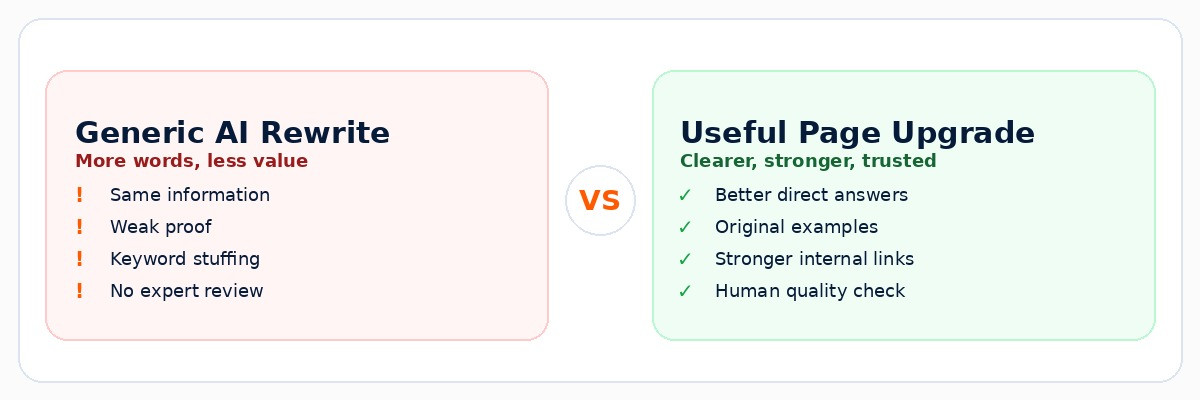
The best use of AI is not “rewrite this article.” The better prompt is: “Audit this page against search intent, user usefulness, competitor gaps, AI-search readability, and original value.” That keeps the workflow focused on improvement instead of generic output.
Simple definition
AI content optimization helps teams improve existing pages with better answers, structure, evidence, internal links, and AI-search readiness while keeping the final content human-led.
Why AI Content Optimization Matters After Quality Updates
After a core update, many teams rush to publish new content. A smarter first move is to inspect existing pages: which ones lost visibility, which ones gained impressions but low clicks, and which ones rank but do not fully satisfy search intent?
AI can help speed up that review. But it should not decide quality alone. Google’s core update guidance recommends reviewing top pages and queries after a full week and focusing on whether pages are genuinely helpful. That makes AI useful for diagnosis, while human judgment remains essential for final decisions.
1
Refresh value
Improve pages that already have search signals.
2
Avoid sameness
Do not turn updates into generic AI rewrites.
3
AI-search fit
Make pages easier to understand and cite.
Important note
AI content optimization works best when it upgrades a page’s usefulness. If it only adds more words, more keywords, or generic definitions, it can weaken the page instead of improving it.
A Practical AI Content Optimization Framework
Use this framework before refreshing any existing page. It keeps your optimization focused on quality, not just AI-generated expansion.
| Optimization Layer | What AI Can Help Find | Human Quality Check |
|---|---|---|
| Search intent | Missing questions, mismatched sections, weak answer depth. | Does the page solve the real user problem? |
| Original value | Generic sections, repeated competitor points, weak examples. | Can we add data, examples, workflows, or experience? |
| Structure | Unclear H2s, long blocks, missing FAQs, poor scanability. | Can a reader understand the answer quickly? |
| AI-search readiness | Missing direct answers, weak internal links, unclear proof. | Can the page support classic SEO and AI citations? |
Step-by-Step AI Content Optimization Workflow
Use this workflow when refreshing an existing blog, landing page, comparison page, or SEO resource.
Choose pages with existing search signals
Start with pages that already have impressions, rankings, backlinks, internal links, or business relevance. These are often better candidates than brand-new AI-generated pages.
Audit intent, structure, and gaps with AI
Use AI to identify unclear sections, missing questions, weak headings, outdated points, and internal link gaps. This connects naturally with AI search optimization.
Add non-commodity value before adding more words
Improve the page with examples, screenshots, original notes, stronger comparisons, workflows, or product-backed insights. Use this guide on non-commodity content for AI search as a quality benchmark.
Strengthen answer-first sections and internal links
Rewrite key sections so users get the answer quickly, then add depth. Connect related pages such as answer engine optimization and generative engine optimization where relevant.
Publish only after human review
Before updating the page, review accuracy, tone, examples, links, product claims, formatting, and whether the page is genuinely better than the previous version.
Common AI Content Optimization Mistakes
Mistake 1: Rewriting the whole page without a reason
A full rewrite can remove useful existing signals, examples, or wording that already works. Improve sections intentionally instead of replacing everything.
Mistake 2: Adding keywords without improving usefulness
AI can easily add related terms, but keyword expansion does not matter if the page still fails to answer the user’s real question.
Mistake 3: Removing the human voice
AI can make content smoother, but it can also make every page sound the same. Keep expert judgment, brand tone, and specific examples.
Mistake 4: Ignoring technical and internal link issues
A better paragraph cannot fix poor crawlability, weak internal linking, slow mobile experience, or unclear page architecture.
SEOSpyder AI Search Readiness Snapshot Use Case
The practical use case for SEOSpyder is to help teams decide how to improve existing pages before refreshing them. Instead of rewriting blindly, teams can review whether a page has answer clarity, original value, technical readiness, internal links, and AI-search fit.
A SEOSpyder AI Search Readiness Snapshot can help prioritize updates based on what matters most: better user answers, stronger topical coverage, clean structure, and a clear reason to cite or click the page.
| Snapshot Area | What It Checks | Why It Matters |
|---|---|---|
| Answer clarity | Does the page answer the main query early? | Improves user satisfaction and AI-search readability. |
| Original value | Does the updated page add something competitors miss? | Prevents generic AI content. |
| Internal links | Is the page connected to related AI SEO resources? | Improves topical context and navigation. |
| Technical readiness | Can the page be crawled, indexed, and understood? | Keeps the page eligible for Search and AI features. |
Upgrade existing pages without making them generic
Use SEOSpyder to review content quality, technical SEO, internal links, answer clarity, and AI-search readiness before your next content refresh.
For SEO managers, content leads, founders, and agencies building AI-ready organic growth.
Frequently Asked Questions
“`






No comment yet, add your voice below!