AI Search Optimization | How to Win Visibility in AI Overviews and AI Mode

AI Search Optimization

“`html

SEOSpyder Guide · AI SEO & AI Search

Quick Answer

AI search optimization means improving your pages so they can perform in classic Google Search and become easier to understand, summarize, and cite in AI-led experiences like AI Overviews and AI Mode. It is not a separate trick from SEO. It is a practical mix of useful content, clear page structure, crawlability, internal linking, evidence-backed answers, and non-commodity insights.

AI search optimization matters because search behavior is moving from simple keyword results to answer-led journeys. Users still use Google, but they now expect summaries, follow-up questions, deeper context, and direct explanations from AI-powered search experiences.

Before building an AI-search workflow, start with this practical guide on AI SEO optimization so your content, audit, and optimization process stays connected to real SEO fundamentals.

This became more important after Google’s March 2026 core update cycle, which reinforced broad quality evaluation. Google’s May 2026 AI-search guidance also reaffirmed that SEO best practices still matter because AI Overviews and AI Mode are rooted in Google’s core Search ranking and quality systems.

This guide explains what AI search optimization means, what Google actually says, where teams go wrong with commodity content, and how to create pages that can rank in classic SERPs while becoming more useful for AI search visibility.


What Is AI Search Optimization?

AI search optimization is the process of improving a website so AI-powered search features can better understand, retrieve, summarize, and cite its content. It includes classic SEO work such as crawlability, technical structure, internal links, useful headings, helpful content, and trustworthy information.

It also includes content-level improvements that make answers easier to extract: direct definitions, clear claim-to-evidence structure, concise explanations, original examples, FAQs, and expert-led insights. This is why AI search optimization, answer engine optimization, and SEO with AI all overlap.

Simple definition

AI search optimization means making your content useful, crawlable, structured, and trustworthy enough to support both traditional rankings and AI-generated search answers.

1

Crawlable

Make pages discoverable and technically clean.

2

Useful

Answer real user needs with original value.

3

Citable

Use clear answers, proof, and structured sections.


Why AI Search Optimization Matters After the 2026 Search Updates

Google’s March 2026 core update started on March 27, 2026, and finished on April 8, 2026, according to the Google Search Status Dashboard. Core updates do not reward one tactic. They reassess broad quality signals such as usefulness, relevance, trust, and content value.

Google’s official AI-search guidance says SEO best practices continue to matter for generative AI features because AI Overviews and AI Mode are rooted in Google’s core Search ranking and quality systems. That means strong SEO still supports AI visibility.

13

Days of rollout

Google’s March 2026 core update ran from March 27 to April 8.

May

AI-search guidance

Google reaffirmed that SEO remains relevant for AI Overviews and AI Mode.

0

AI-only tricks

The safest approach is better SEO, not shortcuts.

Important note

AI search optimization does not mean writing only for AI systems. The page still needs to satisfy real users first. If users find the page useful, clear, and trustworthy, it has a stronger foundation for both SEO and AI-led search.

Check if your page is ready for AI search

Use SEOSpyder to review content quality, technical SEO, internal links, and AI-search readiness before your next publishing cycle.

Try SEOSpyder AI Search Readiness Snapshot →


AI Search Optimization Myths vs What Google Actually Says

Many teams are confused because AI search has created new terms like AEO, GEO, and AI SEO. These terms can be useful internally, but Google’s message is simple: optimizing for generative AI search is still part of SEO.

Myth Reality
You need a separate AI-only SEO strategy. AI search optimization should strengthen your existing SEO foundation.
You must create many pages for every query variation. High-quality, comprehensive pages are safer than scaled thin content.
Structured data guarantees AI Overview visibility. Schema helps SEO, but there is no special schema that guarantees generative AI visibility.
AI-generated content is automatically risky. AI-assisted content can work if it is helpful, accurate, reviewed, original, and people-first.

A Practical Workflow to Win Visibility in AI Overviews and AI Mode

The best workflow starts with strong SEO pages, then improves them for clarity, completeness, and AI-search readiness. Use AI SEO tools to speed up analysis, but keep expert review in the final process.

1

Start with search intent, not AI terms

Decide what the user wants: a definition, comparison, workflow, checklist, decision guide, or troubleshooting answer. AI search visibility begins with solving the real query better than competing pages.

2

Audit the page before rewriting

Check crawlability, headings, metadata, internal links, technical issues, topical coverage, and current rankings. If you need a workflow, use this guide on AI SEO agents to structure audit tasks more clearly.

3

Add non-commodity value

Do not just restate competitor summaries. Add first-hand examples, expert notes, data, screenshots, workflows, product insights, or decision frameworks. For a deeper method, use this guide on non-commodity content for AI search.

4

Use answer-first formatting

Start important sections with direct answers. Then support the answer with context, proof, examples, and next steps. This helps both readers and AI systems understand the claim quickly.

5

Strengthen technical and internal signals

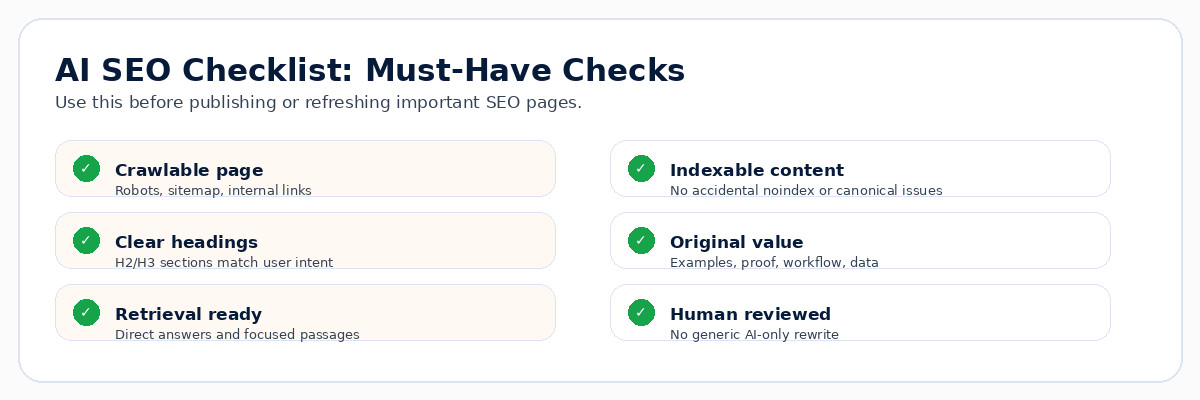
Keep the page crawlable, mobile-friendly, fast, internally linked, and eligible for snippets. AI search cannot reliably surface a page that search systems cannot properly discover or process.

6

Review before publishing

AI can help identify gaps, but humans should approve accuracy, business relevance, examples, tone, and whether the page is genuinely useful before publishing.


Common AI Search Optimization Mistakes

Mistake 1: Creating pages only for AI Overviews

Do not create thin pages for every possible AI query. Build helpful pages for real users, then structure them clearly for search systems.

Mistake 2: Rewriting competitor content

Pages that only summarize what competitors already say are easy to ignore. Add original insight, examples, data, or a stronger workflow.

Mistake 3: Ignoring technical SEO

If pages are not crawlable, indexed, fast, mobile-friendly, or internally linked, AI search optimization becomes much weaker.

Mistake 4: Treating schema as a shortcut

Schema is useful for SEO, but it does not replace helpful content, clear answers, and strong page structure.


SEOSpyder AI Search Readiness Snapshot Use Case

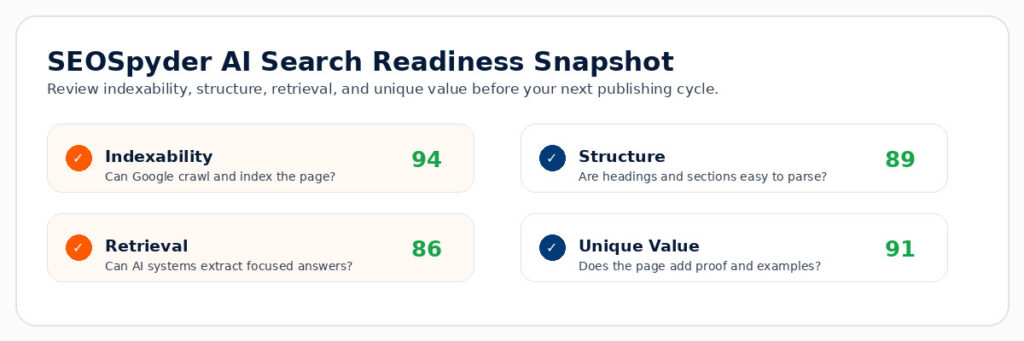
The practical use case for SEOSpyder is to help teams audit whether a page is ready for both classic SEO and AI search visibility. Instead of guessing, teams can review page structure, internal links, technical SEO, and content quality before publishing or refreshing a page.

A SEOSpyder AI Search Readiness Snapshot can help identify whether a page has a direct answer, strong topical coverage, useful internal links, schema opportunities, clear headings, and enough original value to avoid commodity content.

Snapshot Area What to Check Why It Matters
Direct answer Does the page answer the main query early? Supports snippets, AI summaries, and reader clarity.
Original value Does the page add insight beyond generic AI output? Reduces commodity content risk.
Internal links Is the page connected to related SEO resources? Improves topical context and user navigation.
Technical readiness Are crawlability, metadata, mobile layout, and schema clean? Keeps the page eligible and easier to process.

Best practical approach

Use SEOSpyder before publishing new AI-assisted content, after major Google updates, and when refreshing pages that need stronger AI-search readiness.

Improve visibility in Google Search and AI search

Use SEOSpyder to audit content quality, technical SEO, internal links, and AI-search readiness before your next publishing cycle.

For SEO managers, content leads, founders, and agencies building AI-ready organic growth.

Frequently Asked Questions

What is AI search optimization? +

AI search optimization is the process of improving content, technical SEO, structure, internal links, and answer clarity so pages can perform in classic search and AI-led search experiences like AI Overviews and AI Mode.

Is AI search optimization different from SEO? +

It is not separate from SEO. Google says generative AI search still relies on core Search ranking and quality systems, so foundational SEO remains important.

How do I optimize for AI Overviews and AI Mode? +

Create helpful, crawlable, well-structured pages with direct answers, original value, internal links, schema where useful, and clear evidence for important claims.

Do I need special schema for AI search optimization? +

No special schema guarantees AI search visibility. Structured data can still support overall SEO and rich result eligibility, but it does not replace useful content and technical readiness.

Can AI SEO tools help with AI search optimization? +

Yes. AI SEO tools can help identify content gaps, internal link opportunities, technical issues, missing FAQs, weak headings, and unclear answers. Human review is still needed before publishing.

How can SEOSpyder help with AI search optimization? +

SEOSpyder can help teams review content quality, technical SEO, internal links, topical coverage, and AI-search readiness before publishing or refreshing SEO pages.


Continue reading

AI SEO Optimization 2026 | A Practical Framework for Faster Wins

ai seo optimization
SEOSpyder Guide · SEO Automation & Audits

Quick Answer

AI SEO optimization means using AI to improve SEO audits, search intent mapping, content structure, internal linking, technical checks, and AI search readiness without replacing expert judgment. The goal is not to publish more generic AI-written pages. The goal is to use AI SEO tools and structured workflows to create useful pages that can perform in classic Google Search while also becoming easier to understand, summarize, and cite in AI Overviews and AI Mode.

AI SEO optimization has become important because SEO teams are under pressure to move faster while maintaining quality. AI can help with audits, briefs, keyword grouping, content reviews, and technical checks, but faster output does not automatically mean better rankings.

For a strong foundation, start with this guide on AI SEO in 2026 before building your optimization workflow.

This matters more after Google’s March 2026 core update cycle, which reinforced broad quality evaluation across search results. Google’s May 2026 AI-search guidance also reaffirmed that SEO fundamentals still support visibility in generative search features like AI Overviews and AI Mode.

This guide explains what AI SEO optimization means, what it is not, how teams can use it without creating commodity content, and how SEOSpyder’s AI Search Readiness Snapshot can help you prioritize faster wins.


What Is AI SEO Optimization?

AI SEO optimization is the process of using artificial intelligence to improve SEO decisions and execution. It can help SEO teams analyze keywords, review search intent, detect content gaps, improve headings, check internal links, identify technical issues, and prepare pages for AI search optimization.

But AI SEO optimization is not the same as asking a chatbot to write a full blog and publishing it as-is. That approach often creates commodity content: pages that repeat the same definitions, lists, and generic advice already available across search results.

Simple definition

AI SEO optimization means using AI to make SEO audits, content improvements, and search readiness checks faster, more structured, and more consistent.

1

Audit

Find SEO gaps across content, structure, and technical setup.

2

Prioritize

Separate fast wins from low-impact changes.

3

Improve

Update answers, links, schema, headings, and quality signals.


Why AI SEO Optimization Matters After the 2026 Search Updates

Google’s March 2026 core update started on March 27, 2026, and finished on April 8, 2026, according to the Google Search Status Dashboard. Core updates do not reward one small trick. They reassess broad quality signals across content, relevance, usefulness, and trust.

Google’s guidance for generative AI features also makes the direction clear: SEO best practices still matter because AI Overviews and AI Mode rely on Google’s Search systems. That means AI SEO optimization should improve page quality, not bypass SEO fundamentals.

13

Days of rollout

Google’s March 2026 core update ran from March 27 to April 8.

May

AI search guidance

Google reaffirmed that SEO remains relevant for AI search experiences.

0

AI-only shortcuts

The safer path is better content, crawlability, structure, and usefulness.

Important note

AI SEO optimization should not be used to mass-produce thin pages. It should help teams improve page quality, reduce manual audit time, and make content easier to understand for readers and search systems.

Find faster SEO wins before publishing

Use SEOSpyder to review content quality, technical SEO, internal links, and AI-search readiness before your next update cycle.

Try SEOSpyder AI Search Readiness Snapshot →


AI SEO Optimization vs Generic AI Content Generation

The biggest mistake teams make is thinking AI SEO optimization means “generate more content.” The better approach is to use AI to improve the quality and performance potential of pages that already have a clear purpose.

Factor Generic AI Content AI SEO Optimization
Goal Produce more text quickly. Improve pages for search intent, quality, and discoverability.
Output Generic summaries and repeated advice. Clear answers, stronger structure, and better SEO readiness.
Risk Thin or commodity content. Lower risk when reviewed by experts.
Best use Drafting ideas and outlines. Audits, content refreshes, internal links, and AI-search readiness.

A Practical AI SEO Optimization Framework for Faster Wins

The best AI SEO optimization workflow starts with pages that already matter: pages with impressions, rankings, internal link potential, outdated content, or conversion value. Then use AI to audit, prioritize, and improve them with human review.

1

Start with page selection

Choose pages that already have SEO potential: ranking pages stuck on page two, blogs losing traffic, pages with weak CTR, or commercial pages missing supporting content. This keeps optimization focused on faster wins.

2

Run a content and technical audit

Review metadata, headings, crawlability, content depth, schema, page speed, internal links, and topical coverage. For site authority checks, pair this with a domain authority and page authority checker.

3

Improve search intent coverage

Use AI SEO tools to identify missing questions, weak definitions, thin examples, and unsupported claims. Then add useful sections that actually help the reader instead of filling the page with generic paragraphs.

4

Strengthen AI-search readiness

Add direct answers, clear H2s, comparison tables, FAQs, schema, and concise explanations. This supports answer engine optimization and makes the page easier for AI systems to understand and summarize.

5

Add internal links with context

Connect the page to related resources such as your guide on non-commodity content for AI search and your guide on how to use SEO analysis tools.

6

Review before publishing

AI can suggest improvements, but SEO managers should still review accuracy, brand voice, examples, prioritization, and whether the updated page gives readers something genuinely useful.


Common AI SEO Optimization Mistakes

Mistake 1: Optimizing every page equally

Not every page deserves the same effort. Start with pages that already have rankings, impressions, commercial value, or clear refresh potential.

Mistake 2: Using AI only to rewrite content

Rewriting weak content does not fix weak strategy. Use AI to diagnose intent gaps, structure problems, missing links, and unsupported claims.

Mistake 3: Treating AI search optimization as a hack

AI search visibility still depends on useful, crawlable, well-structured pages. Do not ignore classic SEO while chasing AI Overviews or AI Mode.

Mistake 4: Publishing without expert review

AI can speed up optimization, but humans should still verify facts, tone, examples, business relevance, and whether the page feels trustworthy.


SEOSpyder AI Search Readiness Snapshot Use Case

The practical use case for SEOSpyder is to turn AI SEO optimization into a structured review process. Instead of guessing what to update, teams can review pages across content quality, technical SEO, internal linking, and AI-search readiness.

A SEOSpyder AI Search Readiness Snapshot can help identify whether a page has a direct answer, clear search intent match, useful internal links, schema opportunities, original value, and enough structure to support answer engine optimization.

Snapshot Area What to Check Why It Matters
Intent match Does the page solve the real search need? Improves relevance and user satisfaction.
Content quality Does the content add value beyond generic AI output? Reduces commodity content risk.
AI-search readiness Are answers, headings, FAQs, and schema clear? Helps AI systems understand and summarize the page.
Technical readiness Are metadata, crawlability, speed, and mobile layout clean? Keeps the page eligible and easier to process.

Best practical approach

Use SEOSpyder before publishing new AI-assisted content, after major Google updates, and when refreshing pages that are close to ranking but not improving.


Pre-Publish Checklist for AI SEO Optimization

Before publishing, check:

✓ Did you choose a page with real SEO upside?

✓ Does the page answer the main query early?

✓ Are technical SEO issues fixed or clearly prioritized?

✓ Does the content add insight beyond generic AI summaries?

✓ Are internal links useful and contextually placed?

✓ Are FAQs and schema aligned with visible page content?

✓ Has a human reviewed accuracy, examples, and brand voice?

Use AI SEO optimization to find faster wins

Use SEOSpyder to audit content quality, technical SEO, internal links, and AI-search readiness before your next content refresh or publishing cycle.

For SEO managers, content leads, founders, and agencies building AI-ready organic growth.

Frequently Asked Questions

What is AI SEO optimization? +

AI SEO optimization is the use of artificial intelligence to improve SEO audits, content structure, search intent coverage, internal links, technical checks, and AI-search readiness.

Is AI SEO optimization the same as AI content generation? +

No. AI content generation focuses on producing text. AI SEO optimization focuses on improving pages for search intent, technical SEO, internal linking, content quality, and AI search visibility.

Can AI SEO tools improve rankings? +

AI SEO tools can help identify issues and opportunities, but rankings still depend on content quality, technical SEO, relevance, authority, user value, and competition.

How does AI SEO optimization support AI Overviews and AI Mode? +

It helps by improving answer clarity, page structure, crawlability, internal links, schema opportunities, and content usefulness. Google says SEO fundamentals still apply to generative AI features in Search.

What pages should I optimize first with AI SEO? +

Start with pages that already have impressions, rankings, traffic drops, weak CTR, outdated content, or strong business value. These pages usually offer faster wins than starting from zero.

How can SEOSpyder help with AI SEO optimization? +

SEOSpyder can help teams review content quality, technical SEO, internal links, topical coverage, and AI-search readiness before publishing or refreshing important SEO pages.


What an AI SEO Agent 2026 | Does Better Than a Generic AI Chatbot

Ai Seo Agent
SEOSpyder Guide · SEO Automation & Audits

Quick Answer

An AI SEO agent is a task-focused SEO system that can audit pages, check technical issues, analyze search intent, review content quality, suggest internal links, and guide optimization workflows. A generic AI chatbot can answer questions, but an AI SEO agent is built to act inside SEO processes. It is more useful for teams that need repeatable audits, content improvement, AI search optimization, and answer engine optimization at scale.

SEO teams are using AI more than ever, but there is a big difference between asking a chatbot for SEO advice and using an AI SEO agent to complete a specific audit or optimization workflow. A chatbot can give ideas. An AI SEO agent should help diagnose, prioritize, and improve pages based on SEO signals.

This matters more in 2026 because Google’s March 2026 core update reinforced broad quality evaluation, while Google’s May 2026 AI-search guidance confirmed that SEO still underpins visibility in generative search experiences like AI Overviews and AI Mode.

For a wider foundation on AI-led SEO workflows, read this practical guide on AI SEO in 2026 before building your agent-based optimization process.

In this guide, we’ll explain what an AI SEO agent does, how it differs from a generic AI chatbot, where teams go wrong, and how to use SEOSpyder’s AI Search Readiness Snapshot to create pages that perform in classic search and AI-led results.


What Is an AI SEO Agent?

An AI SEO agent is an AI-powered system designed to perform or assist with specific SEO tasks. Instead of only responding to prompts, it works around a defined workflow such as auditing a page, checking metadata, reviewing keyword intent, suggesting internal links, identifying technical issues, or improving content for AI search optimization.

A generic chatbot can explain SEO concepts, but it usually does not know your page structure, crawl issues, internal link gaps, topical depth, or publishing priorities unless you manually provide that context. An AI SEO agent is more useful because it is built around SEO actions, not just conversation.

Simple definition

An AI SEO agent is a specialized AI system that helps complete SEO tasks such as audits, optimization checks, content reviews, and AI-search readiness analysis.

1

Audit

Find technical, content, and on-page SEO gaps.

2

Prioritize

Separate urgent fixes from low-impact suggestions.

3

Optimize

Improve structure, internal links, schema, and clarity.


Why AI SEO Agents Matter After the 2026 Search Updates

The March 2026 core update ran from March 27 to April 8, 2026, according to the Google Search Status Dashboard. Broad updates like this are not about one ranking trick. They reassess overall quality, relevance, usefulness, and trust across search results.

Google’s May 2026 guidance for generative AI features also says SEO best practices continue to matter because AI Overviews and AI Mode are rooted in Google’s core Search ranking and quality systems. This makes structured audits, content quality checks, and AI-search readiness more important.

13

Days of rollout

Google’s March 2026 core update ran from March 27 to April 8.

May

AI search guidance

Google reaffirmed that SEO remains relevant for AI search experiences.

1

Core goal

Create pages useful enough to rank, summarize, and cite.

Important note

An AI SEO agent does not replace SEO judgment. It improves consistency, speed, and coverage, but humans still need to approve strategy, accuracy, brand voice, and final publishing decisions.

Turn AI SEO checks into a repeatable workflow

Use SEOSpyder to review content quality, technical SEO, internal links, and AI-search readiness before your next publishing cycle.

Try SEOSpyder AI Search Readiness Snapshot →


AI SEO Agent vs Generic AI Chatbot

The main difference is workflow depth. A chatbot is useful for brainstorming and explanations. An AI SEO agent is better when you need structured audits, repeatable checks, and page-level optimization support.

Factor Generic AI Chatbot AI SEO Agent
Main role Answers prompts and explains ideas. Runs SEO-specific checks and workflows.
SEO context Depends on what the user provides manually. Works around audits, page checks, and optimization criteria.
Best use Brainstorming, outlines, explanations, drafts. Audits, prioritization, AI search readiness, internal links.
Risk Can produce generic advice without verification. Still needs human review, but gives more workflow control.

How to Use an AI SEO Agent in a Practical SEO Workflow

The best way to use an AI SEO agent is not to ask it for random suggestions. Use it inside a structured workflow where each step has a clear purpose and review point.

1

Start with a page-level audit

Use the agent to review metadata, headings, crawlability, indexability, keyword focus, content depth, and technical issues. Pair this with a broader check using tools such as a domain authority and page authority checker when evaluating site-level strength.

2

Check content for commodity risk

The agent should flag pages that repeat common definitions, lack original insight, miss examples, or do not clearly answer the user’s search need. Use this alongside your guide to non-commodity content for AI search.

3

Improve structure for AI search optimization

Ask the agent to check whether the page has a direct answer, clear section hierarchy, comparison tables, FAQs, schema opportunities, and concise explanations that AI systems can understand and summarize.

4

Find internal linking opportunities

Use the agent to suggest links to related pages, supporting guides, and conversion pages. If you are new to audit workflows, start with this guide on how to use SEO analysis tools.

5

Review and approve before publishing

AI SEO agents can speed up decisions, but SEO managers should still approve accuracy, prioritization, tone, claims, and final changes before publishing.


Common Mistakes When Using AI SEO Agents

Mistake 1: Treating the agent like a magic ranking tool

An AI SEO agent can identify opportunities, but it cannot guarantee rankings. It still needs strong content, technical SEO, authority, and user value.

Mistake 2: Publishing suggestions without review

Agent outputs should be reviewed by someone who understands the business, the audience, and the search intent. Do not publish recommendations blindly.

Mistake 3: Using agents only for content generation

The best use is not only writing. AI SEO agents are stronger when used for audits, gap analysis, content quality checks, internal linking, and AI-search readiness reviews.

Mistake 4: Ignoring the full SEO system

AI search optimization still depends on technical SEO, content quality, internal links, authority, and clear user value. A single agent cannot fix a weak SEO foundation alone.


SEOSpyder AI Search Readiness Snapshot Use Case

The practical use case for SEOSpyder is to help teams turn AI SEO into a structured audit process. Instead of asking a generic chatbot what to improve, teams can review page readiness across content quality, technical SEO, internal links, and AI-search visibility signals.

A SEOSpyder AI Search Readiness Snapshot can help identify whether a page has a direct answer, original value, strong structure, crawlable setup, useful internal links, and enough clarity to support answer engine optimization.

Snapshot Area What to Check Why It Matters
Content quality Does the page add value beyond generic AI output? Reduces commodity content risk.
AI search readiness Does the page have clear answers, structure, and context? Helps AI systems understand and summarize the page.
Internal links Is the page connected to related SEO resources? Improves navigation, relevance, and topical context.
Technical SEO Are metadata, schema, crawlability, and mobile layout clean? Keeps the page eligible and easier to process.

Best practical approach

Use SEOSpyder before publishing new AI-assisted content, after major Google updates, and when refreshing pages that stopped gaining visibility.


Pre-Publish Checklist for AI SEO Agent Workflows

Before publishing, check:

✓ Did the agent identify technical and content issues clearly?

✓ Are the recommendations prioritized by business and SEO impact?

✓ Does the page answer the main query early?

✓ Does the content avoid generic AI summaries?

✓ Are internal links useful and contextually placed?

✓ Is schema aligned with visible content?

✓ Has a human reviewed the final changes?

Use AI for SEO audits, not just SEO prompts

Use SEOSpyder to audit content quality, technical SEO, internal links, and AI-search readiness before your next publishing cycle.

For SEO managers, content leads, founders, and agencies building AI-ready organic growth.

Frequently Asked Questions

What is an AI SEO agent? +

An AI SEO agent is a specialized AI system that helps complete SEO tasks such as audits, content reviews, technical checks, internal link suggestions, and AI-search readiness analysis.

How is an AI SEO agent different from a chatbot? +

A chatbot mainly responds to prompts. An AI SEO agent is designed around SEO workflows, such as auditing pages, checking content quality, identifying internal link opportunities, and prioritizing optimization tasks.

Can AI SEO agents replace SEO managers? +

No. AI SEO agents can speed up audits and recommendations, but SEO managers still need to approve strategy, accuracy, prioritization, business relevance, and final publishing decisions.

Do AI SEO agents help with AI search optimization? +

Yes. They can help review whether a page has clear answers, useful structure, internal links, schema opportunities, and content quality signals that support visibility in AI Overviews and AI Mode.

What should an AI SEO agent check first? +

It should start with page-level fundamentals: indexability, metadata, headings, content quality, search intent match, internal links, schema opportunities, and technical issues.

How can SEOSpyder help with AI SEO agents? +

SEOSpyder can help teams turn AI SEO into a structured audit workflow by reviewing content quality, technical SEO, internal links, topical coverage, and AI-search readiness before publishing or refreshing SEO pages.


How to Create Non-Commodity Content That Performs in Search and AI Results 2026

Non Commodity Content: Create Pages That Rank in AI Search
SEOSpyder Guide · AI SEO & AI Search

Quick Answer

Non commodity content is content that gives readers something they cannot get from a generic AI summary or copied competitor structure. It includes original insight, clear answers, expert review, useful examples, strong structure, and proof. In 2026, this matters because AI SEO, AI SEO agents, AI search optimization, and answer engine optimization all depend on the same core idea: pages must be genuinely useful, easy to understand, and strong enough to perform in both classic Google results and AI-led search experiences.

Most SEO teams are not struggling because they cannot publish enough content. They are struggling because too many pages now look the same. AI tools can generate definitions, lists, outlines, FAQs, and summaries quickly, but speed alone does not create search value.

Google’s March 2026 core update ran from March 27 to April 8, 2026, according to the Google Search Status Dashboard. Core updates are broad quality reassessments, not single-factor changes. Then Google’s May 2026 AI-search guidance reaffirmed that SEO still matters for AI Overviews and AI Mode because these features are rooted in Google’s core Search ranking and quality systems.

That is why non commodity content is becoming a practical SEO requirement. If a page only repeats what other websites already say, it becomes easy to ignore. If it adds useful insight, clear structure, evidence, and expert judgment, it becomes easier for users, search engines, and AI systems to trust.


What Is Non Commodity Content?

Non commodity content is content that has a clear reason to exist beyond covering a keyword. It does not simply summarize competitor pages, rewrite common definitions, or fill a template with generic AI output. It gives the reader useful information, original thinking, and a better way to understand or solve the problem.
Related- How to rank your blog in Italy

For SEO practitioners, this means the page should answer the query quickly, explain the topic with clarity, add a practical workflow, include evidence where needed, and show a point of view that reflects real experience. This is where AI SEO tools are useful: they can support research and structure, but the final value must come from expert judgment.

Simple definition

Non commodity content gives readers original value, not just information they could already get from ten similar pages or a basic AI summary.

1

Intent

Start with the reader’s real search need.

2

Insight

Add examples, data, opinions, or workflows.

3

Structure

Make the page easy to scan and cite.


Why Non Commodity Content Matters After the 2026 Search Updates

The March 2026 core update reinforced a familiar truth: Google does not reward content only because it targets a keyword. Broad core updates reassess whether pages are useful, trustworthy, and relevant compared with what else is available on the web.

Google’s May 2026 guidance for generative AI features also makes one point clear: AI Overviews and AI Mode still depend on Google’s Search index, ranking systems, and quality systems. That means AI search optimization is not a separate hack. It is SEO with better structure, stronger answers, and clearer evidence.

13

Days of rollout

Google’s March 2026 core update ran from March 27 to April 8.

May

AI search guidance

Google reaffirmed that SEO remains relevant for AI search experiences.

1

Core goal

Create pages that are useful enough to deserve visibility.

Important note

Using an AI SEO agent or AI writing tool does not automatically make content weak. The risk comes when teams publish AI output without insight, evidence, expert review, or differentiation.

Check if your page looks too generic

Use SEOSpyder to review content quality, search intent coverage, internal links, technical SEO, and AI-search readiness before publishing.

Try SEOSpyder AI Search Readiness Snapshot →


Commodity Content vs Non Commodity Content

The difference is not whether AI was used. The difference is whether the final page gives the reader a stronger answer than what already exists.

Factor Commodity Content Non Commodity Content
Main value Repeats common information. Adds insight, experience, examples, or data.
Structure Generic headings copied from SERP patterns. Clear answer-first structure built around user needs.
AI search fit Hard to distinguish from other pages. Easier to summarize, cite, and trust.
SEO outcome May rank briefly but is easy to replace. Builds stronger long-term search visibility.

How to Create Non Commodity Content That Performs in Search and AI Results

The best workflow combines AI-supported research with human judgment. Use AI to speed up analysis, but use expertise to decide what is worth publishing.

1

Start with the search need, not the keyword alone

A keyword tells you what people type. Search intent tells you what they need. Before writing, define whether the user wants a definition, checklist, tool comparison, workflow, diagnosis, or decision support.

2

Find what competitors are missing

Review top-ranking pages, AI SEO tools roundups, and AI search optimization guides. Do not copy their structure blindly. Look for weak definitions, missing examples, thin comparisons, outdated advice, or unclear workflows.

3

Add a source of originality

Originality can come from product data, expert commentary, a workflow, a template, a benchmark, a real example, or a clear decision framework. For authority signals, also review technical and trust factors like domain health using tools such as a domain authority and page authority checker.

4

Structure the page for classic SEO and AI search

Use a direct answer, descriptive H2s, short explanation blocks, comparison tables, FAQs, and schema. This supports AI search optimization and answer engine optimization without relying on AI-only tricks.

5

Review for commodity risk before publishing

Ask one simple question: if this page disappeared, would the search result lose anything useful? If the answer is no, the content needs more originality, clarity, or proof.


Common Mistakes That Turn AI SEO Content Into Commodity Content

Mistake 1: Publishing AI drafts without a point of view

AI can create a clean draft, but clean does not mean valuable. Add experience, examples, and a clear editorial decision.

Mistake 2: Confusing length with depth

A long page can still be thin if it repeats obvious points. Depth comes from better explanations, sharper examples, and useful decisions.

Mistake 3: Treating AEO as only FAQ writing

FAQs help, but answer engine optimization starts with the whole page. The main sections should already answer important user questions clearly.

Mistake 4: Skipping technical and internal link review

Even strong content can underperform if it is not crawlable, internally linked, mobile-friendly, or clearly connected to related pages such as your AI SEO guide.


SEOSpyder AI Search Readiness Snapshot Use Case

The practical use case for SEOSpyder is to review whether a page is ready for both classic SEO and AI-led discovery before it goes live. This is especially useful for content teams using AI SEO tools or AI agents to speed up production.

A SEOSpyder AI Search Readiness Snapshot can check whether the page has a direct answer, unique value, complete topical coverage, clear headings, internal links, technical SEO basics, and FAQ/schema opportunities.

Snapshot Area What to Check Why It Matters
Direct answer Does the page answer the main query early? Supports snippets, AI summaries, and user clarity.
Original value Does the page add examples, data, workflow, or expert insight? Reduces commodity content risk.
Internal linking Is the page connected to related SEO resources? Helps users and search engines understand page relationships.
Technical readiness Are metadata, schema, crawlability, and mobile layout clean? Keeps the page eligible and easy to process.

Best practical approach

Use SEOSpyder before publishing new AI-assisted content and when refreshing pages that lost rankings after a major search update.


Pre-Publish Checklist for Non Commodity Content

Before publishing, check:

✓ Does the page answer the main query in the first section?

✓ Does it add something competitors do not clearly provide?

✓ Is there an example, framework, data point, workflow, or expert view?

✓ Are claims easy to verify and not overstated?

✓ Are headings written for readers, not just keywords?

✓ Are internal links useful and contextually placed?

✓ Has a human reviewed accuracy, usefulness, and brand voice?

Create content that stands out in Google and AI search

Use SEOSpyder to audit content quality, technical SEO, internal links, and AI-search readiness before your next publishing cycle.

For SEO managers, content leads, founders, and agencies building AI-ready organic growth.

Frequently Asked Questions

What is non commodity content? +

Non commodity content is content that adds original value beyond generic summaries. It usually includes expert insight, examples, data, practical workflows, clear answers, and a reason for readers to trust the page.

Why does non commodity content matter for AI SEO? +

It matters because AI SEO is not just about producing more pages. AI search systems need clear, trustworthy, useful content to surface and summarize. Generic content is harder to distinguish and easier to replace.

Can AI tools create non commodity content? +

AI tools can help with research, outlines, keyword grouping, and optimization. But the final content becomes non commodity only when humans add judgment, original insight, examples, verification, and brand-specific value.

How do I make content perform in AI Overviews and AI Mode? +

Create crawlable, helpful, well-structured content with direct answers, strong headings, internal links, reliable evidence, and original value. Google says SEO fundamentals still apply to generative AI features in Search.

What is the biggest mistake in AI-assisted content? +

The biggest mistake is publishing AI-generated drafts without adding a real point of view, examples, accuracy checks, or expert review. This often creates pages that look polished but feel replaceable.

How can SEOSpyder help create better content? +

SEOSpyder can help teams review content structure, technical SEO, internal links, topical coverage, and AI-search readiness before publishing or refreshing SEO pages.


What AI SEO Means in 2026 | How to Use It Without Creating Commodity Content

SEOSpyder Guide · AI SEO & AI Search

Quick Answer

AI SEO means using artificial intelligence to improve keyword research, search intent mapping, content structure, technical SEO checks, internal linking, and AI search optimization without removing expert judgment. In 2026, the goal is not to publish more AI-written pages. The goal is to create original, useful, well-structured content that can rank in classic Google results and become easier to understand, summarize, and cite in AI Overviews and AI Mode.

AI SEO has become one of the most searched topics among SEO managers, content leads, founders, and agencies because search is changing from simple blue-link rankings to answer-led experiences. Users still search on Google, but they also expect summarized answers, deeper follow-up paths, and direct explanations from AI-powered search systems.
Related- How to use seo analysis tools

That does not mean traditional SEO is dead. Google’s official guidance for AI features says SEO best practices remain relevant because AI Overviews and AI Mode are rooted in Google’s core Search ranking and quality systems. The March 2026 core update cycle also reminded SEO teams that quality evaluation is broad, sitewide, and not limited to one page element.

This guide explains what AI SEO means in 2026, where teams go wrong with commodity content, and how to build a practical workflow that supports Google rankings, answer engine optimization, and AI search visibility.


What Is AI SEO?

AI SEO is the use of AI systems to make SEO research, planning, optimization, and review faster and more accurate. It can help with clustering keywords, finding search intent gaps, improving page structure, checking headings, creating schema drafts, summarizing SERP patterns, and identifying internal linking opportunities.

But AI SEO is not the same as publishing hundreds of AI-generated articles. That approach often creates commodity content: pages that repeat what already exists, add no original insight, and fail to show why the brand deserves to be trusted.

Simple definition

AI SEO means using AI to support better SEO decisions while keeping the final content original, useful, expert-reviewed, and aligned with real search intent.

1

Research

Use AI to group keywords, questions, entities, and user needs.

2

Structure

Build pages with direct answers, clear headings, and helpful sections.

3

Review

Check originality, accuracy, internal links, schema, and quality signals.


Why AI SEO Matters After the 2026 Google Updates

Google’s March 2026 core update started on March 27, 2026, and finished on April 8, 2026, according to the Google Search Status Dashboard. Core updates do not reward one trick. They reassess broad quality signals across content, relevance, usefulness, and trust.

Then, in May 2026, Google published official guidance for generative AI features in Search. The key point for SEO teams is clear: SEO still matters because AI Overviews and AI Mode use Google’s Search index and ranking systems to surface helpful content.

13

Days of rollout

March 2026 core update ran from March 27 to April 8, 2026.

May

AI search guidance

Google reaffirmed that SEO fundamentals apply to AI search features.

0

AI-only hacks

Google says there are no special AI-only technical requirements beyond Search eligibility.

Important note

AI search optimization is not about tricking AI systems. It is about making your page easier to understand, verify, summarize, and trust.

Check if your page is ready for AI search

Use SEOSpyder to review content structure, search intent coverage, technical SEO, internal links, and AI-search readiness before publishing.

Try SEOSpyder AI Search Readiness Snapshot →


AI SEO vs AI Search Optimization vs Answer Engine Optimization

These terms are connected, but they are not exactly the same. A strong 2026 strategy should cover all three because users discover answers through classic rankings, AI summaries, and answer-led search journeys.
Related- DA PA Checker

Term What It Means Main Goal
AI SEO Using AI to improve SEO research, content planning, technical checks, and optimization. Rank better while improving quality and efficiency.
AI search optimization Structuring pages so AI search systems can understand entities, claims, answers, and context. Improve visibility in AI Overviews, AI Mode, and AI-led discovery.
Answer engine optimization Creating concise, accurate answers for question-based and conversational queries. Win snippets, FAQ visibility, and answer-led search moments.

How to Use AI SEO Without Creating Commodity Content

The best SEO with AI workflow starts with strategy, not generation. AI should help your team find gaps, speed up research, and improve structure. It should not replace original insight, subject-matter review, or real examples.

1

Start with one search intent

Decide whether the page should define a topic, compare tools, solve a problem, explain a workflow, or help the reader make a decision. For this blog, the primary intent is clear: explain what AI SEO means and how to use it correctly in 2026.

2

Map questions before writing

Use AI SEO tools to collect related questions, People Also Ask patterns, entity gaps, and follow-up topics. Then group them into sections so the page answers the topic fully without becoming bloated.

3

Add original insight

Add your own audits, product data, examples, screenshots, expert notes, templates, or frameworks. For international pages, show how search intent changes by market, like ranking a blog in Spain, Brazil, or Italy.

4

Structure for readers and AI systems

Use answer-first sections, descriptive H2s, clean comparison tables, short definitions, FAQs, and schema. This helps users scan the page and helps search systems understand the relationship between claims, evidence, and answers.

5

Run a quality review before publishing

Check whether the page has a clear answer, real value, factual accuracy, useful internal links, author or brand expertise, and a reason to exist beyond summarizing competitor pages.

6

Refresh after ranking signals change

AI search behavior, SERP layouts, and competitor coverage change quickly. Review important pages after core updates, traffic drops, or major product changes so content stays useful and current.


Common AI SEO Mistakes That Create Commodity Content

Mistake 1: Starting with AI output instead of user intent

If the page starts from a generic prompt, it usually becomes a generic article. Start with the query, audience, problem, and search result gap.

Mistake 2: Repeating competitor definitions

A page that only restates what Ahrefs, Semrush, Moz, or tool roundups already say has no strong reason to rank. Add your own framework, data, examples, or workflow.

Mistake 3: Treating AEO as a separate trick

Answer engine optimization works best when the full page is helpful. Do not add FAQs to a weak article and expect the page to become authoritative.

Mistake 4: Publishing without expert review

AI can speed up drafts, but humans should check claims, examples, nuance, brand voice, and whether the page actually helps the target reader.


SEOSpyder AI Search Readiness Snapshot Use Case

The practical use case for SEOSpyder is simple: before publishing or refreshing a page, run an AI Search Readiness Snapshot to check whether the content is structured for both classic SEO and AI-led discovery.

For example, a content lead can review whether a page has a direct answer, complete topical coverage, clean headings, useful internal links, schema opportunities, technical SEO issues, and enough first-hand value to avoid sounding like a recycled AI summary.

Snapshot Area What SEOSpyder Should Check Why It Matters
Direct answer Does the page answer the main query in the first section? Supports snippets, AEO, and AI summary extraction.
Topical coverage Does the page cover related questions and searcher needs? Helps match query fan-out and follow-up search behavior.
Original value Does the page include examples, data, workflow, or expert insight? Reduces the risk of commodity content.
Technical readiness Are metadata, schema, crawlability, speed, and mobile layout clean? Keeps the page eligible and easy to understand.

Best practical approach

Use SEOSpyder before publishing, after a Google update, and when refreshing pages that lost traffic or stopped appearing for important queries.


Pre-Publish Checklist for AI SEO Pages

Before publishing, check:

✓ Does the first section directly answer the primary query?

✓ Is the page useful without relying on generic AI summaries?

✓ Are claims supported by evidence, examples, or official sources?

✓ Are headings clear enough for readers and search systems?

✓ Are internal links relevant and placed naturally in the body?

✓ Is FAQ schema aligned with visible FAQ content?

✓ Has a human reviewed accuracy, examples, and brand voice?

Build pages that are ready for SEO and AI search

Use SEOSpyder to audit content structure, technical SEO, internal links, and AI-search readiness before your next update or publishing cycle.

For SEO managers, content leads, founders, and agencies building AI-ready organic growth.

Frequently Asked Questions

What is AI SEO? +

AI SEO is the use of artificial intelligence to improve SEO research, content planning, optimization, technical checks, internal linking, and quality review while keeping human expertise in the final decision-making process.

Is AI SEO different from SEO with AI? +

They are closely related. SEO with AI usually means using AI inside existing SEO workflows. AI SEO is the broader practice of preparing content, technical signals, and page structure for both classic search and AI-led search experiences.

Do AI SEO tools replace SEO experts? +

No. AI SEO tools can speed up audits, keyword grouping, content briefs, and technical checks, but SEO experts still need to review strategy, search intent, accuracy, originality, and business relevance.

How do I optimize content for AI Overviews and AI Mode? +

Create helpful, crawlable, well-structured content with clear answers, strong headings, reliable evidence, schema where useful, and original value. Google says SEO fundamentals still matter for generative AI features in Search.

What is commodity content in AI SEO? +

Commodity content is generic content that repeats existing search results without adding original insight, real examples, expert review, data, or a useful workflow. It is a common risk when teams use AI only to scale output.

How can SEOSpyder help with AI SEO? +

SEOSpyder can help teams review content structure, technical SEO, internal links, topical coverage, and AI-search readiness before publishing or refreshing important SEO pages.