
Quick Answer
AI SEO for websites means improving your website pages so search engines and AI search systems can crawl them, understand them, retrieve useful sections, and cite them as helpful sources. It is not a separate shortcut from SEO. The strongest approach combines indexability, clear page structure, semantic topic coverage, entity clarity, answer-first content, internal links, and unique value that gives users a reason to click beyond an AI summary.
AI SEO for websites matters because search systems now use pages in more ways than classic blue-link rankings. A page may appear in traditional results, support an AI Overview, be used in AI Mode, answer a follow-up query, or get ignored because it is technically accessible but too generic to be useful.
A strong website-level workflow starts with an AI SEO strategy, then turns that strategy into page-level improvements. The goal is not just to publish more content. The goal is to make important pages easier for search systems, AI systems, and users to understand.
This became more important after Google’s March 2026 update cycle reinforced broad quality evaluation and Google’s May 2026 AI-search guidance reaffirmed that SEO still underpins generative search visibility.
This guide explains what AI SEO for websites means, where teams go wrong, and how to build pages that can perform in classic SERPs while becoming easier to retrieve and cite in AI-led search experiences.
In This Guide
What Is AI SEO for Websites?
AI SEO for websites is the process of improving the technical, structural, and content quality of your website so search systems can use your pages more effectively. It covers the full page experience: crawlability, indexability, headings, internal links, answer clarity, entity signals, page depth, and unique value.
It is different from simply “using AI for SEO.” AI can help with research, outlines, and audits, but AI SEO for websites is about making the website itself easier to understand and trust. A page should answer the main query, explain related subtopics, connect to relevant internal pages, and add something that a generic summary cannot replace.
Simple definition
AI SEO for websites helps important pages become easier to crawl, understand, retrieve, summarize, cite, and click.
Why AI SEO for Websites Matters in 2026
Search has become more answer-led and retrieval-led. Google’s AI-search guidance makes it clear that AI Overviews and AI Mode are still connected to Search ranking and quality systems. That means website owners should not chase unsupported hacks. They should improve the foundations that help pages work across both classic search and generative search experiences.
For websites, this means every important page needs to pass four tests: can it be found, can it be understood, can it answer a focused question, and does it offer enough value to deserve a click?
1
Accessible
The page is crawlable, indexable, and internally discoverable.
2
Understandable
The page has clear headings, entities, and topical context.
3
Useful
The page adds proof, examples, workflow, or original insight.
Important note
AI SEO for websites does not mean adding new files, fake mentions, or AI-only markup. Focus on useful content, technical access, structure, and trust.
A Practical AI SEO Framework for Website Pages
Use this framework when reviewing your homepage, category pages, product pages, service pages, comparison pages, and blog posts.
| Layer | What to Improve | Why It Helps |
|---|---|---|
| Indexability | Robots access, canonical tags, rendering, sitemap, and internal discovery. | Keeps the page eligible for search and AI features. |
| Structure | Clear H1, H2s, H3s, tables, summaries, and FAQs. | Makes pages easier to parse and retrieve. |
| Entity clarity | Define key brands, products, categories, features, and related concepts. | Improves topic signals and semantic context. |
| Unique value | Add proof, examples, use cases, workflows, screenshots, or expert notes. | Creates a reason to cite and click. |
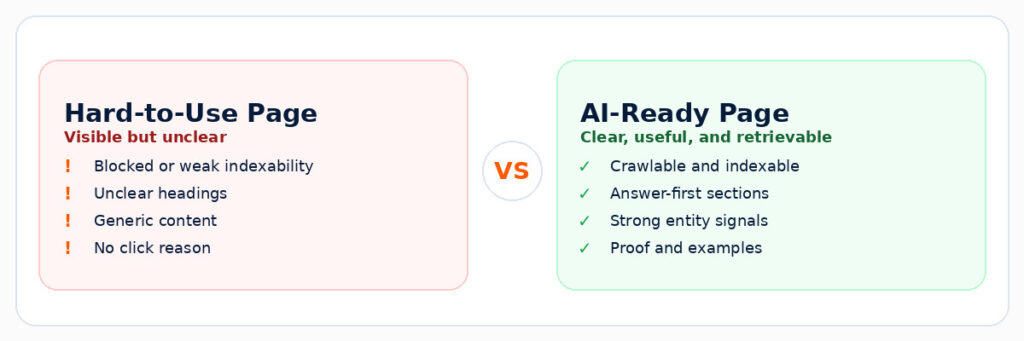
Step-by-Step AI SEO Workflow for Websites
Use this workflow when improving existing website pages or planning new pages for AI-led visibility.
Audit technical eligibility first
Check whether important pages are crawlable, indexable, internally linked, mobile-friendly, and eligible for snippets. Use your AI SEO checklist as the baseline.
Clarify the main entity and topic
Every page should clearly explain what it is about. Product pages should define the product and use case. Category pages should define the category. Guides should define the topic and related concepts. This supports entity SEO.
Build semantic coverage around the page
Cover the main intent, related questions, comparisons, examples, and subtopics. Strong semantic SEO helps the page answer more than one exact-match query.
Structure sections for retrieval
Use answer-first paragraphs, clear headings, compact tables, FAQs, and focused sections. This makes pages easier to retrieve and cite in AI-led search. For deeper structure work, connect this with LLM SEO.
Add unique value before publishing
Add examples, proof, screenshots, workflows, expert notes, or decision support. This is what makes the page useful beyond a generic AI summary.
Common AI SEO Website Mistakes
Mistake 1: Optimizing only blog posts
AI SEO for websites should include homepages, product pages, feature pages, category pages, comparison pages, and help content, not only blogs.
Mistake 2: Publishing generic AI-written pages
Generic pages may be easy to summarize but hard to trust. Add original examples, expert review, product context, and real usefulness.
Mistake 3: Ignoring internal links
Internal links help search systems understand which pages matter and how topics connect across the website.
Mistake 4: Chasing AI-only tricks
Do not rely on unsupported shortcuts. Strong AI SEO still starts with technical access, helpful content, structure, and trust.
SEOSpyder AI Search Readiness Snapshot Use Case
The practical use case for SEOSpyder is to help teams review whether important website pages are ready for classic search and AI-led discovery before publishing or refreshing them.
A SEOSpyder AI Search Readiness Snapshot can check indexability, page structure, entity clarity, semantic coverage, internal links, answer quality, and unique value so teams do not rely on guesswork.
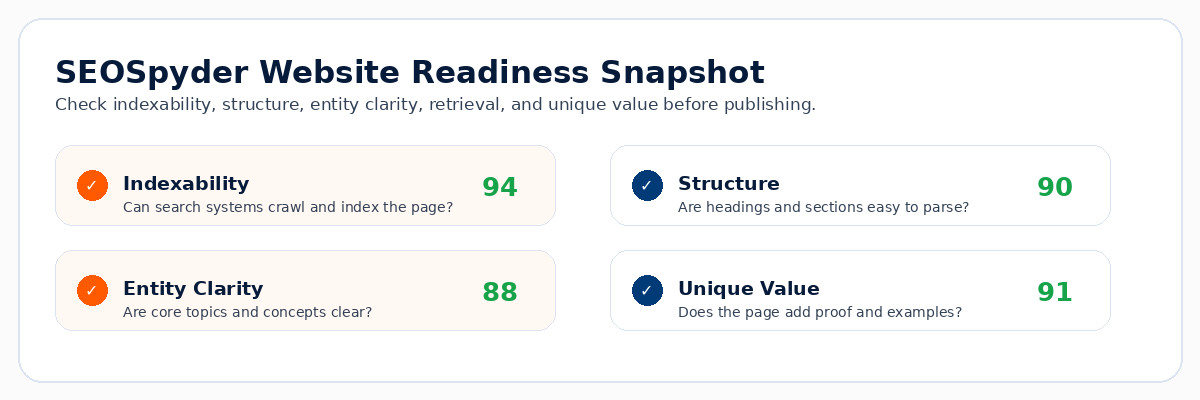
| Snapshot Area | What It Checks | Why It Matters |
|---|---|---|
| Indexability | Can search systems crawl and index the page? | Keeps the page eligible for search visibility. |
| Structure | Are headings, sections, summaries, and FAQs clear? | Improves extraction and usability. |
| Entity clarity | Are main concepts, features, and related terms clear? | Builds stronger topic signals. |
| Unique value | Does the page add proof, examples, or original insight? | Creates a reason to cite and click. |
Make your website pages easier for search and AI systems to use
Use SEOSpyder to review technical SEO, content quality, internal links, answer clarity, topic coverage, entity signals, and AI-search readiness before your next publishing cycle.
For SEO managers, content leads, founders, and agencies building AI-ready organic growth.
Frequently Asked Questions





No comment yet, add your voice below!