
Quick Answer
An AI SEO checklist is a practical review system for making sure a page is crawlable, indexable, well-structured, useful, retrieval-ready, and valuable enough to appear in classic search and AI-led search experiences. In 2026, the checklist should not focus only on keywords. It should check technical access, on-page clarity, content quality, answer structure, internal links, and original value.
AI SEO is not a separate replacement for SEO. It is SEO adapted for a search environment where users see classic results, AI Overviews, AI Mode, answer-led summaries, source cards, and follow-up journeys before deciding whether to click.
That is why this checklist starts with technical basics and ends with AI-search readiness. A page cannot be cited, retrieved, or trusted if it is blocked from crawling, poorly structured, generic, or missing a clear reason for users to visit. For deeper page-level improvement, connect this checklist with your AI content optimization workflow.
This matters more after Google’s March 2026 update cycle reinforced broad quality evaluation and Google’s May 2026 AI-search guidance reaffirmed that SEO still underpins generative search visibility.
Use this AI SEO checklist before publishing a new page, refreshing an older article, or reviewing important URLs after a ranking or traffic shift.
In This Checklist
1. Crawlability and Indexability Checks
Start with the basics. If a page cannot be crawled, indexed, rendered, or discovered through internal links, no amount of AI optimization will help it perform consistently.
Technical baseline
Before reviewing AI visibility, confirm that the page is accessible to Google Search and eligible to appear in search results.
| Check | What to Review | Why It Matters |
|---|---|---|
| Robots access | Robots.txt, meta robots, headers, and noindex tags. | Keeps important pages eligible for search visibility. |
| Canonical signals | Self-canonicals, duplicate pages, and conflicting tags. | Prevents Google from choosing the wrong version. |
| Internal discovery | Internal links, sitemap inclusion, and orphan pages. | Helps crawlers and users find important content. |
2. On-Page Signal Checks
On-page signals tell users and search systems what the page is about. In AI-led search, structure becomes even more important because answers may be pulled from specific sections, not only the full page.
1
Clear title
Use a specific title that matches intent.
2
Useful headings
Use H2s and H3s that answer real sub-questions.
3
Internal links
Connect the page to relevant topic clusters.
For AI-led search topics, link naturally to deeper guides such as AI search optimization, answer engine optimization, and AI SEO optimization where they help the reader continue.
3. Content Quality Checks
Content quality is the part many AI SEO checklists make too shallow. The goal is not just to add more words. The page should be useful, specific, original, and reviewed with real search intent in mind.
Quality rule
If the content can be replaced by a basic AI summary, it needs more original value, examples, data, expert notes, or practical workflow detail.
Check for unique value
Add examples, screenshots, frameworks, original observations, or product-specific analysis. This is where non-commodity content becomes important.
Check for answer depth
The page should answer the main query first, then cover related questions, trade-offs, mistakes, examples, and next steps.
Check for human review
AI can help with drafting and research, but final pages need expert review for accuracy, tone, examples, usefulness, and trust.
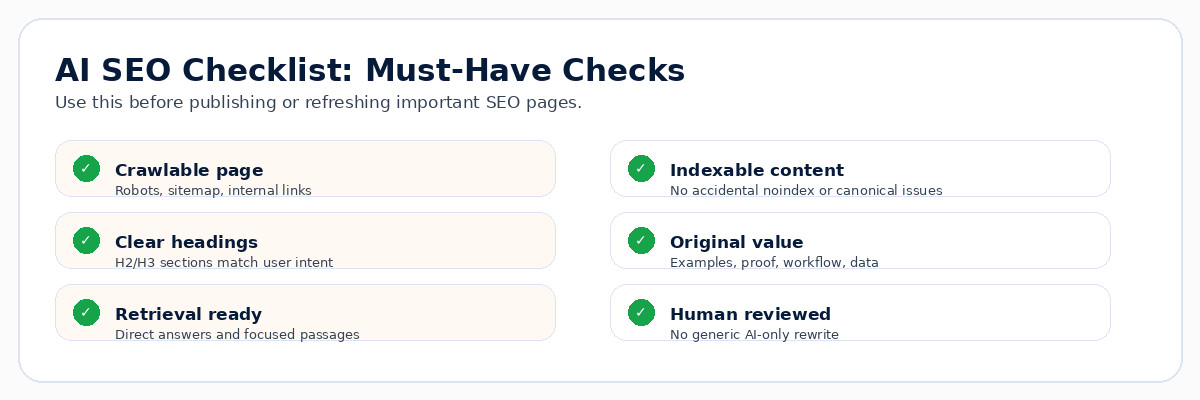
4. AI Readiness Checks
AI readiness means your page is easy to understand, retrieve, summarize, and cite. It does not require a separate trick. It requires clear answers, focused sections, strong context, and useful proof.
| AI Readiness Check | What Good Looks Like |
|---|---|
| Direct answer | The page answers the main query clearly near the top. |
| Retrieval-friendly sections | Each important section answers one focused sub-question. |
| Citation value | The page includes proof, examples, sources, or original insight. |
| Next-click reason | The page offers deeper value than a short AI summary. |
SEOSpyder AI Search Readiness Snapshot Walkthrough
The practical use case for SEOSpyder is to help SEO teams review important pages before publishing or refreshing them. Instead of guessing whether a page is AI-ready, teams can check the main areas that affect classic search and AI-led visibility.
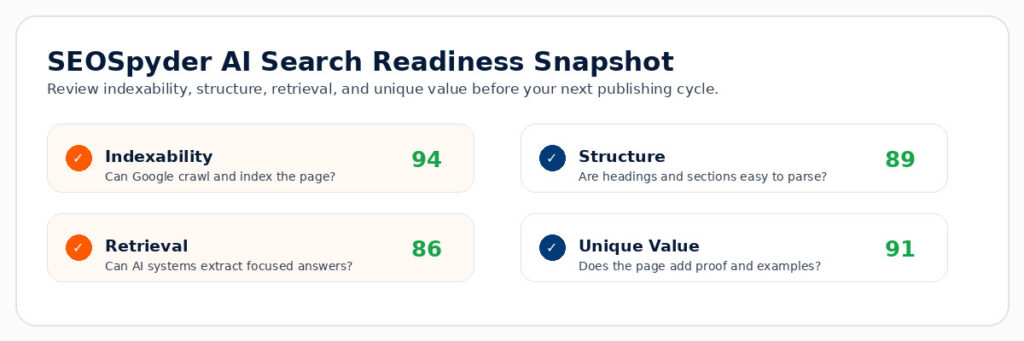
| Snapshot Area | What It Checks | Why It Matters |
|---|---|---|
| Indexability | Can Google crawl, render, and index the page? | Keeps the page eligible for search visibility. |
| Structure | Are headings, answers, and sections clear? | Improves readability and extraction. |
| Retrieval | Can focused passages answer specific questions? | Supports AI-led answer visibility. |
| Unique value | Does the page add proof, examples, or original insight? | Creates a reason to cite and click. |
Turn your AI SEO checklist into a repeatable workflow
Use SEOSpyder to review indexability, structure, content quality, internal links, retrieval readiness, and unique value before your next publishing cycle.
For SEO managers, content leads, founders, and agencies building AI-ready organic growth.
Frequently Asked Questions
“`
:::





No comment yet, add your voice below!