
Quick Answer
An AI SEO strategy is a structured plan to improve how a brand appears across classic search, AI Overviews, AI Mode, answer engines, and retrieval-led discovery. In 2026, a strong AI SEO strategy should not chase blog traffic only. It should improve technical eligibility, topic authority, answer clarity, brand consistency, internal linking, retrieval readiness, and unique value that gives users a reason to click.
Most SEO strategies fail in 2026 because they still treat traffic as the only goal. Traffic matters, but AI-led search has changed the path users take before they visit a website. A brand may appear in an AI answer, be compared in a follow-up prompt, get cited from a third-party page, or lose visibility because its own content does not explain the topic clearly enough.
That is why AI SEO strategy needs a wider plan. It should combine AI search optimization, content quality, technical SEO, internal linking, and brand authority into one practical workflow.
This matters more after Google’s March 2026 update cycle reinforced broad quality evaluation and Google’s May 2026 AI-search guidance reaffirmed that SEO still underpins generative search visibility.
Use this 90-day AI SEO strategy to move beyond publishing random blogs and build a system for search visibility, retrieval, citation, trust, and qualified growth.
In This Guide
Why Most AI SEO Strategies Fail in 2026
Many AI SEO strategies fail because they are only content calendars with a new label. Teams publish more articles, add AI keywords, and wait for traffic. That approach misses how AI-led discovery works.
A useful AI SEO strategy needs to answer bigger questions: Can Google crawl and index the content? Is the page structured for extraction? Does the brand have consistent topic signals? Does the page add something AI cannot easily summarize? Are important pages connected through internal links?
Strategy rule
If your AI SEO strategy only measures blog sessions, it is too narrow. Measure visibility, citations, indexed pages, assisted conversions, topic coverage, and branded demand too.
Core AI SEO Strategy Framework
A strong AI SEO strategy has five pillars. Each pillar supports both traditional organic search and AI-led visibility.
| Pillar | What It Means | Why It Matters |
|---|---|---|
| Technical eligibility | Pages must be crawlable, indexable, fast, and internally discoverable. | AI visibility still starts with search eligibility. |
| Topic authority | Build clusters around buyer problems, entities, and decision journeys. | Strengthens topical understanding and trust. |
| Answer structure | Use direct answers, clear sections, tables, FAQs, and step workflows. | Makes content easier to retrieve and summarize. |
| Unique value | Add examples, data, expert notes, templates, and product-specific insight. | Gives users a reason to click beyond an AI summary. |
| Brand consistency | Keep messaging consistent across pages, profiles, and third-party mentions. | Reduces confusion when AI systems summarize your brand. |
90-Day AI SEO Strategy Plan
Use this 90-day plan to build momentum without trying to fix everything at once.
Days 1–15: Audit search eligibility and current visibility
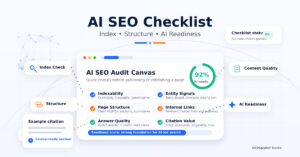
Review crawlability, indexability, technical issues, key landing pages, ranking drops, branded queries, internal links, and pages with high impressions but weak clicks. Connect this with your AI SEO checklist.
Days 16–30: Map prompts, journeys, and topic gaps
Do not optimize for every AI prompt. Identify the questions that matter to buyers: problem discovery, tool comparison, pricing concerns, alternatives, implementation, and decision confidence.
Days 31–55: Upgrade priority pages for retrieval
Refresh existing pages before creating too many new ones. Add direct answers, better headings, comparison sections, internal links, FAQs, examples, and original proof. This is where non-commodity content becomes essential.
Days 56–75: Build authority around commercial topics
Create supporting pages around decision-stage topics, competitor comparisons, use cases, industry examples, and implementation questions. Link them to core product and category pages.
Days 76–90: Measure, refine, and scale
Track ranking movement, AI visibility patterns, branded search growth, assisted conversions, high-impression pages, and pages earning meaningful clicks. Then turn the winning process into a monthly workflow.
Real Example: From Blog Traffic to Revenue-Led AI SEO
A weak strategy might publish ten informational blogs each month and report traffic growth. A stronger AI SEO strategy starts by asking which content helps users choose, trust, compare, and act.
Example workflow
A SaaS brand can map buyer prompts, refresh product-adjacent pages, build comparison content, strengthen internal links, and use AI-readiness checks before publishing. This creates visibility across awareness, evaluation, and decision journeys instead of only top-of-funnel blog traffic.
Where SEOSpyder Fits in the AI SEO Strategy Workflow
The practical use case for SEOSpyder is to help teams review important pages before publishing or refreshing them. Instead of guessing whether a page is AI-ready, teams can check the areas that affect classic search, AI Overviews, and AI Mode.
| SEOSpyder Snapshot Area | What It Helps Review | Strategy Value |
|---|---|---|
| Technical readiness | Indexability, internal links, structure, and accessibility. | Prevents strategy from failing at the foundation. |
| Answer clarity | Direct answers, focused sections, and FAQ readiness. | Improves extraction and user experience. |
| Unique value | Examples, proof, expert insight, and useful depth. | Creates a reason to cite and click. |
| Cluster strength | Supporting guides, internal links, and topic relationships. | Builds authority beyond one blog page. |
Build an AI SEO strategy that goes beyond blog traffic
Use SEOSpyder to review technical SEO, content quality, internal links, answer clarity, topic coverage, and AI-search readiness before your next publishing cycle.
For SEO managers, content leads, founders, and agencies building AI-ready organic growth.
Frequently Asked Questions
“`





No comment yet, add your voice below!