
“`html
Quick Answer
SEO with AI means using artificial intelligence to speed up SEO research, audits, keyword clustering, content briefs, internal linking, technical checks, refresh planning, and AI search readiness. But AI should not replace human judgment. The strongest SEO teams use AI for repetitive, data-heavy work while humans decide strategy, originality, accuracy, brand voice, and whether a page truly deserves to rank.
SEO with AI is no longer just about asking a chatbot to write a blog. In 2026, the better use case is building a smarter SEO workflow: faster audits, sharper briefs, cleaner content structure, better internal links, and stronger readiness for AI Overviews and AI Mode.
To connect this workflow with AI-led visibility, start with this guide on AI SEO optimization. It explains how AI can support better SEO execution without turning your content into generic output.
This matters more after Google’s March 2026 core update cycle, which reinforced broad quality evaluation, and Google’s May 2026 AI-search guidance, which reaffirmed that SEO fundamentals still support visibility in generative search features.
This guide explains what AI changes in SEO, what it does not change, where automation helps, where human judgment still wins, and how SEOSpyder’s AI Search Readiness Snapshot can help teams improve pages before publishing.
In This Guide
What Does SEO With AI Mean?
SEO with AI means using AI tools and AI-assisted workflows to make SEO work faster, more consistent, and easier to prioritize. It can help with keyword research, competitor analysis, technical audits, content briefs, content refreshes, metadata checks, internal linking, and AI search optimization.
But SEO with AI does not mean publishing unchecked AI-generated content. That is where many teams go wrong. AI can help process information quickly, but it cannot fully replace expert judgment, first-hand experience, original research, or strategic prioritization.
Simple definition
SEO with AI is the practice of using AI to speed up SEO tasks while keeping human experts responsible for strategy, accuracy, originality, and final publishing decisions.
What AI Changes in SEO — and What It Does Not
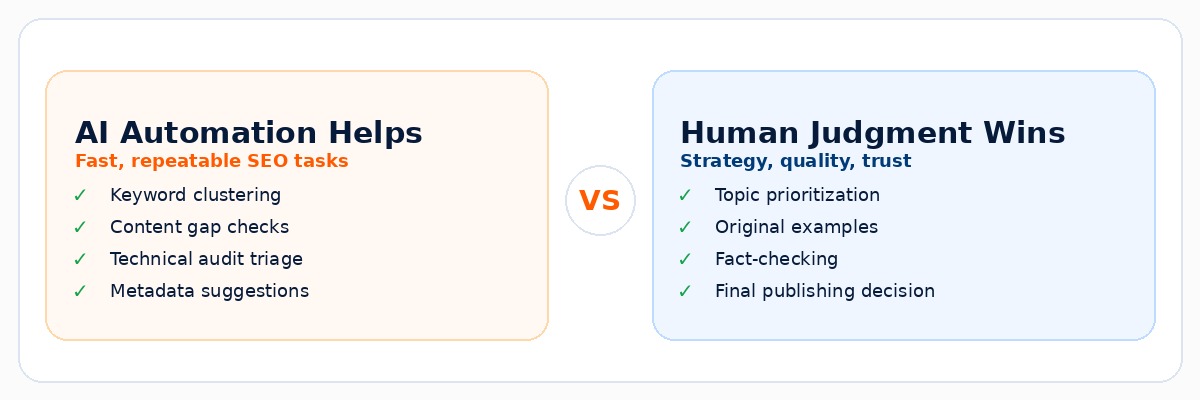
AI changes the speed of SEO execution. Tasks that once took hours, such as clustering keywords, comparing SERP patterns, drafting outlines, identifying missing FAQs, and summarizing technical issues, can now be done much faster with the right workflow.
What AI does not change is the need for quality. Google’s AI-search guidance still points teams back to foundational SEO: helpful content, technical accessibility, clear structure, and pages that provide real value to users.
| SEO Area | Where AI Helps | Where Humans Still Win |
|---|---|---|
| Keyword research | Grouping, pattern discovery, intent mapping. | Choosing business priorities and realistic targets. |
| Content briefs | Outlines, questions, gaps, supporting sections. | Original angle, expertise, examples, and brand voice. |
| Technical SEO | Issue detection, prioritization, reporting. | Understanding trade-offs and implementation impact. |
| Publishing | Formatting, metadata checks, schema suggestions. | Final accuracy, quality control, and user usefulness. |
A Practical AI SEO Framework for Teams
The best AI SEO framework is not “generate and publish.” It is “research, audit, improve, review, then publish.” This keeps automation useful without letting it control the quality of your site.
1
Research faster
Use AI to organize keywords, SERP patterns, and questions.
2
Audit deeper
Find technical, content, and internal link gaps.
3
Review smarter
Let humans approve accuracy, angle, and usefulness.
Important note
AI can speed up SEO, but it cannot automatically create trust. Trust comes from accuracy, expertise, useful examples, transparent claims, and content that genuinely helps the reader.
Step-by-Step Workflow for SEO With AI
Use this workflow when creating new pages, refreshing existing content, or preparing pages for AI search visibility.
Choose the right page or topic
Start with pages that have traffic potential, rankings, impressions, business value, or clear refresh opportunity. Do not let AI choose topics only because they are easy to generate.
Use AI to map intent and gaps
Use AI SEO tools to group questions, compare SERP patterns, identify missing sections, and draft a content brief. This connects naturally with AI search optimization.
Add non-commodity value
AI can help create structure, but humans should add original examples, insights, screenshots, product data, expert judgment, and practical workflows. Use this guide on non-commodity content for AI search as a quality benchmark.
Check AI search readiness
Review whether the page has answer-first sections, clear headings, internal links, technical readiness, and useful FAQs. If you are building repeatable workflows, connect this with an AI SEO agent.
Publish only after human review
Before publishing, review accuracy, tone, originality, source quality, internal links, CTAs, and whether the page gives users something valuable beyond a generic answer.
Common Mistakes When Doing SEO With AI
Mistake 1: Publishing AI drafts without editing
AI drafts often sound polished but generic. They need expert review, fact-checking, examples, and a stronger point of view before publishing.
Mistake 2: Choosing volume over usefulness
AI makes it easy to publish more pages, but more pages do not matter if they are thin, repetitive, or missing search intent.
Mistake 3: Ignoring technical SEO
AI cannot fix a page that is not crawlable, indexable, mobile-friendly, or internally connected. Technical SEO remains part of the foundation.
Mistake 4: Letting AI decide strategy
AI can suggest options, but humans should choose what matters for the audience, brand, funnel, competition, and business goals.
SEOSpyder AI Search Readiness Snapshot Capabilities
The practical use case for SEOSpyder is to help teams review whether a page is ready for classic SEO, AI Overviews, AI Mode, and answer-led search experiences before publishing.
A SEOSpyder AI Search Readiness Snapshot can help identify whether a page has answer clarity, original value, technical eligibility, internal links, topical coverage, and enough structure to support both classic rankings and AI search visibility.
| Snapshot Area | What It Checks | Why It Matters |
|---|---|---|
| Answer clarity | Does the page answer the main query early? | Improves readability and AI-search understanding. |
| Original value | Does the page add insight beyond generic AI output? | Reduces commodity content risk. |
| Technical readiness | Is the page crawlable, indexable, and usable? | Keeps the page eligible for Search. |
| Internal links | Is the page connected to related resources? | Improves topical context and discovery. |
Use AI to speed up SEO without lowering quality
Use SEOSpyder to review content quality, technical SEO, internal links, answer clarity, and AI-search readiness before your next publishing cycle.
For SEO managers, content leads, founders, and agencies building AI-ready organic growth.
Frequently Asked Questions
“`






No comment yet, add your voice below!