
Direct Answer
An on-page SEO audit helps you fix pages that have good intent but still rank poorly.
It checks whether the page matches search intent, uses a strong title and H1, answers the query quickly, covers the topic fully, links to helpful pages, includes useful proof, and gives users something better than a generic answer. The goal is not to add more keywords. The goal is to make the page clearer, more useful, easier to understand, and easier to prioritize.
Fix first
Intent mismatch, weak title, unclear H1, missing answer, thin content.
Improve next
Headings, internal links, examples, schema, FAQs, entity clarity.
Keep human-led
Content quality, brand voice, page consolidation, and business priority.
Why Pages Rank Poorly Even When the Intent Looks Right
Sometimes a page targets the right keyword but still performs badly because the page does not satisfy the query better than competing results. An on page SEO audit finds those page-level gaps before you rewrite the entire article or blame backlinks.
| Symptom | Likely On-Page Problem | Best Fix |
|---|---|---|
| Impressions but low clicks | Weak title, meta description, or SERP promise. | Rewrite title for intent, benefit, and clarity. |
| Ranks on page 2 or 3 | Incomplete coverage or weak internal links. | Add missing sections, examples, FAQs, and contextual links. |
| Traffic drops after update | Content looks generic, outdated, or less useful than competitors. | Add original value, proof, examples, and sharper answers. |
| Good content but no movement | Technical or internal linking issue outside the page. | Run a broader website SEO audit. |
The On-Page SEO Audit Flow
Use this flow when a page already has decent intent alignment but is not ranking, not earning clicks, or not converting well enough.
Check the SERP before editing
Look at what currently ranks: guide, list, comparison, checklist, tool page, template, or definition. If your format does not match the SERP expectation, small edits will not fix the page.
Rewrite the title and H1 for user intent
The title should make the click promise clear. The H1 should confirm the page solves the same problem. Do not stuff variations. Make the value obvious.
Move the answer higher
Users should not wait through long intros. Add a direct answer, checklist, table, or decision box near the top. This also supports AI Overview optimization.
Find missing subtopics and weak sections
Check whether the page answers related questions, explains key terms, includes examples, handles objections, and links to supporting content. This is where semantic SEO and entity SEO help.
Add proof and internal links
Improve credibility with examples, screenshots, data, process notes, expert comments, or product context. Add internal links only where they help the next step, not just for SEO.
Priority Fix Order for Poorly Ranking Pages
Critical
Wrong intent, missing answer, noindex, wrong canonical, or page not internally linked.
High
Weak title, vague H1, poor headings, thin sections, or no useful examples.
Medium
Missing FAQs, weak image alt text, schema gaps, or low internal link support.
Human Review
Rewriting, merging, redirecting, business positioning, and AI-generated content quality.
What Most On-Page SEO Audit Tools Miss
Most tools can detect missing titles, duplicate descriptions, broken links, weak headings, and schema issues. The harder part is deciding whether the page actually deserves to rank.
On-Page SEO Audit Checklist for AI Search Readiness
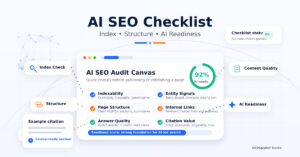
AI readiness is not about adding random AI keywords. It is about making the page easy to understand, extract, summarize, cite, and trust. Use this checklist with AI content optimization and answer engine optimization workflows.
| Check | What Good Looks Like |
|---|---|
| Direct answer | The page answers the main question within the first few lines. |
| Entity clarity | Products, features, people, brands, categories, and terms are clearly explained. |
| Scannable structure | The page uses short sections, tables, bullets, FAQs, and descriptive headings. |
| Non-commodity value | The page adds examples, proof, data, screenshots, workflows, or expert notes. |
| Helpful next step | Users know what to do after reading: compare, fix, audit, test, or choose. |
SEOSpyder Audit Dashboard & Issue Priority View
The practical use case for SEOSpyder is helping teams move from “this page is underperforming” to “these are the fixes we should do first.”
Page issue grouping
Group title, heading, content, link, schema, and quality issues by page type.
Priority view
Separate ranking blockers from low-impact warnings so teams do not waste time.
Team handoff
Give SEOs, writers, developers, and managers the right action list.
Fix pages that should rank better
Use SEOSpyder to audit page-level issues, prioritize fixes, monitor improvements, and help your SEO, content, and development teams focus on what actually improves visibility.
Frequently Asked Questions
What is an on-page SEO audit?
An on-page SEO audit is a page-level review of title tags, headings, search intent, content quality, internal links, schema, images, user experience, and AI-search readiness.
What should I check first in an on-page SEO audit?
Start with search intent, title tag, H1, opening answer, heading structure, content depth, internal links, and whether the page gives users a better answer than competing results.
Why does a page rank poorly despite good intent?
A page can rank poorly if the title is weak, the answer is buried, topic coverage is incomplete, internal links are low, examples are missing, or competitors provide clearer and more useful content.
Can tools fully automate on-page SEO audits?
Tools can automate detection and monitoring, but human review is still needed for intent match, content quality, brand voice, page consolidation, and business-priority decisions.
How can SEOSpyder help with on-page SEO audits?
SEOSpyder can help teams find page-level issues, group them by severity, prioritize fixes, monitor changes, and manage workflows through an Audit Dashboard and Issue Priority View.






No comment yet, add your voice below!