
Quick Answer
Entity SEO is the process of making the people, brands, products, concepts, locations, tools, and topics on a page easy for search engines and AI systems to understand. Instead of relying only on keywords, entity SEO clarifies what the page is about, how the main topic connects to related concepts, and why the page is a trustworthy source.
Entity SEO matters because search is no longer only about matching words. Search systems increasingly need to understand things, relationships, context, and credibility. A page that names the right entities, explains their attributes, and connects them naturally can become easier to rank, retrieve, summarize, and cite.
For AI-led visibility, entity SEO connects closely with semantic SEO and AI search optimization. The goal is not to add random related terms. The goal is to create clear topic signals that help humans, search engines, and AI systems understand the page better.
This became more important after Google’s March 2026 update cycle reinforced broad quality evaluation and Google’s May 2026 AI-search guidance reaffirmed that SEO still underpins generative search visibility.
This guide explains what entity SEO means, why it matters in 2026, how it differs from keyword-only optimization, where teams go wrong, and how SEOSpyder’s AI Search Readiness Snapshot can help teams review entity clarity before publishing.
In This Guide
What Is Entity SEO?
Entity SEO is an approach to search optimization that focuses on clearly identifying the important “things” in your content. These things can include a brand, product, person, software category, process, location, organization, feature, concept, or topic.
A keyword is a phrase users type. An entity is the real concept behind the phrase. For example, “AI search optimization” is a keyword phrase, but the broader entity includes search systems, AI Overviews, AI Mode, generative answers, source citations, content quality, and retrieval.
Simple definition
Entity SEO helps search and AI systems understand what your page is about, what the main topic means, and how it connects to related concepts.
Why Entity SEO Matters in 2026
Google’s AI-search guidance makes it clear that SEO fundamentals still matter for AI Overviews and AI Mode. That means entity SEO should not be treated as a shortcut. It should support helpful content, strong structure, technical accessibility, and trust.
Entity SEO matters because AI-led search experiences need context. A page with clear entity signals can make it easier for systems to understand what the page covers, which related concepts matter, and whether the content is reliable enough to surface as a source.
1
Clarity
Defines what the page is mainly about.
2
Context
Connects related concepts and subtopics.
3
Trust
Supports claims with proof and relevance.
Important note
Entity SEO does not mean adding a list of related words. It means explaining the main topic, its attributes, and its relationships in a way users and search systems can understand.
A Practical Entity SEO Framework
Use this framework when planning new content or improving existing pages. It keeps entity optimization practical instead of theoretical.
| Layer | What to Clarify | Why It Helps |
|---|---|---|
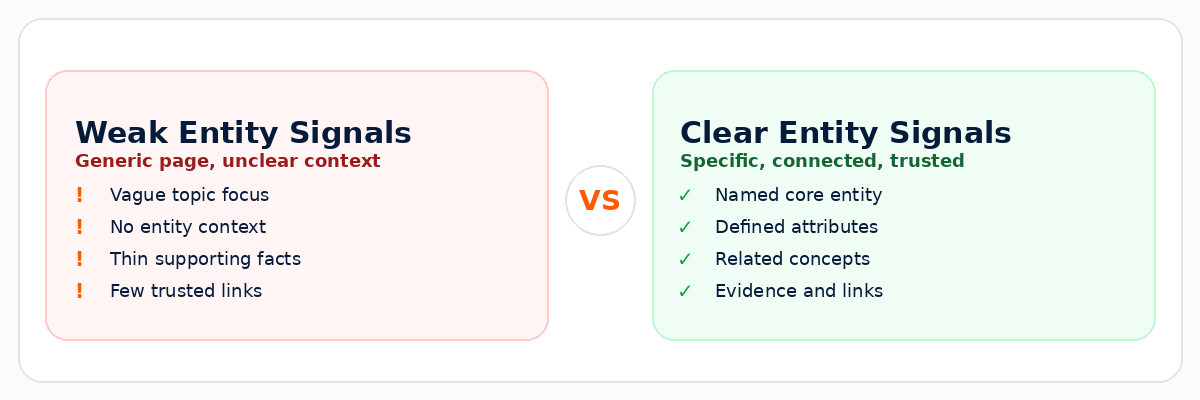
| Core entity | The main thing, concept, product, or category the page covers. | Improves topic clarity. |
| Attributes | Important properties, features, definitions, facts, and examples. | Helps systems understand what makes the entity specific. |
| Relationships | Related entities, subtopics, tools, categories, and use cases. | Builds stronger topical context. |
| Evidence | Proof, expert notes, sources, internal links, and real examples. | Improves trust and citation readiness. |
Step-by-Step Entity SEO Workflow
Use this workflow when creating a new SEO page or improving a page that feels too generic.
Define the core entity clearly
Start by identifying the main entity of the page. Define it in simple language early so users and search systems know exactly what the page covers.
Add attributes and supporting facts
Explain features, definitions, examples, categories, benefits, limitations, and practical use cases. This helps the page move beyond a shallow keyword definition.
Connect related concepts naturally
Build relationships between related topics such as answer engine optimization, generative engine optimization, and AI-led search.
Support claims with proof and internal context
Use examples, expert notes, source-backed explanations, and helpful internal links. This aligns with non-commodity content, where original value matters more than generic summaries.
Review entity readiness before publishing
Before publishing, check whether the page has entity clarity, strong attributes, related concepts, original examples, internal links, and technical readiness. An AI SEO agent workflow can help standardize this review.
Common Entity SEO Mistakes
Mistake 1: Adding related words without context
Entity SEO is not a checklist of terms. Related concepts need to be explained naturally and connected to the user’s intent.
Mistake 2: Creating vague pages with no clear main entity
If a page tries to cover everything, it may not clearly signal what it is mainly about. Define the primary entity early.
Mistake 3: Ignoring internal linking
Internal links help search systems understand relationships between entities, topics, and supporting pages.
Mistake 4: Publishing commodity content
Generic explanations do not build strong entity signals. Add examples, use cases, proof, and expert review.
SEOSpyder AI Search Readiness Snapshot Use Case
The practical use case for SEOSpyder is to help teams review whether a page sends clear entity and topic signals before publishing.
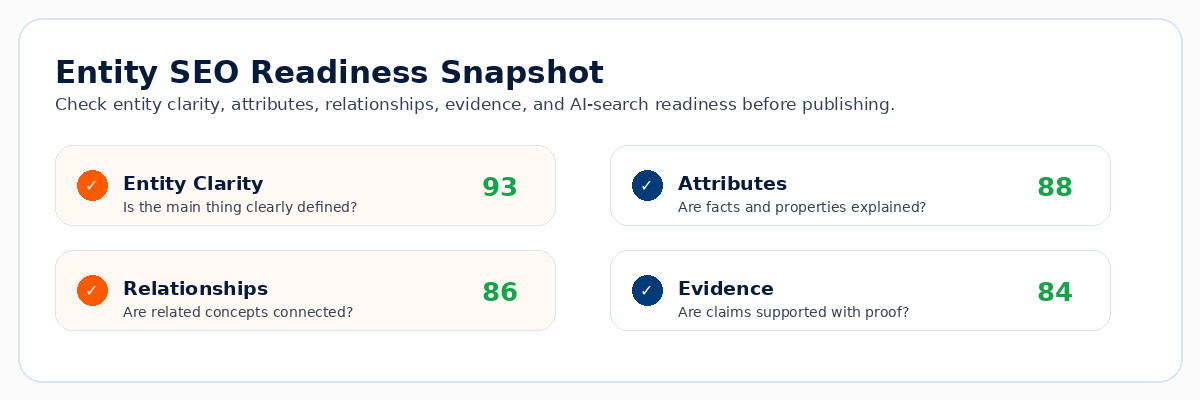
A SEOSpyder AI Search Readiness Snapshot can help check entity clarity, attributes, relationships, evidence, internal links, original value, and AI-search readiness so your pages are stronger for classic search and AI-led discovery.
| Snapshot Area | What It Checks | Why It Matters |
|---|---|---|
| Entity clarity | Is the main topic clearly named and defined? | Improves understanding and relevance. |
| Attributes | Are facts, examples, and properties explained? | Adds specificity and depth. |
| Relationships | Are related concepts connected naturally? | Builds topical context. |
| Evidence | Are claims supported with proof and examples? | Improves trust and citation value. |
Build clearer topic signals for search and AI systems
Use SEOSpyder to review entity clarity, content quality, technical SEO, internal links, answer clarity, and AI-search readiness before your next publishing cycle.
For SEO managers, content leads, founders, and agencies building AI-ready organic growth.
Frequently Asked Questions
“`
:::





No comment yet, add your voice below!