
Quick Answer
AI overview optimization means improving your pages so they can appear as useful, trusted, and clickable sources inside Google AI Overviews and AI Mode. The goal is not just to get mentioned. The goal is to earn a mention that gives users a reason to click through because your page offers deeper value, original insight, proof, tools, examples, or a clear next step.
AI Overview optimization matters because search visibility is no longer only about ranking on a classic results page. Users now see AI-generated summaries, source cards, follow-up paths, and supporting links before they decide whether to visit a website.
For a stronger foundation, start with this guide on generative engine optimization before building your AI Overview strategy. It explains how AI-led discovery still depends on useful content, technical SEO, and clear page structure.
This became more important after Google’s March 2026 core update cycle, which reinforced broad quality evaluation. Google’s May 2026 AI-search guidance also reaffirmed that SEO fundamentals still apply because AI Overviews and AI Mode are rooted in Google’s Search ranking and quality systems.
This guide explains what AI Overview optimization means, what Google says to focus on, where teams go wrong, and how SEOSpyder’s AI Search Readiness Snapshot can help you create pages that earn clickable mentions instead of passive impressions.
In This Guide
What Is AI Overview Optimization?
AI Overview optimization is the process of improving your content so Google can understand it as a useful supporting source for AI-generated answers. It overlaps with answer engine optimization, AI SEO, and classic SEO because it depends on crawlability, helpful content, structure, and trust.
The difference is the outcome you optimize for. A standard SEO page may aim for ranking and impressions. An AI Overview-ready page should also help Google summarize the topic accurately and give users a strong reason to click through for more detail.
Simple definition
AI Overview optimization helps your page become a better source for AI-generated answers while still making the page valuable enough for users to click.
Why AI Overview Optimization Matters in 2026
Google’s official AI-search guidance says SEO best practices continue to matter for AI Overviews and AI Mode because these experiences are rooted in Google’s core Search ranking and quality systems. That means there is no separate “AI-only” shortcut. The same foundations still matter: helpful content, technical accessibility, user value, and trust.
But the user journey has changed. A page can be visible in an AI Overview without earning a meaningful visit. That is why teams need to think beyond impressions and ask: “Does this page give users a reason to click after the AI summary?”
1
Visibility
Can the page be discovered and cited?
2
Trust
Does the page support claims clearly?
3
Clickability
Does the user have a reason to visit?
Important note
AI Overview optimization is not about rewriting content only for AI systems. It is about making pages more useful for humans and clearer for search systems.
Clickable Mentions vs Passive Impressions
A passive impression happens when your page appears somewhere in an AI Overview but the user has no reason to click. A clickable mention happens when your page is cited as a source and the user expects deeper value on your site.
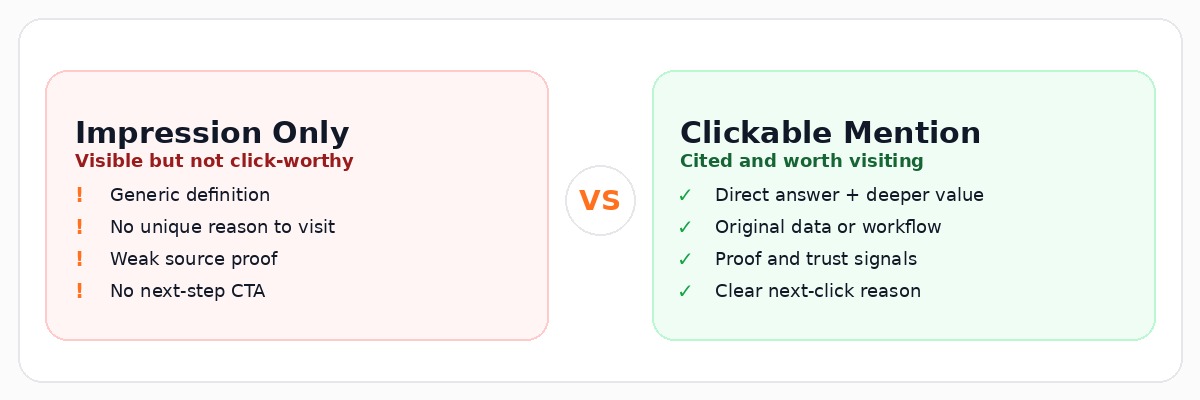
| Area | Passive Impression | Clickable Mention |
|---|---|---|
| Content value | Generic answer already covered in the summary. | Deeper workflow, examples, data, tool, or template. |
| User motivation | No clear reason to visit. | Clear reason to continue on your page. |
| Trust | Claims without proof. | Claims supported with evidence and experience. |
| Outcome | Visibility only. | Visibility plus potential qualified traffic. |
Step-by-Step AI Overview Optimization Workflow
Use this process when creating or refreshing pages for AI Overviews, AI Mode, and classic search performance.
Start with search intent and query depth
AI Overviews usually appear when Google believes a summary can help users understand a topic faster. Build pages that solve the main query and related sub-questions clearly.
Make the page technically eligible
Your page must be crawlable, indexable, and eligible for a Google Search snippet. Technical SEO still matters, so connect this workflow with your AI SEO optimization process.
Add non-commodity value
Do not publish generic definitions that AI can summarize completely. Add original examples, expert notes, product screenshots, checklists, or workflows. This is where non-commodity content for AI search becomes important.
Structure the page for extraction and clicks
Use answer-first paragraphs, clear H2s, comparison tables, FAQs, and useful internal links. Then add a next-step reason to click, such as a checklist, tool, deeper guide, or original research.
Review with an AI-search readiness snapshot
Before publishing, check whether the page has answer clarity, original value, technical eligibility, internal links, and a clear click path. This can be handled through an AI SEO agent workflow.
Common AI Overview Optimization Mistakes
Mistake 1: Optimizing only for impressions
Being visible is useful, but the page also needs a reason for users to click. Add deeper value that the AI summary cannot fully replace.
Mistake 2: Publishing commodity content
If the page only repeats common knowledge, AI systems can summarize it without needing the user to visit your site.
Mistake 3: Ignoring classic SEO
AI Overview visibility still depends on normal Search foundations like crawlability, indexing, snippets, relevance, and quality.
Mistake 4: Chasing artificial mentions
Google’s guidance warns against inauthentic mentions. Focus on being a useful, trusted source instead of trying to manipulate AI systems.
SEOSpyder AI Search Readiness Snapshot Use Case
The practical use case for SEOSpyder is to help teams check whether a page is ready for classic search, AI Overviews, and AI Mode before publishing.
A SEOSpyder AI Search Readiness Snapshot can review whether your page has answer clarity, original value, technical eligibility, internal links, and a clear next-click path.
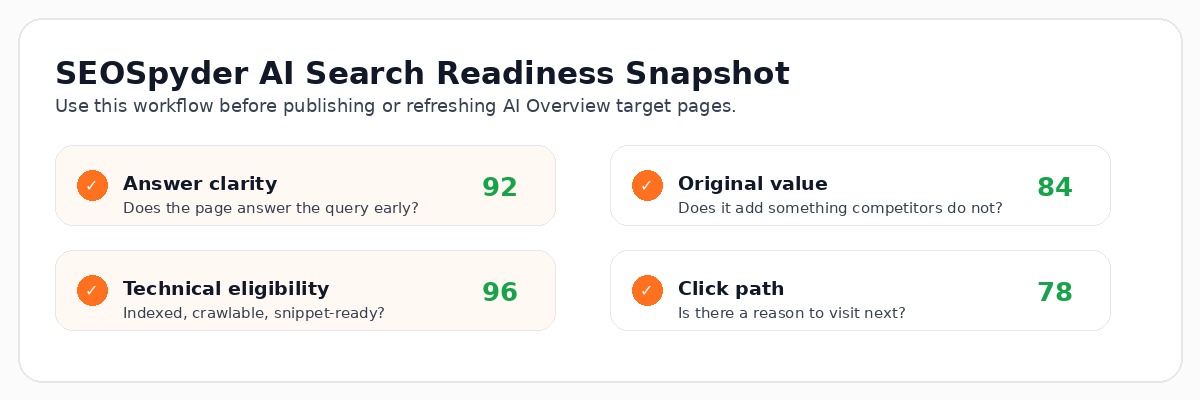
| Snapshot Check | Question to Ask | Why It Matters |
|---|---|---|
| Answer clarity | Does the page answer the query early? | Helps AI systems summarize the page accurately. |
| Original value | Does it add something competitors do not? | Creates a reason to click beyond the summary. |
| Technical eligibility | Is it indexed, crawlable, and snippet-ready? | Keeps the page eligible for Search and AI features. |
| Click path | Is there a reason to visit next? | Turns passive visibility into traffic opportunity. |
Make your AI Overview mentions worth clicking
Use SEOSpyder to review content quality, technical SEO, internal links, answer clarity, and AI-search readiness before your next publishing cycle.
For SEO managers, content leads, founders, and agencies building AI-ready organic growth.
Frequently Asked Questions






No comment yet, add your voice below!