
Quick Answer
An AI SEO agent is a task-focused SEO system that can audit pages, check technical issues, analyze search intent, review content quality, suggest internal links, and guide optimization workflows. A generic AI chatbot can answer questions, but an AI SEO agent is built to act inside SEO processes. It is more useful for teams that need repeatable audits, content improvement, AI search optimization, and answer engine optimization at scale.
SEO teams are using AI more than ever, but there is a big difference between asking a chatbot for SEO advice and using an AI SEO agent to complete a specific audit or optimization workflow. A chatbot can give ideas. An AI SEO agent should help diagnose, prioritize, and improve pages based on SEO signals.
This matters more in 2026 because Google’s March 2026 core update reinforced broad quality evaluation, while Google’s May 2026 AI-search guidance confirmed that SEO still underpins visibility in generative search experiences like AI Overviews and AI Mode.
For a wider foundation on AI-led SEO workflows, read this practical guide on AI SEO in 2026 before building your agent-based optimization process.
In this guide, we’ll explain what an AI SEO agent does, how it differs from a generic AI chatbot, where teams go wrong, and how to use SEOSpyder’s AI Search Readiness Snapshot to create pages that perform in classic search and AI-led results.
In This Guide
What Is an AI SEO Agent?
An AI SEO agent is an AI-powered system designed to perform or assist with specific SEO tasks. Instead of only responding to prompts, it works around a defined workflow such as auditing a page, checking metadata, reviewing keyword intent, suggesting internal links, identifying technical issues, or improving content for AI search optimization.
A generic chatbot can explain SEO concepts, but it usually does not know your page structure, crawl issues, internal link gaps, topical depth, or publishing priorities unless you manually provide that context. An AI SEO agent is more useful because it is built around SEO actions, not just conversation.
Simple definition
An AI SEO agent is a specialized AI system that helps complete SEO tasks such as audits, optimization checks, content reviews, and AI-search readiness analysis.
1
Audit
Find technical, content, and on-page SEO gaps.
2
Prioritize
Separate urgent fixes from low-impact suggestions.
3
Optimize
Improve structure, internal links, schema, and clarity.
Why AI SEO Agents Matter After the 2026 Search Updates
The March 2026 core update ran from March 27 to April 8, 2026, according to the Google Search Status Dashboard. Broad updates like this are not about one ranking trick. They reassess overall quality, relevance, usefulness, and trust across search results.
Google’s May 2026 guidance for generative AI features also says SEO best practices continue to matter because AI Overviews and AI Mode are rooted in Google’s core Search ranking and quality systems. This makes structured audits, content quality checks, and AI-search readiness more important.
13
Days of rollout
Google’s March 2026 core update ran from March 27 to April 8.
May
AI search guidance
Google reaffirmed that SEO remains relevant for AI search experiences.
1
Core goal
Create pages useful enough to rank, summarize, and cite.
Important note
An AI SEO agent does not replace SEO judgment. It improves consistency, speed, and coverage, but humans still need to approve strategy, accuracy, brand voice, and final publishing decisions.
Turn AI SEO checks into a repeatable workflow
Use SEOSpyder to review content quality, technical SEO, internal links, and AI-search readiness before your next publishing cycle.
AI SEO Agent vs Generic AI Chatbot
The main difference is workflow depth. A chatbot is useful for brainstorming and explanations. An AI SEO agent is better when you need structured audits, repeatable checks, and page-level optimization support.
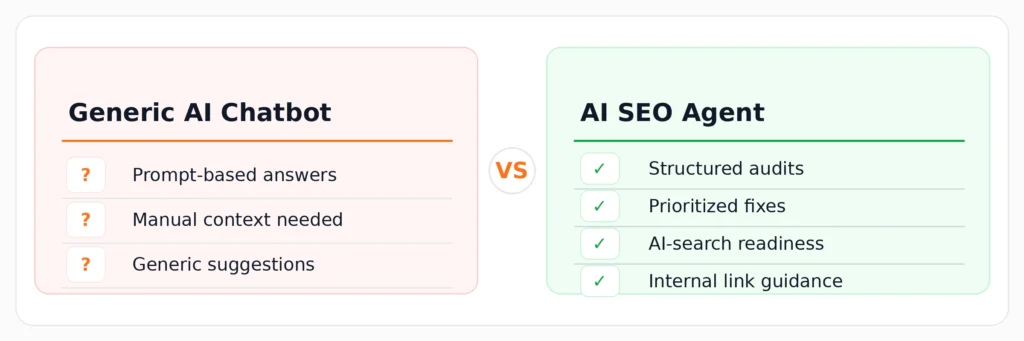
| Factor | Generic AI Chatbot | AI SEO Agent |
|---|---|---|
| Main role | Answers prompts and explains ideas. | Runs SEO-specific checks and workflows. |
| SEO context | Depends on what the user provides manually. | Works around audits, page checks, and optimization criteria. |
| Best use | Brainstorming, outlines, explanations, drafts. | Audits, prioritization, AI search readiness, internal links. |
| Risk | Can produce generic advice without verification. | Still needs human review, but gives more workflow control. |
How to Use an AI SEO Agent in a Practical SEO Workflow
The best way to use an AI SEO agent is not to ask it for random suggestions. Use it inside a structured workflow where each step has a clear purpose and review point.
Start with a page-level audit
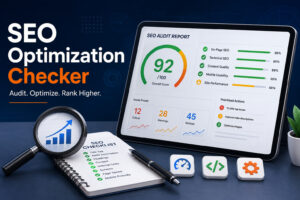
Use the agent to review metadata, headings, crawlability, indexability, keyword focus, content depth, and technical issues. Pair this with a broader check using tools such as a domain authority and page authority checker when evaluating site-level strength.
Check content for commodity risk
The agent should flag pages that repeat common definitions, lack original insight, miss examples, or do not clearly answer the user’s search need. Use this alongside your guide to non-commodity content for AI search.
Improve structure for AI search optimization
Ask the agent to check whether the page has a direct answer, clear section hierarchy, comparison tables, FAQs, schema opportunities, and concise explanations that AI systems can understand and summarize.
Find internal linking opportunities
Use the agent to suggest links to related pages, supporting guides, and conversion pages. If you are new to audit workflows, start with this guide on how to use SEO analysis tools.
Review and approve before publishing
AI SEO agents can speed up decisions, but SEO managers should still approve accuracy, prioritization, tone, claims, and final changes before publishing.
Common Mistakes When Using AI SEO Agents
Mistake 1: Treating the agent like a magic ranking tool
An AI SEO agent can identify opportunities, but it cannot guarantee rankings. It still needs strong content, technical SEO, authority, and user value.
Mistake 2: Publishing suggestions without review
Agent outputs should be reviewed by someone who understands the business, the audience, and the search intent. Do not publish recommendations blindly.
Mistake 3: Using agents only for content generation
The best use is not only writing. AI SEO agents are stronger when used for audits, gap analysis, content quality checks, internal linking, and AI-search readiness reviews.
Mistake 4: Ignoring the full SEO system
AI search optimization still depends on technical SEO, content quality, internal links, authority, and clear user value. A single agent cannot fix a weak SEO foundation alone.
SEOSpyder AI Search Readiness Snapshot Use Case
The practical use case for SEOSpyder is to help teams turn AI SEO into a structured audit process. Instead of asking a generic chatbot what to improve, teams can review page readiness across content quality, technical SEO, internal links, and AI-search visibility signals.
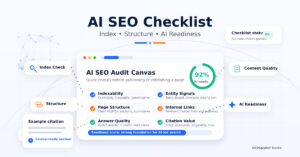
A SEOSpyder AI Search Readiness Snapshot can help identify whether a page has a direct answer, original value, strong structure, crawlable setup, useful internal links, and enough clarity to support answer engine optimization.
| Snapshot Area | What to Check | Why It Matters |
|---|---|---|
| Content quality | Does the page add value beyond generic AI output? | Reduces commodity content risk. |
| AI search readiness | Does the page have clear answers, structure, and context? | Helps AI systems understand and summarize the page. |
| Internal links | Is the page connected to related SEO resources? | Improves navigation, relevance, and topical context. |
| Technical SEO | Are metadata, schema, crawlability, and mobile layout clean? | Keeps the page eligible and easier to process. |
Best practical approach
Use SEOSpyder before publishing new AI-assisted content, after major Google updates, and when refreshing pages that stopped gaining visibility.
Pre-Publish Checklist for AI SEO Agent Workflows
Before publishing, check:
✓ Did the agent identify technical and content issues clearly?
✓ Are the recommendations prioritized by business and SEO impact?
✓ Does the page answer the main query early?
✓ Does the content avoid generic AI summaries?
✓ Are internal links useful and contextually placed?
✓ Is schema aligned with visible content?
✓ Has a human reviewed the final changes?
Use AI for SEO audits, not just SEO prompts
Use SEOSpyder to audit content quality, technical SEO, internal links, and AI-search readiness before your next publishing cycle.
For SEO managers, content leads, founders, and agencies building AI-ready organic growth.
Frequently Asked Questions



No comment yet, add your voice below!