
Quick Answer
AI SEO means using artificial intelligence to improve keyword research, search intent mapping, content structure, technical SEO checks, internal linking, and AI search optimization without removing expert judgment. In 2026, the goal is not to publish more AI-written pages. The goal is to create original, useful, well-structured content that can rank in classic Google results and become easier to understand, summarize, and cite in AI Overviews and AI Mode.
AI SEO has become one of the most searched topics among SEO managers, content leads, founders, and agencies because search is changing from simple blue-link rankings to answer-led experiences. Users still search on Google, but they also expect summarized answers, deeper follow-up paths, and direct explanations from AI-powered search systems.
Related- How to use seo analysis tools
That does not mean traditional SEO is dead. Google’s official guidance for AI features says SEO best practices remain relevant because AI Overviews and AI Mode are rooted in Google’s core Search ranking and quality systems. The March 2026 core update cycle also reminded SEO teams that quality evaluation is broad, sitewide, and not limited to one page element.
This guide explains what AI SEO means in 2026, where teams go wrong with commodity content, and how to build a practical workflow that supports Google rankings, answer engine optimization, and AI search visibility.
In This Guide
What Is AI SEO?
AI SEO is the use of AI systems to make SEO research, planning, optimization, and review faster and more accurate. It can help with clustering keywords, finding search intent gaps, improving page structure, checking headings, creating schema drafts, summarizing SERP patterns, and identifying internal linking opportunities.
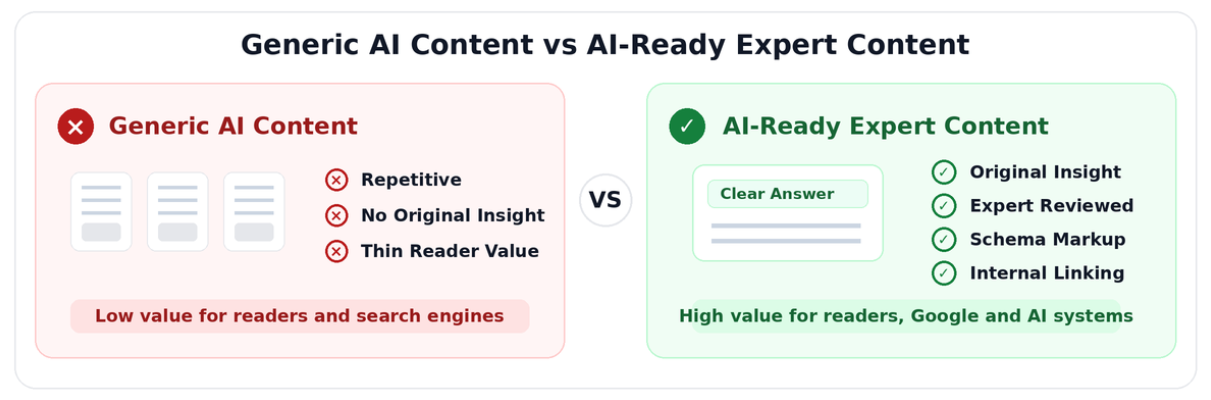
But AI SEO is not the same as publishing hundreds of AI-generated articles. That approach often creates commodity content: pages that repeat what already exists, add no original insight, and fail to show why the brand deserves to be trusted.
Simple definition
AI SEO means using AI to support better SEO decisions while keeping the final content original, useful, expert-reviewed, and aligned with real search intent.

1
Research
Use AI to group keywords, questions, entities, and user needs.
2
Structure
Build pages with direct answers, clear headings, and helpful sections.
3
Review
Check originality, accuracy, internal links, schema, and quality signals.
Why AI SEO Matters After the 2026 Google Updates
Google’s March 2026 core update started on March 27, 2026, and finished on April 8, 2026, according to the Google Search Status Dashboard. Core updates do not reward one trick. They reassess broad quality signals across content, relevance, usefulness, and trust.
Then, in May 2026, Google published official guidance for generative AI features in Search. The key point for SEO teams is clear: SEO still matters because AI Overviews and AI Mode use Google’s Search index and ranking systems to surface helpful content.
13
Days of rollout
March 2026 core update ran from March 27 to April 8, 2026.
May
AI search guidance
Google reaffirmed that SEO fundamentals apply to AI search features.
0
AI-only hacks
Google says there are no special AI-only technical requirements beyond Search eligibility.
Important note
AI search optimization is not about tricking AI systems. It is about making your page easier to understand, verify, summarize, and trust.
Check if your page is ready for AI search
Use SEOSpyder to review content structure, search intent coverage, technical SEO, internal links, and AI-search readiness before publishing.
AI SEO vs AI Search Optimization vs Answer Engine Optimization
These terms are connected, but they are not exactly the same. A strong 2026 strategy should cover all three because users discover answers through classic rankings, AI summaries, and answer-led search journeys.
Related- DA PA Checker
| Term | What It Means | Main Goal |
|---|---|---|
| AI SEO | Using AI to improve SEO research, content planning, technical checks, and optimization. | Rank better while improving quality and efficiency. |
| AI search optimization | Structuring pages so AI search systems can understand entities, claims, answers, and context. | Improve visibility in AI Overviews, AI Mode, and AI-led discovery. |
| Answer engine optimization | Creating concise, accurate answers for question-based and conversational queries. | Win snippets, FAQ visibility, and answer-led search moments. |
How to Use AI SEO Without Creating Commodity Content
The best SEO with AI workflow starts with strategy, not generation. AI should help your team find gaps, speed up research, and improve structure. It should not replace original insight, subject-matter review, or real examples.
Start with one search intent
Decide whether the page should define a topic, compare tools, solve a problem, explain a workflow, or help the reader make a decision. For this blog, the primary intent is clear: explain what AI SEO means and how to use it correctly in 2026.
Map questions before writing
Use AI SEO tools to collect related questions, People Also Ask patterns, entity gaps, and follow-up topics. Then group them into sections so the page answers the topic fully without becoming bloated.
Structure for readers and AI systems
Use answer-first sections, descriptive H2s, clean comparison tables, short definitions, FAQs, and schema. This helps users scan the page and helps search systems understand the relationship between claims, evidence, and answers.
Run a quality review before publishing
Check whether the page has a clear answer, real value, factual accuracy, useful internal links, author or brand expertise, and a reason to exist beyond summarizing competitor pages.
Refresh after ranking signals change
AI search behavior, SERP layouts, and competitor coverage change quickly. Review important pages after core updates, traffic drops, or major product changes so content stays useful and current.
Common AI SEO Mistakes That Create Commodity Content
Mistake 1: Starting with AI output instead of user intent
If the page starts from a generic prompt, it usually becomes a generic article. Start with the query, audience, problem, and search result gap.
Mistake 2: Repeating competitor definitions
A page that only restates what Ahrefs, Semrush, Moz, or tool roundups already say has no strong reason to rank. Add your own framework, data, examples, or workflow.
Mistake 3: Treating AEO as a separate trick
Answer engine optimization works best when the full page is helpful. Do not add FAQs to a weak article and expect the page to become authoritative.
Mistake 4: Publishing without expert review
AI can speed up drafts, but humans should check claims, examples, nuance, brand voice, and whether the page actually helps the target reader.
SEOSpyder AI Search Readiness Snapshot Use Case
The practical use case for SEOSpyder is simple: before publishing or refreshing a page, run an AI Search Readiness Snapshot to check whether the content is structured for both classic SEO and AI-led discovery.
For example, a content lead can review whether a page has a direct answer, complete topical coverage, clean headings, useful internal links, schema opportunities, technical SEO issues, and enough first-hand value to avoid sounding like a recycled AI summary.
| Snapshot Area | What SEOSpyder Should Check | Why It Matters |
|---|---|---|
| Direct answer | Does the page answer the main query in the first section? | Supports snippets, AEO, and AI summary extraction. |
| Topical coverage | Does the page cover related questions and searcher needs? | Helps match query fan-out and follow-up search behavior. |
| Original value | Does the page include examples, data, workflow, or expert insight? | Reduces the risk of commodity content. |
| Technical readiness | Are metadata, schema, crawlability, speed, and mobile layout clean? | Keeps the page eligible and easy to understand. |
Best practical approach
Use SEOSpyder before publishing, after a Google update, and when refreshing pages that lost traffic or stopped appearing for important queries.
Pre-Publish Checklist for AI SEO Pages
Before publishing, check:
✓ Does the first section directly answer the primary query?
✓ Is the page useful without relying on generic AI summaries?
✓ Are claims supported by evidence, examples, or official sources?
✓ Are headings clear enough for readers and search systems?
✓ Are internal links relevant and placed naturally in the body?
✓ Is FAQ schema aligned with visible FAQ content?
✓ Has a human reviewed accuracy, examples, and brand voice?
Build pages that are ready for SEO and AI search
Use SEOSpyder to audit content structure, technical SEO, internal links, and AI-search readiness before your next update or publishing cycle.
For SEO managers, content leads, founders, and agencies building AI-ready organic growth.
Frequently Asked Questions





No comment yet, add your voice below!