
Quick Answer
Non commodity content is content that gives readers something they cannot get from a generic AI summary or copied competitor structure. It includes original insight, clear answers, expert review, useful examples, strong structure, and proof. In 2026, this matters because AI SEO, AI SEO agents, AI search optimization, and answer engine optimization all depend on the same core idea: pages must be genuinely useful, easy to understand, and strong enough to perform in both classic Google results and AI-led search experiences.
Most SEO teams are not struggling because they cannot publish enough content. They are struggling because too many pages now look the same. AI tools can generate definitions, lists, outlines, FAQs, and summaries quickly, but speed alone does not create search value.
Google’s March 2026 core update ran from March 27 to April 8, 2026, according to the Google Search Status Dashboard. Core updates are broad quality reassessments, not single-factor changes. Then Google’s May 2026 AI-search guidance reaffirmed that SEO still matters for AI Overviews and AI Mode because these features are rooted in Google’s core Search ranking and quality systems.
That is why non commodity content is becoming a practical SEO requirement. If a page only repeats what other websites already say, it becomes easy to ignore. If it adds useful insight, clear structure, evidence, and expert judgment, it becomes easier for users, search engines, and AI systems to trust.
In This Guide
What Is Non Commodity Content?
Non commodity content is content that has a clear reason to exist beyond covering a keyword. It does not simply summarize competitor pages, rewrite common definitions, or fill a template with generic AI output. It gives the reader useful information, original thinking, and a better way to understand or solve the problem.
Related- How to rank your blog in Italy
For SEO practitioners, this means the page should answer the query quickly, explain the topic with clarity, add a practical workflow, include evidence where needed, and show a point of view that reflects real experience. This is where AI SEO tools are useful: they can support research and structure, but the final value must come from expert judgment.
Simple definition
Non commodity content gives readers original value, not just information they could already get from ten similar pages or a basic AI summary.
1
Intent
Start with the reader’s real search need.
2
Insight
Add examples, data, opinions, or workflows.
3
Structure
Make the page easy to scan and cite.
Why Non Commodity Content Matters After the 2026 Search Updates
The March 2026 core update reinforced a familiar truth: Google does not reward content only because it targets a keyword. Broad core updates reassess whether pages are useful, trustworthy, and relevant compared with what else is available on the web.
Google’s May 2026 guidance for generative AI features also makes one point clear: AI Overviews and AI Mode still depend on Google’s Search index, ranking systems, and quality systems. That means AI search optimization is not a separate hack. It is SEO with better structure, stronger answers, and clearer evidence.
13
Days of rollout
Google’s March 2026 core update ran from March 27 to April 8.
May
AI search guidance
Google reaffirmed that SEO remains relevant for AI search experiences.
1
Core goal
Create pages that are useful enough to deserve visibility.
Important note
Using an AI SEO agent or AI writing tool does not automatically make content weak. The risk comes when teams publish AI output without insight, evidence, expert review, or differentiation.
Check if your page looks too generic
Use SEOSpyder to review content quality, search intent coverage, internal links, technical SEO, and AI-search readiness before publishing.
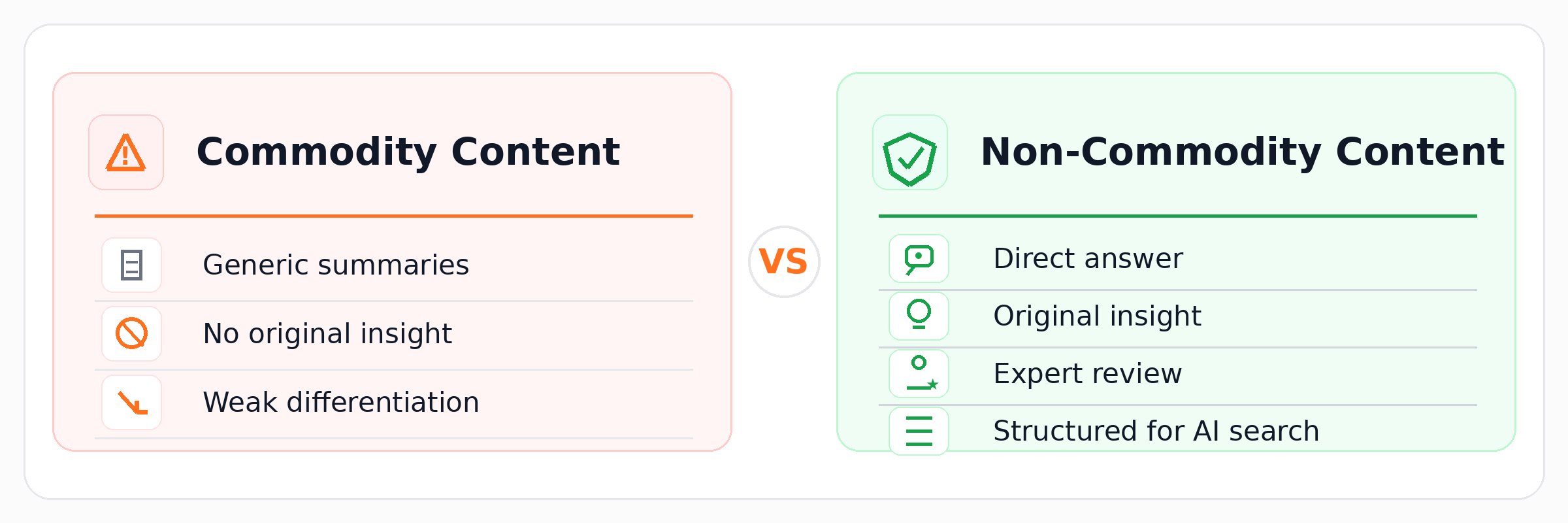
Commodity Content vs Non Commodity Content
The difference is not whether AI was used. The difference is whether the final page gives the reader a stronger answer than what already exists.
| Factor | Commodity Content | Non Commodity Content |
|---|---|---|
| Main value | Repeats common information. | Adds insight, experience, examples, or data. |
| Structure | Generic headings copied from SERP patterns. | Clear answer-first structure built around user needs. |
| AI search fit | Hard to distinguish from other pages. | Easier to summarize, cite, and trust. |
| SEO outcome | May rank briefly but is easy to replace. | Builds stronger long-term search visibility. |
How to Create Non Commodity Content That Performs in Search and AI Results
The best workflow combines AI-supported research with human judgment. Use AI to speed up analysis, but use expertise to decide what is worth publishing.
Start with the search need, not the keyword alone
A keyword tells you what people type. Search intent tells you what they need. Before writing, define whether the user wants a definition, checklist, tool comparison, workflow, diagnosis, or decision support.
Find what competitors are missing
Review top-ranking pages, AI SEO tools roundups, and AI search optimization guides. Do not copy their structure blindly. Look for weak definitions, missing examples, thin comparisons, outdated advice, or unclear workflows.
Add a source of originality
Originality can come from product data, expert commentary, a workflow, a template, a benchmark, a real example, or a clear decision framework. For authority signals, also review technical and trust factors like domain health using tools such as a domain authority and page authority checker.
Structure the page for classic SEO and AI search
Use a direct answer, descriptive H2s, short explanation blocks, comparison tables, FAQs, and schema. This supports AI search optimization and answer engine optimization without relying on AI-only tricks.
Review for commodity risk before publishing
Ask one simple question: if this page disappeared, would the search result lose anything useful? If the answer is no, the content needs more originality, clarity, or proof.
Common Mistakes That Turn AI SEO Content Into Commodity Content
Mistake 1: Publishing AI drafts without a point of view
AI can create a clean draft, but clean does not mean valuable. Add experience, examples, and a clear editorial decision.
Mistake 2: Confusing length with depth
A long page can still be thin if it repeats obvious points. Depth comes from better explanations, sharper examples, and useful decisions.
Mistake 3: Treating AEO as only FAQ writing
FAQs help, but answer engine optimization starts with the whole page. The main sections should already answer important user questions clearly.
Mistake 4: Skipping technical and internal link review
Even strong content can underperform if it is not crawlable, internally linked, mobile-friendly, or clearly connected to related pages such as your AI SEO guide.
SEOSpyder AI Search Readiness Snapshot Use Case
The practical use case for SEOSpyder is to review whether a page is ready for both classic SEO and AI-led discovery before it goes live. This is especially useful for content teams using AI SEO tools or AI agents to speed up production.
A SEOSpyder AI Search Readiness Snapshot can check whether the page has a direct answer, unique value, complete topical coverage, clear headings, internal links, technical SEO basics, and FAQ/schema opportunities.
| Snapshot Area | What to Check | Why It Matters |
|---|---|---|
| Direct answer | Does the page answer the main query early? | Supports snippets, AI summaries, and user clarity. |
| Original value | Does the page add examples, data, workflow, or expert insight? | Reduces commodity content risk. |
| Internal linking | Is the page connected to related SEO resources? | Helps users and search engines understand page relationships. |
| Technical readiness | Are metadata, schema, crawlability, and mobile layout clean? | Keeps the page eligible and easy to process. |
Best practical approach
Use SEOSpyder before publishing new AI-assisted content and when refreshing pages that lost rankings after a major search update.
Pre-Publish Checklist for Non Commodity Content
Before publishing, check:
✓ Does the page answer the main query in the first section?
✓ Does it add something competitors do not clearly provide?
✓ Is there an example, framework, data point, workflow, or expert view?
✓ Are claims easy to verify and not overstated?
✓ Are headings written for readers, not just keywords?
✓ Are internal links useful and contextually placed?
✓ Has a human reviewed accuracy, usefulness, and brand voice?
Create content that stands out in Google and AI search
Use SEOSpyder to audit content quality, technical SEO, internal links, and AI-search readiness before your next publishing cycle.
For SEO managers, content leads, founders, and agencies building AI-ready organic growth.
Frequently Asked Questions






No comment yet, add your voice below!