
SEOSpyder Guide · AI SEO & AI Search
Quick Answer
LLM SEO means structuring your content so search engines, AI search systems, and large language models can find it, understand it, retrieve the right passages, and cite it as a useful source. It is not a replacement for SEO. The best LLM SEO strategy combines classic SEO fundamentals with answer-first structure, clear headings, source-backed claims, internal links, FAQs, and original value that makes the page worth citing.
LLM SEO matters because users are no longer discovering content only through traditional rankings. They now interact with AI Overviews, AI Mode, answer engines, chat-based search, and retrieval-based AI tools that summarize information from different sources.
A strong LLM SEO workflow starts with AI content optimization, because pages need to be clear, useful, technically accessible, and structured before they can perform well in AI-led discovery.
This became more important after Google’s March 2026 update cycle reinforced broad quality evaluation and Google’s May 2026 AI-search guidance reaffirmed that SEO still underpins generative search visibility.
This guide explains what LLM SEO means, what Google actually says, how to structure pages for retrieval and citation, where teams go wrong, and how SEOSpyder’s AI Search Readiness Snapshot can help teams prepare pages before publishing.
In This Guide
What Is LLM SEO?
LLM SEO is the practice of improving content so large language models and AI search systems can retrieve, understand, summarize, and cite it accurately. It focuses on how your content is structured at the section, paragraph, and passage level.
Classic SEO helps search engines crawl, index, and rank pages. LLM SEO adds another layer: it makes your content easier to extract and reference in answer-led experiences. That is why it overlaps with generative engine optimization, answer engine optimization, and AI search optimization.
Simple definition
LLM SEO helps your page become easier to search, retrieve, summarize, and cite by using clear structure, answer-first writing, strong evidence, and helpful internal context.
Why LLM SEO Matters After 2026 Search Updates
Google’s AI-search guidance makes one thing clear: optimizing for generative AI features is still part of SEO because AI Overviews and AI Mode rely on Google’s Search ranking and quality systems. That means technical SEO, helpful content, structure, and quality signals still matter.
But AI-led search changes how pages are used. Instead of showing only a ranked URL, AI systems may retrieve specific passages, compare multiple sources, and cite pages that answer part of a user’s question. So your page needs to be strong at both the page level and the passage level.
1
Search
Can the page be crawled, indexed, and understood?
2
Retrieval
Can specific sections answer specific questions?
3
Citation
Does the page provide trustworthy, source-worthy value?
Important note
LLM SEO is not about writing for bots. It is about making your useful content easier for humans, search engines, and AI systems to understand.
A Practical LLM SEO Structure Framework
The best LLM SEO structure is simple: answer clearly, support the answer, organize related questions, and make the page easy to cite. Use this framework before publishing or refreshing important pages.
| Layer | What to Improve | Why It Helps |
|---|---|---|
| Answer-first sections | Start important sections with a direct answer. | Makes passages easier to retrieve and summarize. |
| Heading hierarchy | Use clear H2 and H3 sections for subtopics. | Helps search and AI systems understand relationships. |
| Evidence and examples | Add source-backed claims, examples, data, and use cases. | Improves trust and citation value. |
| Internal context | Link related guides naturally across the article. | Improves topical relationships and user navigation. |
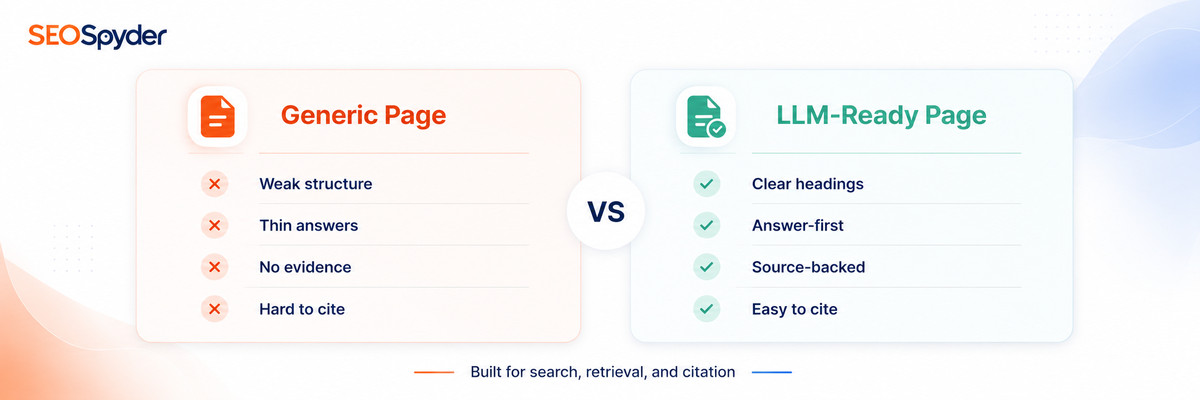
Step-by-Step LLM SEO Workflow
Use this workflow when creating new content or upgrading existing pages for AI search visibility.
Map the query and sub-questions
Start with the main query, then identify follow-up questions, related definitions, comparison needs, and practical steps users expect. This connects naturally with AI search optimization.
Structure the page for retrieval
Use clear H2s and H3s, keep sections focused, and make each section answer a specific user need. Retrieval works better when content is organized into clear, useful passages.
Add original value and proof
A page that only repeats generic definitions is easy to summarize but not always worth citing. Add examples, frameworks, expert notes, use cases, and original insights. Use non-commodity content as your quality benchmark.
Improve internal links and topical context
Connect the page to related resources such as answer engine optimization, generative engine optimization, and AI SEO workflows.
Run an AI-search readiness review
Before publishing, review answer clarity, structure, evidence, internal links, technical readiness, and citation value. This is where an AI SEO agent workflow can help standardize checks.
Common LLM SEO Mistakes
Mistake 1: Writing only generic definitions
Definitions are useful, but they are not enough. Add practical examples, decision frameworks, use cases, and expert commentary.
Mistake 2: Ignoring passage-level clarity
LLM SEO depends on clear sections. If a paragraph tries to answer too many things at once, it becomes harder to retrieve and cite.
Mistake 3: Treating LLM SEO as a hack
LLM SEO is not about manipulating AI systems. It is about making useful content easier to understand, verify, and reference.
Mistake 4: Forgetting classic SEO foundations
A page still needs crawlability, indexability, performance, internal links, helpful content, and clear search intent alignment.
SEOSpyder AI Search Readiness Snapshot Use Case
The practical use case for SEOSpyder is to help teams review whether a page is structured for search, retrieval, and citation before publishing.
A SEOSpyder AI Search Readiness Snapshot can help check answer clarity, structure quality, original value, internal links, technical readiness, and citation value so teams can improve the page before it goes live.
| Snapshot Area | What It Checks | Why It Matters |
|---|---|---|
| Answer clarity | Does each section answer a specific question? | Improves retrieval and readability. |
| Structure quality | Are headings, tables, FAQs, and summaries clear? | Helps search and AI systems understand the page. |
| Original value | Does the page add examples, proof, or expert insight? | Prevents commodity content. |
| Citation value | Would the page be a useful source for an answer? | Supports AI-search visibility and trust. |
Structure your content for search, retrieval, and citation
Use SEOSpyder to review content quality, technical SEO, internal links, answer clarity, and AI-search readiness before your next publishing cycle.
For SEO managers, content leads, founders, and agencies building AI-ready organic growth.
Frequently Asked Questions
“`
:::





No comment yet, add your voice below!