
Quick Answer
Answer engine optimization means improving your content so it can answer user questions clearly, support AI-generated search responses, and still perform in traditional SEO. For Google Search, AEO is not a replacement for SEO. It is a way to make SEO pages more answer-focused, structured, helpful, and easier to cite in AI Overviews, AI Mode, featured snippets, and other answer-led search experiences.
Search is no longer only about ranking ten blue links. Users now expect short answers, summaries, comparisons, and follow-up paths. That is why answer engine optimization has become important for SEO managers, content leads, founders, and agencies exploring AI-led growth.
But AEO should not be treated as a shortcut or a separate replacement for SEO. Google’s May 2026 guidance for generative AI features says SEO best practices remain relevant because AI Overviews and AI Mode are rooted in Google’s core Search ranking and quality systems.
If your team is already working on AI search optimization, AEO should become part of the same workflow: answer the query directly, support the answer with evidence, improve page structure, and avoid generic commodity content.
This guide explains what answer engine optimization means, which signals matter, how to improve pages step by step, and how SEOSpyder’s AI Search Readiness Snapshot can help teams review content before publishing.
In This Guide
What Is Answer Engine Optimization?
Answer engine optimization is the practice of making content easier for search engines and AI-powered answer systems to understand, extract, summarize, and cite. It focuses on answering questions clearly while keeping the page useful for human readers.
In practical SEO terms, AEO means your page should include a direct answer, clear headings, strong topical coverage, evidence-backed claims, useful internal links, FAQs, schema where relevant, and original insight. It should not be a thin page created only to capture a question.
Simple definition
Answer engine optimization helps your page become a better answer source while still following SEO fundamentals like crawlability, quality, relevance, and helpful content.
Key Signals to Improve for Answer Engine Optimization
AEO works best when it improves the quality of the full page, not just the FAQ section. These are the practical signals SEO teams should improve first.
1
Direct answer
Answer the main query early and clearly.
2
Evidence
Support claims with examples, data, or experience.
3
Structure
Use clear H2s, tables, bullets, and FAQs.
Important note
AEO is not about writing only for answer boxes. The strongest pages still need depth, usefulness, technical SEO, and a reason to be trusted.
Step-by-Step Process for Answer Engine Optimization
Use this workflow when creating new pages or refreshing existing pages for AI search, snippets, and classic SEO performance.
Identify the core question behind the keyword
Do not optimize only for the phrase. Understand what the user wants to know, compare, decide, or fix. For this blog, the real question is: “How can SEO teams structure content so answer engines and AI search systems can use it?”
Write the direct answer first
Start important sections with a short, clear answer. Then expand with context, examples, proof, and next steps. This improves readability and makes the answer easier to extract.
Add non-commodity value
Avoid repeating the same definitions and lists already available on competitor pages. Add expert notes, workflows, examples, screenshots, or tool-based insights. You can use this guide on non-commodity content for AI search as a supporting framework.
Improve internal links and topical context
Connect the page to related resources so users and crawlers can understand the topic cluster. For example, link to deeper content on AI SEO optimization when explaining how AEO fits into a broader SEO workflow.
Review technical and schema basics
Make sure the page is crawlable, indexed, mobile-friendly, internally linked, and technically eligible for Google Search. Add FAQ schema only when the FAQ is visible and genuinely useful.
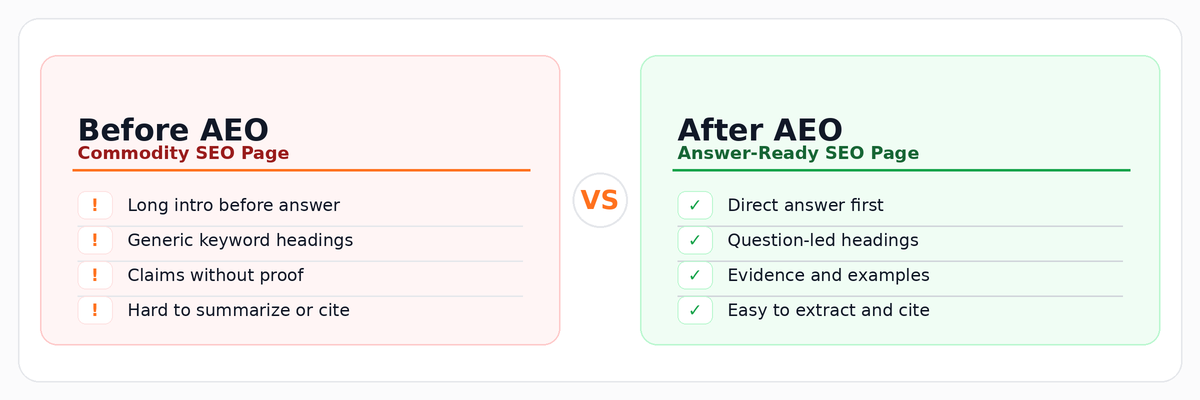
Before/After Impact: What AEO Changes on a Page
AEO usually improves clarity. The goal is not to make the page robotic. The goal is to make useful information easier to find, verify, and reuse.
SEOSpyder AI Search Readiness Snapshot Workflow
The practical use case for SEOSpyder is to help SEO teams review whether a page is ready for answer-led and AI-led search experiences before publishing.
A SEOSpyder AI Search Readiness Snapshot can check whether the page has a direct answer, clean structure, helpful FAQs, internal links, original value, and technical SEO readiness.
| Snapshot Check | Question to Ask | Why It Matters |
|---|---|---|
| Direct answer | Can the user get the core answer quickly? | Supports snippets, AI answers, and user satisfaction. |
| Non-commodity value | Does the page add something competitors do not? | Makes the content harder to replace. |
| Internal links | Is the page connected to related SEO resources? | Improves topical context and navigation. |
| Technical readiness | Can Google crawl, index, and understand the page? | Keeps the page eligible for search visibility. |
Make your SEO pages ready for answer-led search
Use SEOSpyder to review content quality, technical SEO, internal links, and AI-search readiness before your next publishing cycle.
For SEO managers, content leads, founders, and agencies building AI-ready organic growth.
Frequently Asked Questions







No comment yet, add your voice below!