
“`html
Quick Answer
AI search optimization means improving your pages so they can perform in classic Google Search and become easier to understand, summarize, and cite in AI-led experiences like AI Overviews and AI Mode. It is not a separate trick from SEO. It is a practical mix of useful content, clear page structure, crawlability, internal linking, evidence-backed answers, and non-commodity insights.
AI search optimization matters because search behavior is moving from simple keyword results to answer-led journeys. Users still use Google, but they now expect summaries, follow-up questions, deeper context, and direct explanations from AI-powered search experiences.
Before building an AI-search workflow, start with this practical guide on AI SEO optimization so your content, audit, and optimization process stays connected to real SEO fundamentals.
This became more important after Google’s March 2026 core update cycle, which reinforced broad quality evaluation. Google’s May 2026 AI-search guidance also reaffirmed that SEO best practices still matter because AI Overviews and AI Mode are rooted in Google’s core Search ranking and quality systems.
This guide explains what AI search optimization means, what Google actually says, where teams go wrong with commodity content, and how to create pages that can rank in classic SERPs while becoming more useful for AI search visibility.
In This Guide
What Is AI Search Optimization?
AI search optimization is the process of improving a website so AI-powered search features can better understand, retrieve, summarize, and cite its content. It includes classic SEO work such as crawlability, technical structure, internal links, useful headings, helpful content, and trustworthy information.
It also includes content-level improvements that make answers easier to extract: direct definitions, clear claim-to-evidence structure, concise explanations, original examples, FAQs, and expert-led insights. This is why AI search optimization, answer engine optimization, and SEO with AI all overlap.
Simple definition
AI search optimization means making your content useful, crawlable, structured, and trustworthy enough to support both traditional rankings and AI-generated search answers.
1
Crawlable
Make pages discoverable and technically clean.
2
Useful
Answer real user needs with original value.
3
Citable
Use clear answers, proof, and structured sections.
Why AI Search Optimization Matters After the 2026 Search Updates
Google’s March 2026 core update started on March 27, 2026, and finished on April 8, 2026, according to the Google Search Status Dashboard. Core updates do not reward one tactic. They reassess broad quality signals such as usefulness, relevance, trust, and content value.
Google’s official AI-search guidance says SEO best practices continue to matter for generative AI features because AI Overviews and AI Mode are rooted in Google’s core Search ranking and quality systems. That means strong SEO still supports AI visibility.
13
Days of rollout
Google’s March 2026 core update ran from March 27 to April 8.
May
AI-search guidance
Google reaffirmed that SEO remains relevant for AI Overviews and AI Mode.
0
AI-only tricks
The safest approach is better SEO, not shortcuts.
Important note
AI search optimization does not mean writing only for AI systems. The page still needs to satisfy real users first. If users find the page useful, clear, and trustworthy, it has a stronger foundation for both SEO and AI-led search.
Check if your page is ready for AI search
Use SEOSpyder to review content quality, technical SEO, internal links, and AI-search readiness before your next publishing cycle.
AI Search Optimization Myths vs What Google Actually Says
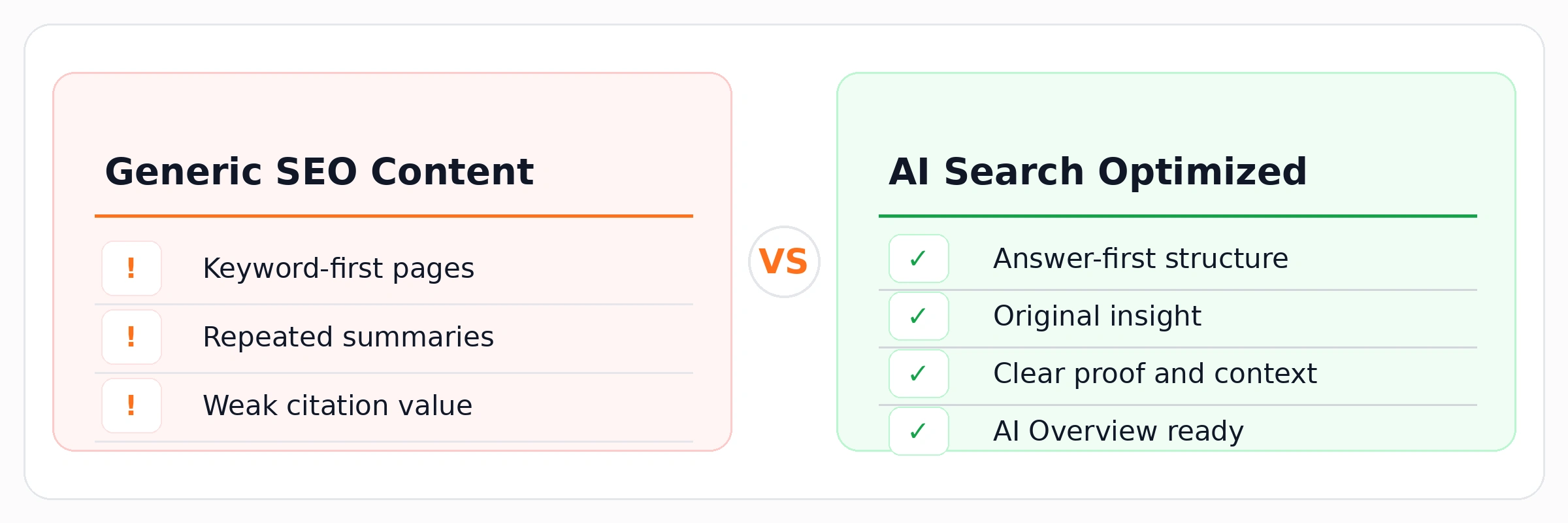
Many teams are confused because AI search has created new terms like AEO, GEO, and AI SEO. These terms can be useful internally, but Google’s message is simple: optimizing for generative AI search is still part of SEO.
| Myth | Reality |
|---|---|
| You need a separate AI-only SEO strategy. | AI search optimization should strengthen your existing SEO foundation. |
| You must create many pages for every query variation. | High-quality, comprehensive pages are safer than scaled thin content. |
| Structured data guarantees AI Overview visibility. | Schema helps SEO, but there is no special schema that guarantees generative AI visibility. |
| AI-generated content is automatically risky. | AI-assisted content can work if it is helpful, accurate, reviewed, original, and people-first. |
A Practical Workflow to Win Visibility in AI Overviews and AI Mode
The best workflow starts with strong SEO pages, then improves them for clarity, completeness, and AI-search readiness. Use AI SEO tools to speed up analysis, but keep expert review in the final process.
Start with search intent, not AI terms
Decide what the user wants: a definition, comparison, workflow, checklist, decision guide, or troubleshooting answer. AI search visibility begins with solving the real query better than competing pages.
Audit the page before rewriting
Check crawlability, headings, metadata, internal links, technical issues, topical coverage, and current rankings. If you need a workflow, use this guide on AI SEO agents to structure audit tasks more clearly.
Add non-commodity value
Do not just restate competitor summaries. Add first-hand examples, expert notes, data, screenshots, workflows, product insights, or decision frameworks. For a deeper method, use this guide on non-commodity content for AI search.
Use answer-first formatting
Start important sections with direct answers. Then support the answer with context, proof, examples, and next steps. This helps both readers and AI systems understand the claim quickly.
Strengthen technical and internal signals
Keep the page crawlable, mobile-friendly, fast, internally linked, and eligible for snippets. AI search cannot reliably surface a page that search systems cannot properly discover or process.
Review before publishing
AI can help identify gaps, but humans should approve accuracy, business relevance, examples, tone, and whether the page is genuinely useful before publishing.
Common AI Search Optimization Mistakes
Mistake 1: Creating pages only for AI Overviews
Do not create thin pages for every possible AI query. Build helpful pages for real users, then structure them clearly for search systems.
Mistake 2: Rewriting competitor content
Pages that only summarize what competitors already say are easy to ignore. Add original insight, examples, data, or a stronger workflow.
Mistake 3: Ignoring technical SEO
If pages are not crawlable, indexed, fast, mobile-friendly, or internally linked, AI search optimization becomes much weaker.
Mistake 4: Treating schema as a shortcut
Schema is useful for SEO, but it does not replace helpful content, clear answers, and strong page structure.
SEOSpyder AI Search Readiness Snapshot Use Case
The practical use case for SEOSpyder is to help teams audit whether a page is ready for both classic SEO and AI search visibility. Instead of guessing, teams can review page structure, internal links, technical SEO, and content quality before publishing or refreshing a page.
A SEOSpyder AI Search Readiness Snapshot can help identify whether a page has a direct answer, strong topical coverage, useful internal links, schema opportunities, clear headings, and enough original value to avoid commodity content.
| Snapshot Area | What to Check | Why It Matters |
|---|---|---|
| Direct answer | Does the page answer the main query early? | Supports snippets, AI summaries, and reader clarity. |
| Original value | Does the page add insight beyond generic AI output? | Reduces commodity content risk. |
| Internal links | Is the page connected to related SEO resources? | Improves topical context and user navigation. |
| Technical readiness | Are crawlability, metadata, mobile layout, and schema clean? | Keeps the page eligible and easier to process. |
Best practical approach
Use SEOSpyder before publishing new AI-assisted content, after major Google updates, and when refreshing pages that need stronger AI-search readiness.
Improve visibility in Google Search and AI search
Use SEOSpyder to audit content quality, technical SEO, internal links, and AI-search readiness before your next publishing cycle.
For SEO managers, content leads, founders, and agencies building AI-ready organic growth.
Frequently Asked Questions
“`






No comment yet, add your voice below!